Collector Guide: Beyond Collecting
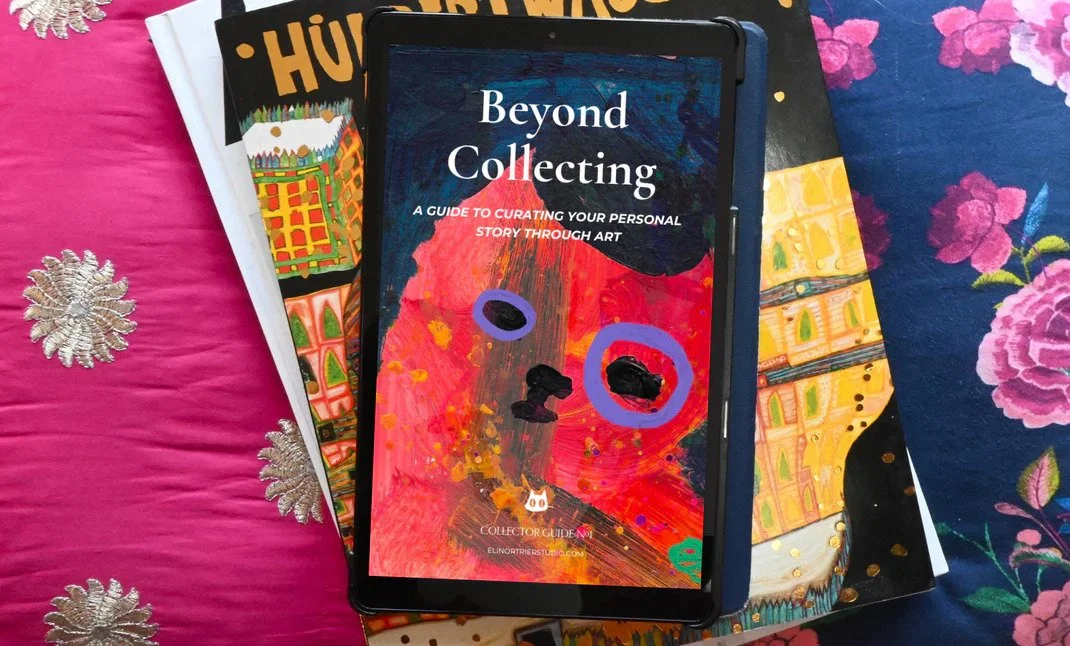
How to Build an Art Collection That Actually Means Something
Most advice about art collecting is about investment. Which artists are trending, which pieces will hold their value, how to make smart choices in a market that rewards certain things and ignores others. It's fine advice if you're running a portfolio. But if what you actually want is to come home at the end of a difficult day and feel immediately, viscerally better - that advice is completely useless.
This is the other kind of collecting. The kind where a painting becomes an anchor, or even a friend. Where the right piece in the right place does something to the atmosphere of a room that you couldn't have predicted before it arrived. Where your walls start to tell a story that is specifically, unmistakably yours.
Here's how to build that kind of collection.
Start with how it makes you feel, not whether you "get" it
The most useful question in front of a piece of art is not "is this good?" It's "what is this doing to me?" One of my collectors described it as feeling "fizzy in my tummy" - which happens to be one of my favourite compliments about my work. That instinctive physical response is important. It’s a signpost. Pay attention to it.
Notice what you're repeatedly drawn to - certain colours, certain scales, certain kinds of marks or surfaces. In my experience these preferences aren't random. They're pointing you towards something you need, or something you're trying to understand. Your taste can be a valuable form of self-knowledge if you treat it that way.
Think about what you need your art to do
Different pieces can serve very different functions in a home. Some art energises - it's the first thing you want to see in the morning, the thing that reminds you what you're capable of. Other pieces are quieter, more grounding, the visual equivalent of a hand on your shoulder. Some are conversation starters, deliberately provocative, designed to make people stop and ask questions. Others are just for you.
It's worth thinking about this deliberately, because placement matters enormously. A piece that would be perfect in a bedroom might be overwhelming in a kitchen. A work that feels confrontational in a narrow hallway might be exactly right in a large living room where people have space to sit with it. Think about the emotional journey you take through your home each day and what you need at each point on that journey.
For neurodivergent people in particular, this becomes the fundamental infrastructure of your home. The art on your walls is part of how you regulate, ground yourself, and come back to who you are when the world has been doing its thing. Choosing it intentionally, and placing it with care, makes it work harder for you.
Let it tell your story
The best collections aren't assemblages of individually beautiful things. They're cumulative, with each piece adding to a larger narrative that only makes sense in relation to everything else. The piece you bought when you finally left that job. The print you got to mark a year of survival. The painting that looked exactly like how you felt during a particular winter and which now, hanging on your wall, reminds you that you deserve grace.
This also means learning to let pieces go when they no longer fit the story you're telling. Outgrowing a piece happens. It’s a shame, and can be uncomfortable, but it's also evidence that you've evolved. Pass it on, and make room for what comes next.
Find your artists
The right artists for your collection aren't necessarily the most famous or the most expensive - they're the ones whose work seems to understand something about your experience. When you find one, follow them. Read what they write about their work. Sign up for their newsletter. Go to their shows if you can, or ask about studio visits - seeing work in the space where it was made is a completely different experience from seeing it online, and most artists are genuinely delighted to have that conversation.
And when something resonates, say so. Artists make work because they want it to land somewhere. Knowing it landed (and where, and how) is part of what keeps us going.
One last thing
Collecting art that means something to you is, in a small but real way, a political act. It says: this is who I am, this is what I value, this is what I want to look at every day. In a world that spends a lot of energy telling us who we should be and what we should want, that's worth taking seriously.
Are you interested in collecting my art? If so, I have a selection available online in The Gallery, or you can contact me directly for a Studio Visit or a complete list of available pieces.