Interview: What’s Je Suis Wibbly Wobbly all about then?
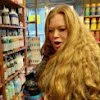
I asked my community what they most wanted to know about my Je Suis Wibbly Wobbly collection (they came up with some absolutely cracking questions), and then I roped in my brilliant (and very nervous) husband to interview me on camera - this is the result.
We had so much fun recording this that most of my editing job was cutting out prolonged fits of the giggles - I hope you enjoy watching it as much as we enjoying making it.
If you prefer to read, here’s the transcript:
My gorgeous husband Lars sat down with me to ask your questions about Je Suis Wibbly-Wobbly. Here's what we talked about.
The paintings have a physicality to them — the textures, the layers, the way light plays with the colours. What's your process for building that depth?
I use a palette knife more than brushes or anything else, and quite often my fingers. I really like to get in there with the paints and smoosh it about — it's a very technical term.
The way I paint is almost like sculpting, like icing a cake. I use very thick, heavy body paints and lay it on in layers and layers. Any marks that come up, I'm not trying to obliterate them — I'm trying to bring them further to the surface to create those textures and interesting knobbly bits.
How do you come up with the titles of your paintings?
They just come to me. It's not a very satisfactory answer.
Often it comes out of conversations Lars and I have together — we'll be talking about something, we'll riff off each other, and something will emerge from that. I'll usually have one or two titles in my head that need to be attached to a painting, and those form the seed from which the rest germinate. It's sort of like poetry — each title is almost like a line of a poem. Each title in this collection has a particular connotation that marries up with its painting. Which means the paintings are also part of a larger, visual poem.
When someone says "I don't get it" — what do you want them to know?
I have to put my ego aside here, because my instinctual response is: then it's not for you. Which is probably my ego.
But also — the people who really get my work, it just happens like that. It's an instant energetic match. So I'm actually delighted when people don't get it, because it means I've done something that's true to me. If people don't get it, that means some people will absolutely get it. The last thing I want is to make work that's pleasing to everybody. I want to make work that's really attractive to some people — and that means making work that's actively repulsive to others.
That said, if someone wants a way in, I'd suggest they spend a bit of time with the pieces. Understand the story and the concept behind them. My paintings reward looking — the more you look, the more you see.
Conversely, what's the best possible reaction people can have?
My favourite reactions are when people jump up and down. When they see the work in person and just squeal.
What I'm always looking for is a point of connection — someone saying I love this and I don't know why, or this is me, or this looks like how I feel, or simply that it makes them laugh. There's something magical that happens when people truly get the work on a deep level, and it's the most gratifying thing.
Every piece I make is an attempt at conversation, an attempt at connection — me saying: this is how I feel, this is how I see the world, this is how I'm interpreting this feeling or situation. For people to come back to me and say, on some level, me too — that is everything.
Which painting is your favourite?
It's like asking me to choose a favourite child.
This one — I'll Watch Over You And Keep You Safe — is the one I can't bear to part with. Mostly because he reminds me of Lars. He hangs in the studio and he watches over me and keeps me safe. He has such kind eyes and such a lovely face and he just radiates warmth and generosity. We do have limited edition prints of this one, so people can have the same guardian angel in their own homes. But the original stays with me. For now.
I also love Falling Down Can Feel So Good — there's something about triumphing over adversity that comes through for me with that one. His prints are available too, even if I'm not quite ready to let the original go.
Which artists would you say you're most influenced by?
I'm really drawn to naïve art, outsider art, self-taught artists. I find that whole genre completely fascinating — although the way it's spoken about is often incredibly patronising. I think anyone who's working outside the confines of conventional art-world training comes up with work that feels pure and true in a particular way.
I also love the Expressionist movement, and I'd describe my own work as expressionist. I'm interested in how an artist sees the world rather than how well they render something that's already there. That's what photography is for. What I want — as a viewer and as an artist — is for you to show me how you see it, how it makes you feel, to show me something of yourself in the work.
I have no interest in painting a photorealistic portrait of a cat. I'm using cats as symbols of something. This entire collection is essentially self-portraits.
People often ask me why cats, and I always bristle a little at that, because they're not cats. I mean, they are cats — but more importantly, they're not. What I'm trying to convey is a feeling, something cat-like, something innately myself. The colour and form and texture and everything I've done on the picture plane goes towards translating that to the viewer.
There's a dichotomy in your work — it's bold and bright, childlike even, but also very personal, humorous, intellectual. Is that intentional?
Absolutely. The bright colours and the silliness are a good access point. People can come into the work on a purely visual level and enjoy a bright, colourful cat on a canvas. What I love and encourage is for people to come a little bit deeper — into the stories, the ideas, the intellectual side of things.
I'm a very thinky artist. I'm cerebral. I like the stories and the concepts almost as much as I like the visual — my brain does both together. And whilst I love it when people enjoy the work purely visually, I'm most gratified when they come with me into the story side of things. It also makes it less of a jolt when I do something darker or edgier, because when you can see the through line between all of it, it all makes a lot more sense.
Which work was the most challenging to make?
Some of them just fell out of the end of my brush. Others were more fraught.
I struggled with the eyes in In The Magic — they were a number of different colours before they ended up as that dark blue and pale blue. I had an idea in my head and translating it visually just wasn't working, so I repainted them over and over.
The face in another piece also got me in my head. I did hundreds of practice gestural faces so I could just do it on the canvas. I was so happy with everything else that had happened, and I was terrified of ruining it at the last minute. I got there eventually, but I think if I'd just relaxed and let myself go, it would have been a much less fraught experience.
Do you start with an idea for an image, or do you let the brush speak for itself?
It depends very much on the painting, but broadly: there are two distinct parts to the process.
The first all happens in my head. Once I have the idea and it's fleshed itself out and taken form — that's when I go to the materials. And then the materials show me how to finish the work. In the production phase, I'm very loose and very intuitive. Whatever's going to happen is going to happen. That's where the intuitive, channelling part of the process happens.
Once I've reached the end of the intellectual phase on a particular piece and the handwork takes over, I'm pretty much done thinking about it. But in terms of putting a whole collection together, yes — it does go back and forth from piece to piece.
The paintings have a particular glow to them. Is that a technique, or the colour choices?
Mostly colour choice — choosing different shades of the same colour and getting a tonal range going. It has an almost alchemical effect of making the whole painting glow. But the colour gets all the glory, when it's actually the tone and value — how light or dark something is — that's doing most of the work. The colour just lies on top.
People are often surprised to hear that my colours are far more desaturated than they look. I knock everything back — I mix in neutrals, I rarely use colour straight from the tube because it's too garish. And then every now and again I'll use a pop of saturated colour and it leaps off the canvas. A hit of neon pink can lift an entire painting.
Does this collection stand out compared to your other work?
It feels different to me, yes. I made it in 2022, and I feel like this is the collection where I really figured out what I wanted to do with my work — what I wanted to say and how I wanted to say it. I remember being utterly transported as it came out of me. When I saw it all together I thought: yes. This is it.
I've been able to use that experience in subsequent collections — to hold onto that me-ness, that essence. But this was the turning point. This is where I knew: this is the work I make, and nobody else does. This is me.
Do you feel sad when you let the paintings go?
Heartbroken. But also so happy for them to go to loving homes all over the world.
I have work in private collections all over the globe, and hearing that people are brought joy every day because a piece of mine hangs in their home — I get messages from collectors, sometimes almost from the painting, checking in. I keep in touch with almost all of them. That brings me enough joy to counteract the wrench of letting go.
They're making other people happy. That's what they're for. I can make more.
Finally — where does the name "Je Suis Wibbly-Wobbly" come from?
When I used to do business and marketing consulting, one thing I'd say over and over was encouraging people to show up in their wibbly-wobbly, wonky glory. Show up warts and all, exactly as you are. Be honest and enthusiastic and genuine, and stop worrying about what people think.
And when you say je suis wibbly-wobbly in an outrageous French accent, it sounds absolutely hilarious.
So it started as "I am wibbly-wobbly," and then I thought — fuck it, let's put it in French.
For more about my work, visit The Atelier