The outsider history of black & white stripes
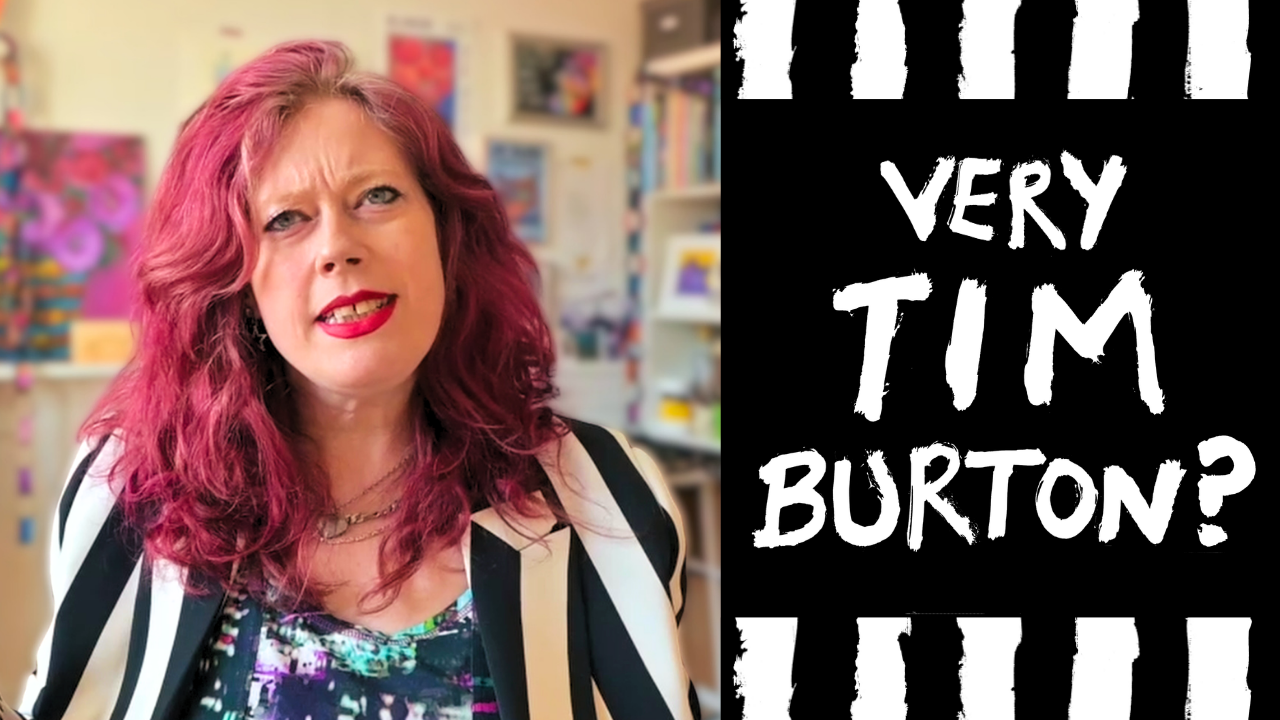
Every time I wear black and white stripes, someone says "ooh, very Tim Burton." And every time, I think: well actually, that’s only a fraction of the story 😜. Because the black and white stripe is soaked in otherness - going back centuries!
From medieval outcasts to prison uniforms, from queer people to punks, goths and the circus, this is a potted history of how one pattern has been used to mark people as other, and how, again and again, othered people have taken it back and worn it with pride.
It's a video about stripes, but really it’s a video about cultural literacy, misfittery, and the reclamation of power.
💙 BECOME A FRIEND OF THE HAUS 💙
If you want to support what I do then become a Friend of The Haus! All the details are here.
💌 SIGN UP FOR MY NEWSLETTER 💌
I’m not on social media anywhere else so if you want to keep up with me between videos this is the only place to be. Sign up to my excellent weekly newsletter here.
💛 BUY ART AND MORE 💛
To purchase art, zines, books, and more, visit The Gallery page to see what’s available.
-
When you see someone wearing black and white stripes, is your first thought, “ooh, very Tim Burton”? If that’s the case then buckle up, buttercup - I’m going to blow your mind.
If you’re new here, my name is Zuzu - art monster, certified weirdo, and quite possibly a pile of cats in a trench coat. And on this channel we talk about art, books, style, and of course, all aspects of misfittery and moving through a world that feels like it wasn’t made for you. If that sounds like your cup of tea then I do hope you’ll subscribe.
A few months ago I made a video about clothes and looking different in which I said…
Whenever I wear black and white stripes, some cunt always says, “ooh Tim Burton, Tim Burton”, and I think, “Really? Is that your only frame of reference?”. And maybe it is. Who am I to judge?
So, I thought I’d give you a potted history of black and white stripes: what they represent (and why Tim Burton uses them as a motif in so many of his films).
Because when you put on a black and white striped top, you are not “doing a Tim Burton”. Tim Burton is actually following a well worn groove of something which started out as a deliberate act to visually mark out undesirables, and has been reclaimed and overturned more times than I can count. The stripe has been marking people out as wrong, dangerous, and other for centuries - long before Tim Burton made a single film.
And I think that's thrilling. Because the black and white stripe might be the most loaded fabric pattern in the entire history of Western dress. It has been the garb of prisoners, the devil’s emissaries, Holocaust victims, sailors, lesbians in 1920s Paris, punks, rock stars, and, of course, me - at least three times a week. And almost nobody knows the back story - we just see "quirky" and move on.
So this is a video about fixing that. But it's not really about stripes. The stripe is a portal to the thing I really care about: how symbols work, how power uses them to mark the people it wants gone - and the best bit - how the marked people take the symbol back and wear it like a crown.
And, as is so often the case, what starts out as a fun dive into fashion history is actually a conversation about the importance of cultural literacy.
PART ONE - Cultural Literacy
So let's briefly touch on what that means, because I promise it's more interesting than it sounds.
Normally when we say "literacy" we’re talking about reading and writing, but there's a whole other language running underneath everything - in clothes, in colour, in symbols - and we mostly read it on instinct. Something strikes us as "quirky," or "a bit much," and we dismiss it without ever asking where that reaction came from, or whose interests it serves.
And the cost of not asking is two-fold.
Firstly, when you don’t know how to read a symbol, you can walk straight into it. You can pick up something - wear it, say it, share it - that's carrying a whole freight of meaning you had no clue about, because to you it was just a pattern. A vibe. A nice top.
And, secondly, you miss the story. The meaning and the depth of it. Because when it comes to the stripe, what you’re looking at is centuries of clothes being used as a battlefield. A mark of oppression and rejection, reclaimed and flaunted with power, defiance, and joy. Which is a hell of a lot more interesting than “quirky”.
So where did this all begin? For that, we need to go all the way back to the Middle Ages...
PART TWO - The Devil’s Cloth
In The Devil’s Cloth: A History of Stripes, historian Michel Pastoureau describes how medieval society viewed stripes as a symbol of deviance and transgression.
There are multiple reasons for this, possibly it came from a Bible passage (Leviticus 19:19) which explicitly forbids wearing garments made of two different types of threads, for some reason. Medieval theologians interpreted this broadly as a ban on mixing colors or patterns in a single textile.
And more importantly: with stripes, you can’t tell what’s background and what’s foreground. They flicker and switch, and so they became associated with duplicity, with things that shift and can't be trusted.
A pattern that wouldn’t settle was quietly threatening and downright disobedient - so, in a pretty logical (albeit simplistic) move when you think about it, it was assigned to the people they'd decided were disobedient. Pastoureau tracks how striped cloth was designated to the outcasts: prostitutes, lepers, executioners, jesters and entertainers, heretics and Jews, anyone who consorted with the devil. If you were someone medieval society wanted everyone to be able to spot and avoid, they put you in stripes. It was a warning label.
It became a symbol of the morally bad, the not-to-be-trusted, and, of course, our old friends: the outsiders.
That's the seed. At the very beginning of modern Western culture, the stripe means the wrong sort of person.
PART THREE - The Darkest Part
Fast forward to the 1800s, and we’re in America. Specifically Auburn Prison in New York, where a particularly nasty piece of work named Elam Lynds invents the prison uniform we can all picture - horizontal black and white stripes.
His reasoning for choosing stripes was pretty diabolical, but maybe he does get a point for cultural literacy. He was well aware of the cultural association - the one leftover from the Middle Ages - and deliberately chose a pattern that society already connected with moral corruption and deviance to enforce public shaming.
There was also a practical reason for the choice - you’re easy to spot and track against the landscape if you run. But primarily Lynds’ objective was to humiliate, anonymise, and never let his prisoners forget they were locked up and stripped of their freedom. He wanted to break them psychologically, so that they would be easier to control.
It’s important to note here that huge numbers of the people in those uniforms were Black men, many locked up under laws built to re-enslave people after abolition. Those chain gangs in stripes, working the roads, are a straight line from the medieval warning label to the machinery of American racism. And there we have the black and white stripes again - the same pattern, doing the same job: marking the people that power had decided didn't count.
And, of course, the most hideous use of the stripe is a direct cousin of Lynds’ dehumanising ideas: the concentration camp uniform.
The record from the Auschwitz museum is very plain about its purpose. Every striped uniform carried a number that replaced the person's name. One study describes how the stripes made prisoners recognisable from a great distance and turned them into a single, indistinguishable mass.
And although this stripe is not strictly black and white, it is not a separate story. It is the same pattern, carrying the same medieval warning label - to mark the outcast so all can see them, carried to its most evil possible end. Not only marking out someone as lesser, but erasing them entirely, en masse.
I think if you're going to truly understand the cultural significance of wearing stripes, you have to know that it carries this weight too. It doesn't cancel out the joy that comes later, but it sits alongside it, impossible to ignore.
Deep breath. Because now the tables are about to turn…
PART FOUR - The Idea Escapes
But next, the prison stripe does something interesting. It escapes the prison.
Because once Auburn had drilled it into everyone's head that black and white stripes meant criminal, that meaning escaped the prison walls and the idea spread (as ideas are wont to do). The black and white stripe became an instantly-legible shorthand. See stripes, think crook. Job done.
This is probably most apparent in cartoons. The classic image of a burglar - flat cap, little domino mask, sack marked "swag," and of course the black and white striped top - turns up throughout the 1800s, and he's wearing a version of the prison uniform before he's even been caught.
Which is pretty ironic, if you think about it.
But my favourite bit is when the meaning the black and white stripe is now laden with gets flipped, and is suddenly pointed in the other direction.
In the early 1870s, the cartoonist Thomas Nast - is waging war on the spectacularly corrupt politician William "Boss" Tweed. And one of the ways Nast goes after him is to draw him in a convict's stripes.
For centuries, the stripe had been imposed downward - onto the powerless, the poor, the outcast, to mark them as less-than. Nast turns this symbol around and aims it at the man at the top. He uses the criminal's stripe to say: actually, the real crook is this rich, powerful guy robbing everyone. The mark of shame becomes an accusation. The stripe gets weaponised against power instead of in its favour.
A quick detour
Now, a quick detour. There's another stripe running alongside the black and white one, and they join up a bit later. This one is blue and white - the sailor's marinière (although, interestingly enough, the blue was often so dark it was forever being written down as, or mistaken for, black).
And this matters to our story for one reason: it's the clearest early case of the stripe being adopted, deliberately, as an outsider's flag. Sailors were rootless, ungoverned, tangled up with a reputation for sex outside the rules - outsiders, yes, but enviable ones. By the late 1920s, gay men holidaying on the Riviera were wearing the striped sailor shirt as a signal - the dancer Frederick Ashton remembered everyone being sailor-mad and buying their striped tops straight from the sailor shops. And the historian Eleanor Medhurst traces the same Breton stripe becoming a recognisable lesbian look in exactly those years.
Here's a thought I can't prove, so take it with a pinch of salt, but I think is a really cool example of how ideas spread - almost every photo of these stripey Riviera boys and menswear-clad lesbians would've been in black and white. So I do wonder how many people, seeing those images, just clocked them as black and white stripes without a second thought?
So anyway, even this sunny, seaside stripe was quietly doing the same job (and working to reinforce the same symbolic meaning) as it was worn as a deliberate marker by exactly the people the medieval version was invented to flag. Same pattern. Same outsiders. Different colour (sort of).
PART FIVE - Reclamation
Because the thing about branding a group of people with a mark of shame is that oftentimes, they’ll take it, and pull the rug out from under you. They’ll pick it up, put it on deliberately, and wear it with pride - and the whole thing flips. What was a symbol of oppression becomes a symbol of rebellion.
That's reclamation.
It's the whole story with certain words - slurs a community seized, turned around, and wore with pride. "Queer" did exactly this: from an insult thrown at people, to something people call themselves proudly, to the name of an academic discipline. It’s the same word, but the power is completely inverted. The feminists did it with “bitch”, the punks did it with, well… “punk”.
And it happens, over and over, with the stripe.
Punk grabbed it and did it with the safety off. Because by the 1970s, the black and white stripe had centuries of "criminal, deviant, outsider, wrong" soaked into it, and that was exactly the appeal. Punk wanted the loaded version. Wearing the mark of the convict and the outcast on purpose was the whole statement: you think I'm deviant? yeah I fucking am, what of it?
Goth took that same stripe and stylised it into something theatrical and otherworldly. Even rock stars knew the power of the black and white stripe - Siouxsie Sioux, Robert Smith, David Bowie, Mick Jagger, all using the same language to signify the same thing - counter culture. Outsiderness, strangeness, newness. These things are not like the others - but isn’t that COOL?
The queer reclaiming of the sailor stripe is the same move - taking a signal that had been whispered, dangerous, criminalised, and simply wearing it in the open.
Every one of these is the same beautiful trick: you marked me to keep me out, so I'll wear the mark to let myself in.
The most perfect example of reclamation comes a little earlier though - an older, richer black-and-white stripey tradition: The circus. The cabaret. The sideshow.
The circus is the home of the professional outsider. And whilst circuses are festooned in stripes of many colours, there is an inextricable association with black and white. The circus is where the "freaks” have traditionally found our home. The people who didn't fit anywhere else, but turned not-fitting into a spectacle of delight and wonder. The circus took every kind of person the rest of the world wanted to mark and exclude, and put them in a stripey tent and sold tickets.
The chain binding otherness and stripes gains another link.
That thread runs from the decadent, censored, gloriously queer cabarets of 1920s Weimar Berlin, right through to the "dark cabaret" acts of today. The whole Brechtian-punk-cabaret world, striped stockings and painted faces and all, where black and white stripes are practically the house uniform. The outsider stripe, worn as a badge, by people who've decided the outside is the more interesting place to be.
PART SIX - Back to Tim
So. Tim Burton.
Here's what I want you to see. When Burton dresses Beetlejuice in that black-and-white striped suit - a suit his own costume designer called a hip version of a prison uniform - he's not inventing a look. He's the latest link in a chain that's hundreds of years long.
Over and over again, in film, in literature, in illustration and cartoons, black and white stripes have been used to mean something - they are a symbol of otherness or outsiderness that we read almost completely unconsciously.
From The Cabinet of Dr. Caligari to Edward Gorey’s macabre Victorian characters, The Wicked Witch of the East in her striped stockings to The Addams Family.
And in literature, Erin Morgenstern's The Night Circus - one of my favourite books of recent years - uses a circus built entirely in black and white stripes to signify a magical, albeit undeniably strange, place of wonder and delight.
Once you start looking, the black-and-white stripe is everywhere film or literature wants to say "this one is other. This one is dangerous. This one is not like you."
So when Burton reaches for the black and white stripe, he's doing on purpose what this whole video has been about. He takes the mark of the outcast, and he makes the outcast the hero. No matter how grotesque Beetlejuice seems - he’s the most alive thing in that whole film. Burton just quietly turns the ancient meaning inside out: the striped one, the strange one, the othered one - that's who you're rooting for now.
Which means saying "ooh, very Tim Burton" isn't wrong, exactly. Or bad. It's just… reading the last page of a very long book, and thinking that's where the story starts.
CLOSE
The next time you see someone dressed in black and white stripes, you’ll know what's actually sitting in that choice. The devil. The leper. The outcast. The chain gang. The sailor and the queer boys on the Riviera. The punk, the goth, the sideshow, the circus, the cabaret. Hundreds of years of people that power wanted to mark as wrong, bad, unacceptable, and the defiant reclamation of that power as well.
Of course, it was the stripe. The stripe that flickers, and defies the eye. That refuses to be contained or constrained. Which is exactly what every single person in this video was accused of. Not fitting. Not settling. Refusing to disappear quietly into the background where they'd been put. The pattern and the people are the same. The black and white stripe was always the mark of a thing that won't stay in its box.
And that's what cultural literacy actually is, and the whole reason I wanted to make this video. It's the difference between seeing a quirky top… and seeing a seven-hundred-year argument about power, and shame, and the people who took the mark they were given to keep them out, and wore it to let themselves in.
Because that’s what this whole channel is about, really. Daring to take up space and let yourself in.
Whether you’re wearing stripes or not.
Thanks for watching love you byeeeeeeeeeeeeeeeeeeeeeeeeeeeee
See more videos: