Things Men Have Said To Me Instead Of Hello: Artist Talk
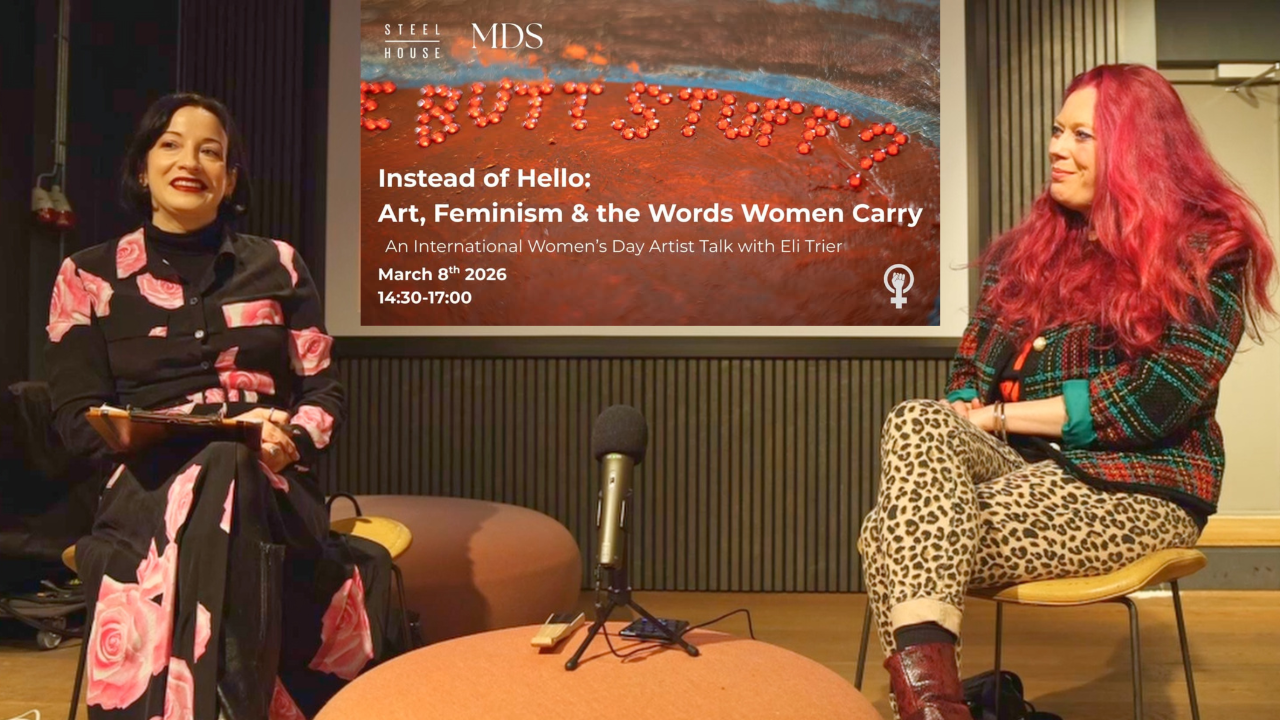
In January I opened an exhibition at MDS Gallery in Copenhagen called Things Men Have Said To Me Instead Of Hello - the culmination of a year’s worth of thought and labour. And in March, for International Women's Day, I sat down with gender studies scholar Elisabeth Gehrke to talk about it live on stage.
We got into the emotional labour of gluing hundreds of pearls onto a canvas by hand, why humour is a fantastic tool for talking about genuinely awful things, Judy Chicago, Tracey Emin, shame, the body, lady monsters, and the patriarchal soup we're all swimming in.
Thank you so much to Elisabeth for some incredible, thoughtful and insightful questions, to my gallerist Melanie Smith for believing in this work from the very beginning (and facilitating this conversation), and (as always) to my beloved Lars for all of the technical stuff and for making sure I was able to show up without succumbing to a menty b. And of course to all of the wonderful people who showed up live and engaged with the work and asked brilliant questions - you made this artist very happy.
💙 BECOME A FRIEND OF THE HAUS 💙
If you want to support what I do then become a Friend of The Haus! All the details are here.
💌 SIGN UP FOR MY NEWSLETTER 💌
I’m not on social media anywhere else so if you want to keep up with me between videos this is the only place to be. Sign up to my excellent weekly newsletter here.
💛 BUY ART AND MORE 💛
To purchase art, zines, books, and more, visit The Gallery page to see what’s available.
-
Things Men Have Said To Me Instead Of Hello
Panel Discussion Transcript
International Women’s Day — MDS Gallery / Steel House, Copenhagen
Speakers: Eli Trier (artist); Elisabeth Gehrke (moderator); Melanie Smith (MDS Gallery)
Melanie Smith
Guys, welcome. My name is Melanie and I’m the owner of MDS Gallery. We’ve put today together as a response to Eli’s opening back in January. To start, I want to say thank you to the ladies for doing this — this is really exciting, and as you can see, they’re recording everything.
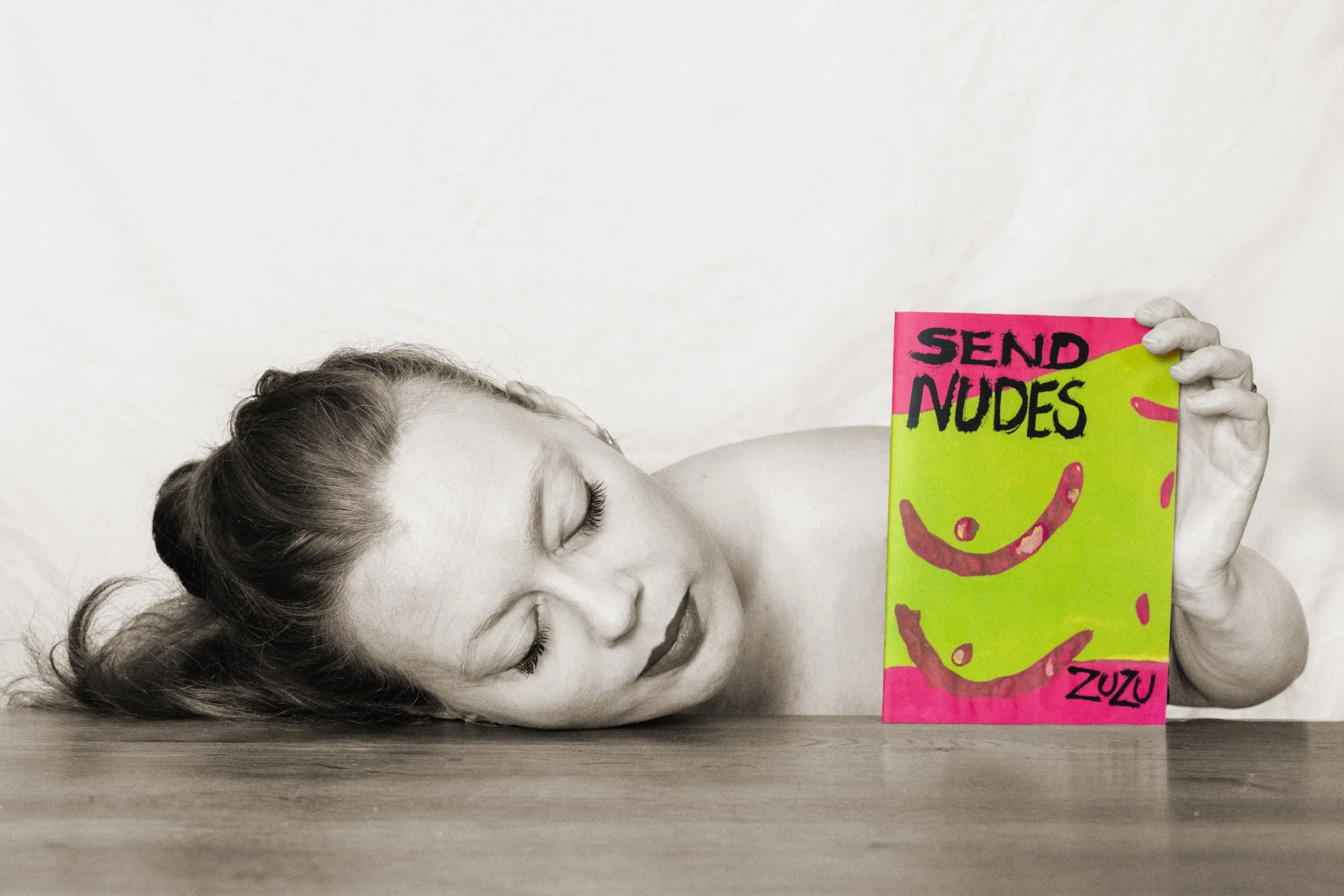
It’s going to be a fun afternoon. If you’d like a drink, you can buy something from the bar upstairs. On the tables you’ll see there are some note cards where you can write things that men — or women — have said to you instead of hello. I know Eli has been collecting some of these for the panel we put up at the studio, so this would be a lovely addition. Don’t be shy, and feel free to take the postcards with you today. If you’d like a little something from Eli’s exhibition, the Send Nudes zines are for sale — you can help yourself to those after. I’m going to hand over to get us started.
Elisabeth Gehrke
Thanks, Mel. And just to mention: you can still see Eli’s exhibition at Mel’s Gallery for the next week or so, so make sure you don’t miss it if you haven’t been yet.
My name is Elisabeth Gehrke. I’m a Swedish American — hence the accent, sorry about that. I’ve been fortunate enough to study gender studies at London University and in Sweden, and after a long career in politics, went back to study comparative literature. The intersection between gender, politics, and culture is incredibly important and always a fascinating debate. It’s wonderful to be here to talk to Eli on the 8th of March — International Women’s Day. A day with a very interesting history. We still manage to celebrate it even though Lenin was the one who instituted it, but we can’t throw out all the good things communism did.
So here we are on International Women’s Day. We have to start with the title of your exhibition: Things Men Have Said To Me Instead Of Hello. This is your first explicitly feminist exhibition — how does that feel for you, and what has the reaction been so far?
Eli Trier
The reaction has been absolutely astonishing. I’m a neurodivergent person — I have autism and ADHD — and generally a lot of my work is quite weird and unrelatable to most people. So to have created something that is so relatable to so many has been mind-boggling, and really heartening. Seeing how men in particular have responded to it has made me feel very optimistic.
Elisabeth Gehrke
Following on from that — can you describe the moment when you put pen to paper, or glue gun to canvas? What was it specifically that sparked you to start this work?
Eli Trier
It’s interesting, because all of these things were said to me about ten years ago. I was in my mid-thirties, I’d just moved to Copenhagen, I was out of a relationship and just kind of dating and having fun. I was on all of the apps, getting these messages, and I would screenshot the creepy or heinous or stupid ones and send them to my friends — but I held on to the screenshots. I didn’t know why, I just knew there would eventually be a reason. Then about ten years later, the idea just wouldn’t leave me alone. I started thinking about how I could present this work in a way that would be impactful and meaningful. I started seeing certain materials and techniques that were sparking ideas, and the whole thing sort of came together in one big wash. And then I was off.
Elisabeth Gehrke
I’ve been lucky enough to see a lot of your other work, and while these pieces are clearly an evolution, there are also such strong red threads running through everything you make. For me that’s colour, texture, humour, and joy. I’d love to talk a little about how you feel the theme of the work relates to colour and materials. Let’s start with A Thousand Tiny Pricks — what is behind the colours and materials here?
Eli Trier
This one was really interesting to make. I wanted to show the violence of this constant drip, drip, drip of being reduced to your body — to what you could do sexually, how available you were. And I loved the idea of taking something as soft and feminine and crafty as felt, and using materials traditionally associated with feminine pursuits. Safety pins are a classic — I think everyone in the world has a packet somewhere. Very classically female. There’s such a perfect representation there of this constant penetration of the feminine by a hard metal object.
Against that background, this piece is really about refusing shame. I didn’t realise when I made it quite how much shame there is about having these things said to you. A lot of people have been reluctant to write on the wall at the exhibition because they feel somehow responsible for what men have said to them. I wanted this piece to be a real fuck-you to all of that — to be resplendent in its pinks and jade greens, the exuberant sloppiness of it. Just vibrant and out there.
Elisabeth Gehrke
One of the things I love about your exhibition is the play between form and words — and not just the words on the canvas, but also in your descriptions on your website and in the titles. A lot of the humour for me sits in how you use text in relation to the pieces. How important are the titles and descriptions to the effect of your work? And what do you think about humour’s place in art in general?
Eli Trier
I think it’s really important. I’m an artist and I work in a visual medium, but I’m also a writer, and the joining-up of words and images is where my practice really sits. Throughout all my collections, the titles are an extra layer. I like to think of all my work as having multiple points of entry: people can come to it and appreciate it purely on the level of the picture plane, but they can also go deeper — read the title, which adds another layer, then read the description, which adds another still. With this collection in particular, it felt like an opportunity to reflect on why these messages were so problematic, how I felt about them, and how they tied into the patriarchal culture we all live in.
On humour specifically — I think it’s crucial when you’re dealing with challenging subjects. It creates a space where people can come to the work without all of their guards up. A lot of the men at the opening told me they were expecting to feel attacked, but actually they felt included. It was important to me that this work wasn’t presented in a judgemental way. Humour is a great way to be disarming. Beauty is a great way to be disarming. Colour is a great way to be disarming. I’ve tried to incorporate all three, because I want people to be already engaging with the work before they’ve realised it — before their guard goes up.
Elisabeth Gehrke
There is of course such a strong bodily theme throughout, because these men are often referring to your body, passing judgement on bodies, asking for access to bodies — and with the pearl necklace piece, we’re in the realm of bodily fluids as an opening line. It’s wild. Women — and really any marginalised group — become acutely aware of how tied to the body their identity is in the perception of others. You’ve worked with that across several pieces — the large breasts in one, the words arranged in a bodily shape in Fetish/Phobia. You’ve said that The Epitome of Elegance was the most time-consuming piece in the exhibition. You put your physical labour into it. Can you tell us about that process and how it connects to the work?
Eli Trier
It was a really interesting one. There are hundreds and hundreds of pearls on this piece, all glued on meticulously by hand with tweezers, and it took months. So I had a lot of time, while my hands were busy, to think about why I was making this work. There’s also an element of: why do I have to do this? Obviously I’ve chosen to, I want to — but in a perfect world, this should be completely irrelevant. I chose to take on the emotional labour of gluing thousands of tiny pearls onto a canvas in order to express something about the world we live in. And that felt really representative of the emotional labour that women perform every single day just to navigate their experiences.
I don’t think there is a woman in the world who hasn’t experienced some form of sexual harassment, or knows someone who has. And a lot of our work as women, just to survive, involves managing men’s reactions to us: trying to tell someone you’re not interested without making them angry enough to follow you home. We share these strategies behind closed doors — walk in the middle of the street, keep your keys between your fingers — and it becomes so natural that we don’t even realise we’re performing this constant labour. Sitting there for months on end gluing tiny pearls very much felt like the medium is the message.
Elisabeth Gehrke
The Epitome of Elegance highlights the depth of your work so well. The symbolism of pearls is so interesting and multifaceted — can you tell us a bit about that?
Eli Trier
We have this cultural idea of pearls as symbols of being cultured and ladylike — connotations of wealth, propriety, the perfect woman. And I think it throws a sharp light on the Madonna-whore dichotomy that the patriarchy is so fond of perpetuating, constantly trying to sort women into one category or the other. Combined with the words on the canvas — you’d look great in a pearl necklace — it’s extraordinarily layered. Because it’s also a bit like gaslighting: it’s such an innocuous statement on the surface. Lots of people who’ve come to the show haven’t understood that it’s a reference to a sexual act. If you don’t know what it means, the sender is completely safe from repercussions; if you do know, then you’re probably the kind of person who’d be up for it. The Madonna-whore Sorting Hat, in action.
I also wanted the picture plane itself to look almost like the inside of a mother-of-pearl shell — delicate, sophisticated, ladylike — with this heinous request slapped on top of it. The juxtaposition between those two things I found very pleasing.
Elisabeth Gehrke
One of the things I love about this exhibition is the references to classical imagery — the pottery, the Medusa. The play with history is so thought-provoking, especially given how often women have been written out of it. How did you make the connection between the modern dating world and classical imagery?
Eli Trier
A couple of different angles. From the very beginning, I wanted to use these heavy, gilded, classical frames — I was thinking about what gets put in museums, the things we lift up as examples of our civilisation’s achievements. And I wanted to call back to the idea that we venerate the words of men even when those words are this. The words of men carry far more weight than the words of women — to the point where many of the men who’ve seen this work were unaware that this sort of thing happens. I don’t think it’s because women haven’t told them. I think it’s because they’ve never seen it three feet high before.
When I was working on the three-dimensional pieces, I wanted something that would carry that same monumental weight. What better than the pinnacle of civilisation — ancient Greece and Rome? Which is where the amphora came in. There’s this wonderful juxtaposition between an object that declares itself museum-worthy and valuable, and the piss-poor pick-up line it’s carrying.
And then with the Medusa piece: she’s the original lady monster — a woman who was turned into a monster by the violence of a man. She was raped in the temple, and her punishment was to become a monster. I’m referring back to that with the idea that we have been dealing with this since the dawn of time. The medium has changed. The messages have changed. The violence behind it has not.
Elisabeth Gehrke
Women are culturally more tied to the body, as we’ve been saying, and at the same time the body is seen as something monstrous when it breaks its boundaries. In Sweden we had the famous debate around a public artwork in the Stockholm Metro — a cartoon ice skater who happened to be menstruating; effectively just a small red dot, but it caused a massive outrage, and our nationalist party campaigned on it for years. Why do you think feminist art that features the body is so provoking for certain people?
Eli Trier
I think it comes down to control and shame. We all know how much representation matters — when you see yourself reflected in the culture and art around you, it makes you feel less ashamed of things you thought were only yours. Showing that in art is a wonderful way to disrupt control and to reduce shame, particularly for women. And shame is such a brilliantly effective tool of control.
It’s also about the idea that women are only valuable when they are young, beautiful, and fertile — easy to control, easy to manipulate. When you put art into the world that addresses the body in all its forms — the monstrousness of it, the grotesqueness, the completely natural animal reality of it — you disrupt that. And that is terrifying to any system that relies on the status quo. Systems that rely on making women feel so bad about themselves that they don’t even speak to each other about what they’re going through.
There’s also something symbolic about being reminded that you have a body, that you were born, and that you are mortal. We live in a very sanitised culture now. Bodies are organic; they don’t always do what you want them to do. We are not good little cogs in the machine, and I think that causes a certain amount of existential dread for people who are invested in keeping those machines running.
Elisabeth Gehrke
There is of course a solid history of feminist art that you’re tapping into here, and we’ve been lucky enough to have several relevant exhibitions in Copenhagen recently. I know you’ve mentioned artists like Judy Chicago and Tracey Emin as inspirations — what about their work specifically has inspired you? I’ve been lucky enough to be in the room with The Dinner Party at the Brooklyn Museum, and it is as breathtaking as it looks.
Eli Trier
A few things take it over the edge for me. First, the sheer scale: if you make something big, you’re telling the world it’s important. And what Judy Chicago has done is made women important. The other thing — which I think is crucial — is that it’s made with craft techniques: embroidery, ceramics, textile work. All the things that are considered women’s work and therefore supposedly not art. And yet it is undeniably one of the most dramatic, moving, breathtaking pieces of art — feminist or otherwise.
That use of craft is something I love about Tracey Emin too. Everyone I Have Ever Slept With 1963–1995 — the tent — is all done in embroidery and applique and textile, and it caused a fury. People thought it was just about everyone she’d ever had sex with, but it’s about abuse, intimacy, love — the names inside include people she’d lost, her grandmother, friends, people who had abused and assaulted her. It’s a stitched history of intimacy. You can see that use of craft throughout my collection: A Thousand Tiny Pricks with the safety pins and felt, the stitch work and lace — all these very feminine materials used in service of very unfeminine truths.
Elisabeth Gehrke
The piece that always hits me the hardest when I see it — physically makes me recoil — is Jailbait. I remember having that kind of dolphin necklace as a teenager. The sentiment is such a testament to how obsessed our culture has become with young women since the 70s and 80s — which is not some eternal constant, but a specific shift that happens around the second wave of feminism, where young women become objectified in the media in ways they weren’t previously. What did that message make you think when you received it? And how do you feel about it today, especially in the context of everything we’re now watching unfold?
Eli Trier
For me personally, it’s the same as it ever was. The fact that this is now more public and people are talking about it more doesn’t change the fact that this has been happening throughout my entire lifetime, certainly since I was a teenager receiving unwanted attention in exactly this way.
I wanted this piece to be more about the girls — the sixteen-year-olds, the fifteen-year-olds, the fourteen-year-olds — rather than about the men saying these things. I wanted it to look like it could have been made by a sixteen-year-old: the sweet 16 bracelet, the lace, the pretty girliness of it. And then this hardness, this acid yellow, this fucked-up frame. The phallic forms on the corner — this thrusting of male attention into a childlike space.
Unlike many of the other pieces, where I think the men were fully aware of what they were doing, I think this particular guy genuinely thought he was paying me a compliment. He thought he was being sweet. And that is perhaps the creepiest thing of all: we live in a society that says it is better to be 16 than 34. That it is better for this man to strip away 18 years of life and wisdom and experience in order to have her be young and available. That is really the point of this piece, and it remains the point, regardless of what’s currently in the news.
Elisabeth Gehrke
The silences are such a big part of what it means to be a woman, and confronting those silences is such a big part of feminist art. There is such a taboo around receiving these kinds of messages from men — it’s so easy to think there’s something wrong with you, or that you provoked it. Here you’re flipping that around: making it public, colourful, adding depth and humour. What would you say to someone who questions using humour when dealing with serious issues like this?
Eli Trier
It’s an important question. Whilst I feel humour is completely appropriate in this context, it’s not always appropriate — it is not a joke. But humour is a wonderful deflator of shame. If you can come at something traumatic with levity, it enables you to move outside of the trauma or the judgement and actually think a little more objectively about what’s going on — and even have a conversation about it. Which you can’t do when you’re shovelling on guilt, shame, and judgement. Humour can be a gateway to these conversations rather than making it feel like I’m making light of the situation.
Elisabeth Gehrke
Feminist art often includes different kinds of portraiture, and you’ve included that in your exhibition too — I really love it as a touch. You have a face and a subjectivity; the men have a voice, of course framed within your art, but no face. Can you reflect on that choice?
Eli Trier
It was a very deliberate and very important choice. Naming names and identifying individuals who said these specific things would miss the point entirely — this isn’t about a few bad apples. This is about the fact that we are all — men, women, and everyone in between — complicit to varying degrees in upholding the patriarchal structures that make these behaviours possible in the first place. We all need to examine our own complicity: where we’re upholding these structures, where we could start to dismantle them from the inside out.
It would have been very easy to just say these men are terrible. But it’s not about men — it’s about the patriarchy. I’ve heard from many men in my sphere that women can be equally awful on dating apps, and some of what men receive is also horrendous, and is very much operating within the same system. What I’m trying to do is hold up a mirror and say: this is happening. Maybe you were aware of it, maybe you weren’t. Maybe now we can begin to have the conversations that start moving us somewhere better.
Elisabeth Gehrke
One of the great through-lines of feminist art has been including women’s voices in different ways. At your opening you had a large piece where people could share what men had said to them. Can you reflect a bit on what that experience was like — watching that paper fill up, and reflecting on it after the exhibition?
Eli Trier
I’m really glad that Melanie suggested it, because this is not my experience alone — this is a universal experience that so many women are having. Having that panel up at the gallery really brought that home. I’m not unique in this; I’m just the one who hot-glued it all to a canvas.
It was really powerful to see — and also kind of heartbreaking and devastating to see the things going up on the board. Something struck me: at the opening, people were going up, writing, talking about what was written, reflecting in real time. And then after the opening night ended, fewer and fewer people wrote on it, even though the exhibition was still on. And Mel told me a lot of people were just: oh no, I couldn’t possibly. And I think there’s something very interesting about the fact that being in that shared space together enabled people to be a bit braver and say: this happened to me too. And then afterwards, even surrounded by the work and other people’s experiences, people were more reticent. Which is really why we need to keep having these conversations.
Elisabeth Gehrke
One of the things that struck me about your exhibition — and that several people mentioned — was the presence of quite a few men. As we both know, both in art and especially at any event around a ‘women’s issue’, the men tend to be absent. What do you think brought them in? Did they share anything with you? And do you have any tips for how we can trick them into joining us for these kinds of conversations?
Eli Trier
I think it comes back to how the work is framed. I didn’t want men to come to this exhibition and feel attacked, because as I’ve said, it’s not about that. I want them to feel included. I want them to think: fellow humans are being treated in this way — and I know women who’ve experienced this, and maybe I have too in some form — and maybe we could just try to be a bit kinder to each other. Really, it’s a bid for connection. Even in a heinous frame, it’s a bid for connection.
The men who came told me various things: some came because they were interested in the subject, some because they knew someone who’d been assaulted, some because they were gay and had had similar experiences on apps, and some just came with their girlfriends or sisters and were genuinely moved. One of the most striking things was how many of them said they simply hadn’t known this was happening at this scale. Not because women hadn’t told them — but because hearing it and seeing it three feet high are different experiences.
As for tricking them into joining us — I think the trick is not making it feel like a trap. Don’t make it feel like they’re coming to be lectured or judged. Make it something with humour, with beauty, where they feel invited rather than accused. And then once they’re in the room, the work can do the rest.
Questions from the audience
Audience member
Speaking on the issue of shame — do you feel any catharsis or release from having spent so much time laboriously creating beautiful works of art that represent these very ugly things that were directed at you?
Eli Trier
A really interesting question, because I never felt any shame about it in the first place. One of the things that surprised me at the opening was how many people came up and told me how brave I was. And I was like: well, it doesn’t feel like a brave thing. I wasn’t scared of putting this out there. I didn’t say these things — they’ve got nothing to do with me. So I think the catharsis was more about having an idea and seeing it through. Really though, it’s about the connection: being able to come together and have conversations that feel important. And I think I was able to do that partly because I wasn’t ashamed, and also because it happened ten years ago. I don’t remember feeling shameful about it at the time, and it’s part of my past, not my present.
Audience member
I haven’t been to the exhibition yet, but I’d love to go. You said a lot of men engaged positively and felt included rather than attacked. But have you faced any backlash?
Eli Trier
[Laughs] I assume people have been very polite and not said anything unpleasant directly to my face. The reaction has been overwhelmingly positive, which did surprise me. But if you’re coming to an exhibition like that, you’re probably not there to be antagonistic. And a lot of the men who attended were already predisposed to engage thoughtfully — they came because the subject mattered to them. As this work makes its way further into the world, I imagine there will be some who have a problem with it. But I hope it’s framed in such a way that that’s not the dominant response.
Susanna (audience member)
I was at the exhibition on the opening night. There were a lot of men there, many of them coming through international networks, and I spoke with several of them — they worked for large companies, recently arrived in Copenhagen. They said they’d found the exhibition a kind of guide to navigating Danish social culture that they’d never encountered before. A couple of them asked me whether there’s any organisation in Copenhagen that arranges men-only events where these issues could be discussed, facilitated by someone. They said they would come, and the other men agreed it felt like an important conversation to have.
Eli Trier
That’s fascinating, and it goes straight back to what you were saying about bringing more men into these conversations. Making it a space explicitly for them, for their own processing, is actually a really good way in.
Melanie Smith
Something Eli and I have both discovered in putting this exhibition together — from mounting the work to having the panel up — is that there is a lot of shame, and women carry it with them as if they’ve done something wrong, as if they inherently deserved these words. How do you think we move forward in helping women to accept that this isn’t their fault?
Eli Trier
Overthrow the patriarchy — shall we all get together and do that next week? [Laughs] Seriously though: more conversations. People like me, who perhaps don’t carry so much shame around these things, can step up and try to bring everyone else with us. Maybe it is the neurodivergence — certain social conditioning messages completely bypassed me, and it simply never occurred to me that this was my fault. In some ways that’s quite awful, but in instances like this, it’s been useful: I can shine a light on it from a position somewhat outside of it. I think neurodivergent people are often at the forefront of showing people a different way of doing things.
But it’s also about the people who are willing to sit in the discomfort and be brave enough to put it out there regardless. And it’s multi-pronged: different things work for different people. For some, this exhibition will unlock something. For others, it’ll be a conversation with a friend, a film, an article. It’s about cultural touchpoints — the water we’re all swimming in. It’s about finding ways to make the world more human, more about connection and care. That’s the goal. That’s always the goal.
Elisabeth Gehrke
Thank you so much, Eli. And thank you all for being here.
See more videos: