Behind the scenes of the Tussie Mussie collection
Step into my studio and explore the vibrant world of my Tussie Mussie collection! In this intimate tour, I'll reveal the stories behind these emotion-filled floral paintings, sharing my creative process and the deeply personal meanings woven into each piece. From the euphoria of I'm Too Happy to the chaotic beauty of Tranquilize My Anxiety, discover how the secret language of flowers serves as my unique language for expressing complex feelings.
-
I'm going to do something a bit different with you today. I've been showing you loads of sketchbook tours, but today I want to show you some of my actual finished artwork - the art that I sell, that people buy, that gets exhibited, like the stuff that actually goes out into the world. You'll see a little peek of it here and there, like it's often in the background in my videos, I try and show it as B roll as we're going through. But I don't think I've yet given you an in-depth look. So that's what we're going to do today. I really hope you like it.
In case you're new here, I'm Eli Trier. I'm a professional artist living and working in Copenhagen, Denmark. I'm more nervous about showing you my final work than I am about showing you my sketchbooks, which is weird, but there we go. I've just got these paintings, my Tussie Mussie collection. They've been out at an exhibition and have just come back to the studio. They'll actually be for sale as soon as my online shop launches, which should be in the next month or two, so stay tuned for that. If there's one that particularly catches your eye, it will be up for sale shortly.
I want to talk to you about this collection, but it's super personal, and it feels really difficult to talk about. It's odd trying to describe what I was feeling and thinking as I was making each piece, because it's such an intuitive collection, and to be honest, most of it just kind of flowed out of me. I've done my best, but I wanted to give you an overall idea of what the collection is about.
It's called Tussie Mussie. A Tussie Mussie is an actual thing. In the Victorian era, there was a trend for what's known as floriography - the secret language of flowers. People would communicate with each other by giving each other tussie mussies, which were little posies that they would either give to each other or wear on their clothes. Each flower in the tussie mussie would have a particular meaning. There were books of all the meanings that circulated; it was like a whole craze.
Unlike the rigid structure of Victorian floriography, though, these paintings are riotous and expressive. There's no one flower that means a particular thing. Someone expressed it to me wonderfully the other day: they are memories of emotions expressed as flowers. That's basically what they are.
As an autistic person, I can sometimes suffer from something called alexithymia, which is a difficulty in identifying and expressing emotions. I often find it difficult to process emotions in the moment. I often don't know until much later how I feel about something or what I'm feeling at all in any given moment. These paintings, these flowers, are sort of my stand-ins. They express things that I might not be able to do verbally. They're able to capture emotion that I might not realise I'm experiencing.
Flowers are hugely symbolic for me. If you're familiar with any of my work, you'll know there are symbols that repeat over and over again. Cats is one, obviously; flowers is another, and they always symbolise some kind of emotional state for me. I think of this as a kind of game of telephone. I do give you a little insight into what each painting means to me, what the thinking was behind it. But really, it's about how you feel, how these pictures make you feel. Sometimes my original meaning gets lost in the message, but it's a communication between me, the artist, and you, the viewer. Whatever emotions one of my pieces elicits in you, that is valid. That's part of the conversation. I'm calling, you're responding; we're communicating in that way.
I'm going to go through and take a couple of my favourite pieces. I'll try to go into a little more detail, talk about how I made them and the thinking behind them, but I really want you to absorb the work and come to your own idea about what it means and how you feel about it.
I forgot to mention all of the titles of the paintings are actually taken from an original floriography dictionary, so they are actual meanings that were represented by flowers in tussie mussies at the time. That's just a fun little extra thing.
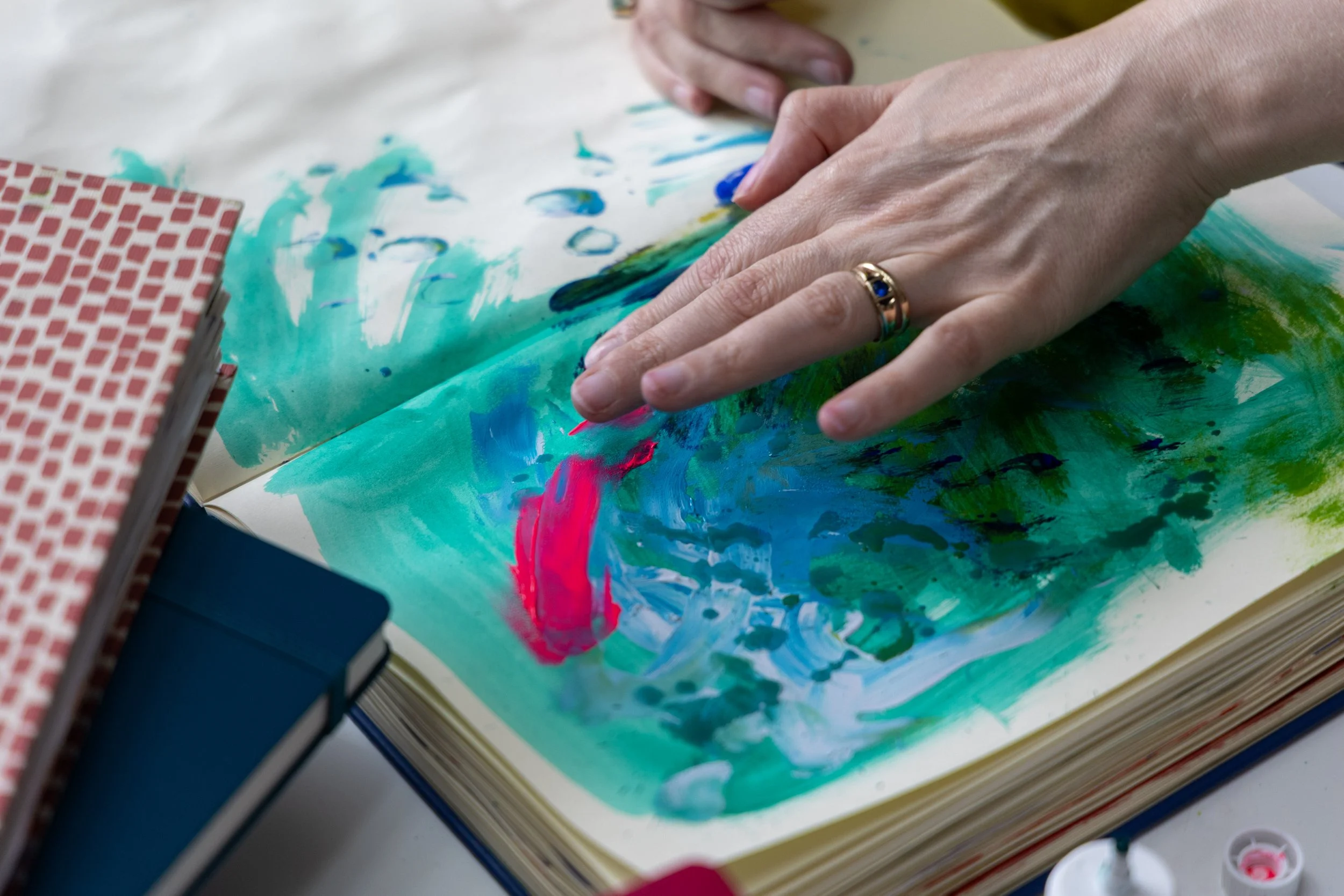
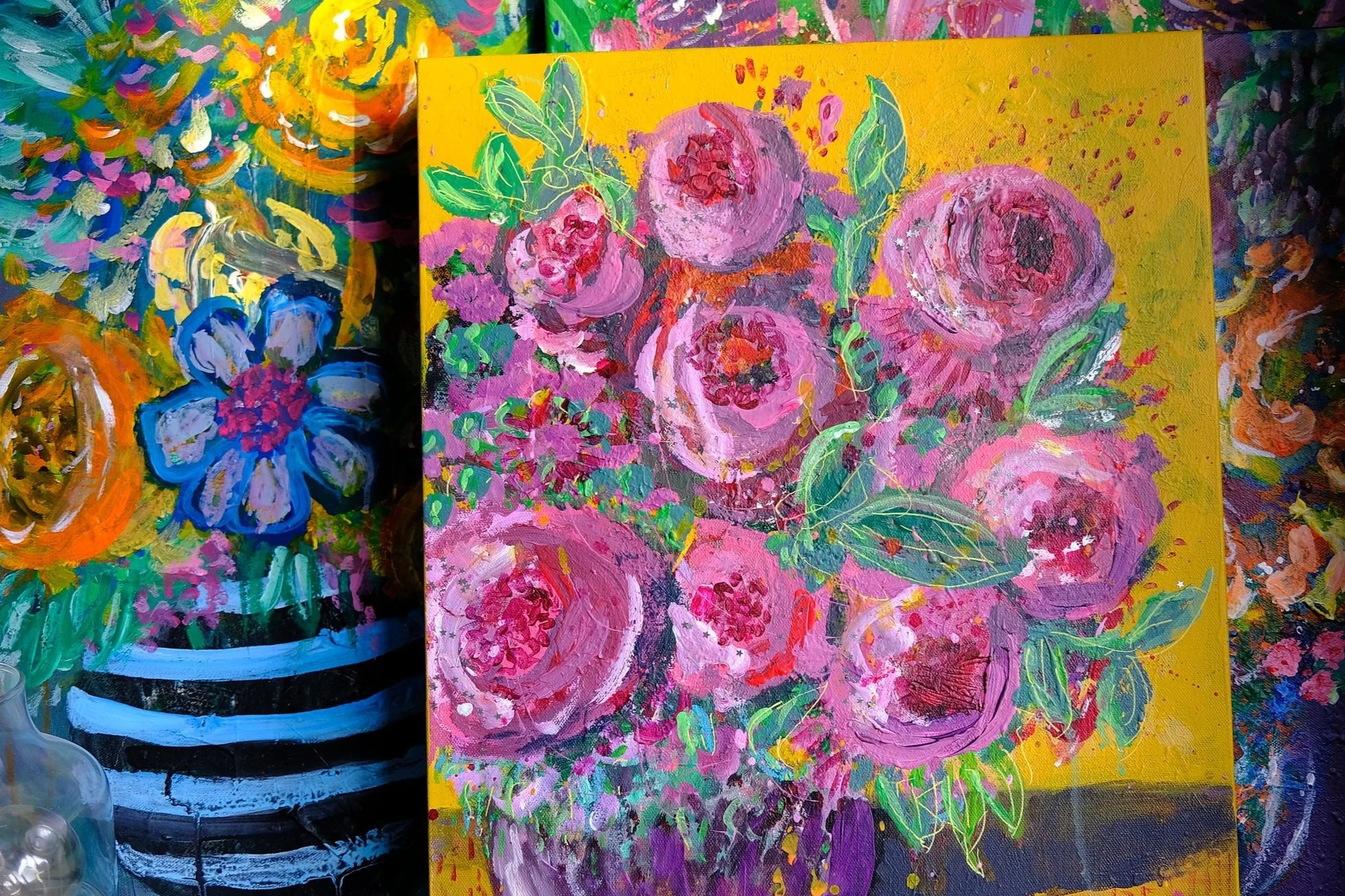
The first piece I want to show you is called "I'm Too Happy". It's 30 centimetres by 40 centimetres, acrylic on canvas. I very rarely use brushes when I'm painting my final pieces. I do use them a bit, but often I'm using my fingers and a whole host of mark-making tools. My favourite tool is a palette knife, and I also love to use a scrapey tool to apply the paint. I use all sorts of random stuff, like old sponges, plastic bags, the net bags that you get fruit in - all sorts of interesting things to try and make interesting marks. I also use rags for scraping the paint on or daubing it on and off.
I really love these passages of just really lovely, bubbly texture. You're not supposed to touch paintings - I don't recommend you go around galleries touching paintings - but when it's your own, it's so lovely. It's got shiny bits, knobbly bits, and oh, it's so lovely. I work in multiple, multiple layers of paint. You can see how much depth that gives it in these areas here and here and under here as well. There's just so much going on and each layer, oftentimes you'll just see a tiny spot of the layer that went before, but it just adds extra dimension.
"I'm Too Happy" describes that sort of overwhelming feeling of joy that you get sometimes, like it's almost euphoria. It's almost painful in its intensity. You get that from this big swoosh of yellow and these hot pink spikes that kind of come up. There's a heat to it, there's an intensity to it. The blue that I've used throughout acts as a sort of counterpoint to that. This blue, for me in particular, is very symbolic. I don't want to over-explain it, but this is that sort of feeling of euphoric joy that borders on the painful.
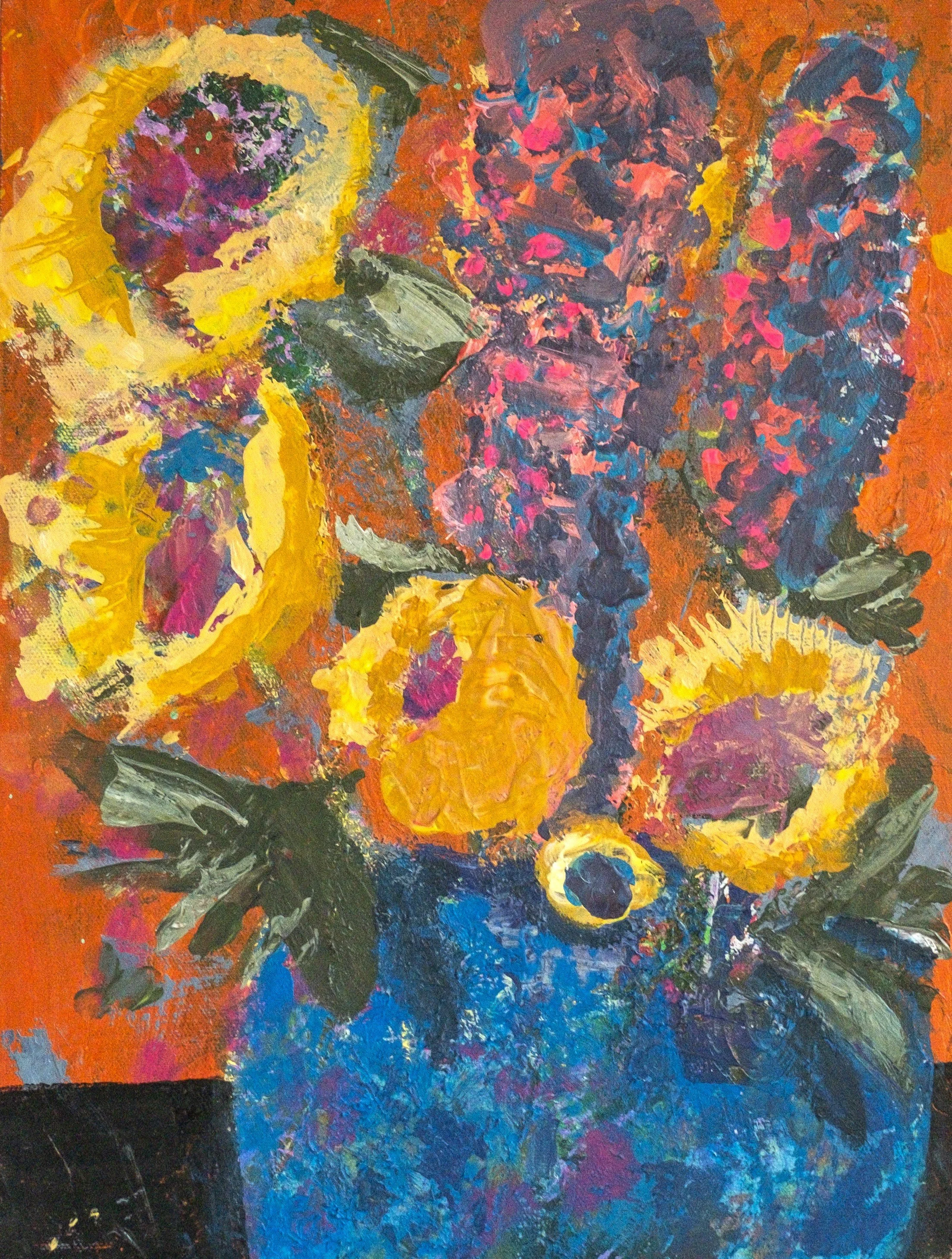
This next piece is another one of my absolute favourites. It's called "Impatient Resolves". It's really tricky to get a good photograph of it - it doesn't come across very well in photographs. I've tried to get the lighting right in here, but it's tricky. You really have to see it in person, but I wanted to show it to you anyway, and hopefully you can get some idea of how it looks.
What I was trying to capture was that feeling of having so much going on on the inside and having to keep it all in, like a really tightly contained emotion container. Sometimes that's just not possible, and everything spills out of your neat, little container. That's why I've done the vase very contained, and then the blooms that are coming out are just this chaotic explosion of light and heat and passion and fire, cascading out of the pot. They're uncontainable. They're not going to sit around and behave. They're not your average bouquet. They are messy and passionate.
This piece is called "For Once May Pride Befriend Me". You might recognise the composition from one of my sketchbook tours. You've heard of the phrase 'tall poppy syndrome', which is when there's a cultural phenomenon where people who are successful and talented and do really well are cut down by their communities and made to shrink themselves down. There's a similar concept in Denmark called 'Janteloven', which basically means that nobody is better than anybody else. It's lovely, but again, it results in criticism of people who are felt to be getting too big for their britches.
It means that a lot of people try to shrink themselves down and hide in order to not be rejected by their communities. We have this societal fear, this fear as human beings of being rejected by the group or ousted. It causes a lot of people to just shrink themselves down and keep themselves really small and try not to outshine anybody else, or keep their light under a bushel.
But as you can see, these poppies are tall. They're surrounded by nothing else, just growing and reaching for the sky and shining in all of their beautiful, crazy colours. They're free, and they're doing their own thing, and they don't give a fuck what anybody else thinks. Basically, they're proud poppies and they're allowed to be proud. They're giving themselves that glorious gift.
There are a few things that I particularly love about this piece. One is the line work. I really love how the line kind of delineates what's inside, but doesn't describe it completely. So you have this kind of ghost image around the edge. I think that's absolutely beautiful. I really love this passage here with the turquoise overlaying the pink and the purple. I really just love the depth and the interest in the petals themselves, how the colours kind of interplay. The gestural lines here as well. But yeah, it just speaks to that kind of joy of just doing what you do and existing and being in the world.
I think paintings have an energy, and when you stand in front of a piece of artwork, you can really feel that energy. There's a resonance between you and the piece. Sometimes it's on your frequency, and sometimes it's not - it's on somebody else's frequency, and they love it, and it leaves you cold. I think maybe you can get a little bit of that come through in the screen. It's not the same as seeing artwork in the flesh. It's really not and you know, I wish that I could invite every single one of you into my studio. We'd have a cup of tea, and I could show you these pieces in person. But this is the next best thing.
It's a real mix of emotions, but what I really wanted to convey was the pride in being who you are and doing what you want to do, and not caring what anybody else thinks of you. Sometimes, you know, that can be very painful, especially if you get rejected for that. But it can also be utterly, utterly glorious, like true joy. And I hope this piece gives you the idea that you can be both.
This piece is the biggest one in the collection. It's 60 centimetres by 80 centimetres, and it's called "Tranquilize My Anxiety". This one actually stayed half-finished for a really long time, like two or three years. I think it took a while to find its way, and now it's finished. All the pieces I've shown you are basically my favourites from the collection, and this one is no exception.
The thing that I love about it is this whoosh of energy, the upwards drips here in the lilac and the yellow. There's so much chaos in this painting. It really does feel like an expression of that jangliness of anxiety. But then we have these gorgeous, calm pink swooshes that just kind of - and you can see the blue coming down from the top - it's just calming, calming, calming. It's coming through slowly. It's an intense painting. I think it's gorgeous, obviously.
This one, again, was done in a very tactile way. A lot of the underlayers were done using very fluid paint, and kind of tipping and turning and tilting the canvas around, getting the drips to run, like these sideways drips and these curved drips. For a long time, it didn't have a top, I was constantly spinning the canvas around, moving it and then gradually carving out this surface, the background, and then kind of pulling out the descriptions of the flowers from the chaos behind. It was such a collaborative experience with the materials.
Whilst on one level it's about anxiety, it's also about the counterbalance of anxiety with joy. I love these areas up here, we've got this kind of pink and blue and purple. There's all sorts of stuff going on here, and then all of these areas where you get these upward drips - I really love upward drips. I love this yellow swoosh. I love how it's echoed in the pink swooshes. And I don't think I used a brush. This is all done with this palette knife again. So just carving the paint, all of the surfaces are thick and lumpy, and there's all sorts of stuff going on here. It's because I'm basically sculpting the paint on the canvas with the palette knife, which is my favourite way to paint.
I use my fingers and all kinds of whatever I can pick up that I think might make an interesting mark. It all goes in there. And again, layers and layers and layers, some of them come through, some of them don't. Some of them are way in the background, forgotten about, and some of them just make really interesting little corners.
One thing I always try and do with my paintings is give you so much to see. You could just sit and stare at them, and you'll find something different. You'll find a different corner or a different expression on the picture plane, and it will give you something new. It'll give you a whole new experience.
These printed circles down here, I think that was done with a bottle cap. I can't even really remember. I kind of go into a bit of a fugue state when I'm painting. Stuff comes out of me. I'm not really aware of it at the time. It's kind of magical. It's the best anti-anxiety thing I've ever found - better than medication, better than meditation, better than anything. Just paint, music, emotion, whoosh. It all comes out.
This last piece is called "Sleep. My Bane. My Antidote.", and it describes the experience of insomnia. Sleep is, for all of us really, the foundation of living a good life. As far as I'm concerned, if you sleep well, then the following day is fabulous. If you sleep poorly, the following day is just an absolute living hell. So yeah, sleep is the bane of my life. It's one of the most complicated things I have to deal with, but it's also when it happens, it's the antidote to everything awful. It solves so many problems. Being tired causes so many problems, sleeping solves so many problems.
This is that kind of half-awake, half-dream-like state. These feel like dreams of flowers. The indistinctness of them, the way that they're not kind of - they're so soft. And dream-like, blue is representative of the unconscious; it feels very dreamy to me, like a dream landscape behind them. The flowers are more abstracted. I love these contrasting colours. I think they create a really unreal kind of atmosphere. There's something sort of otherworldly about this piece. Sleep and dreams and strange places you visit when you're asleep, it's all in this painting.
And again, it's full of lovely passages of texture. I love this kind of falling petal here, I love the edges of the stems and the ridges of texture butting up against the flowers.
Anyway, I just wanted you to have the experience of being able to gaze at these pieces for a little while. I really hope that you've enjoyed hanging out with me in my studio today and having a look at some of my paintings. Like I said, if any of these have caught your eye, they will be coming up for sale in the not too distant future.
We also have a print shop, which is going to be launching very, very soon, which is so exciting. We're going to be selling some prints from my sketchbook. A lot of you have been asking for copies of some of my sketchbook drawings, and we're making that happen for you. So I am so excited about that. It's going to be amazing. We're working very hard behind the scenes at the moment to get everything done.
The best place to get the first look at everything that happens is to go over to my website, elinortrierstudio.com, and sign up for my newsletter. I send a newsletter out once a month, my monthly bulletin. And then there's also news about collections being released and special offers and the print shop and everything. It will all happen there first. So do go over there and sign up. The link is in the description.
Thanks for hanging out with me today, and I will see you next week.