Ep #16: Nostalgia, longing, and landscapes - with artist & curator Victoria J. Fry
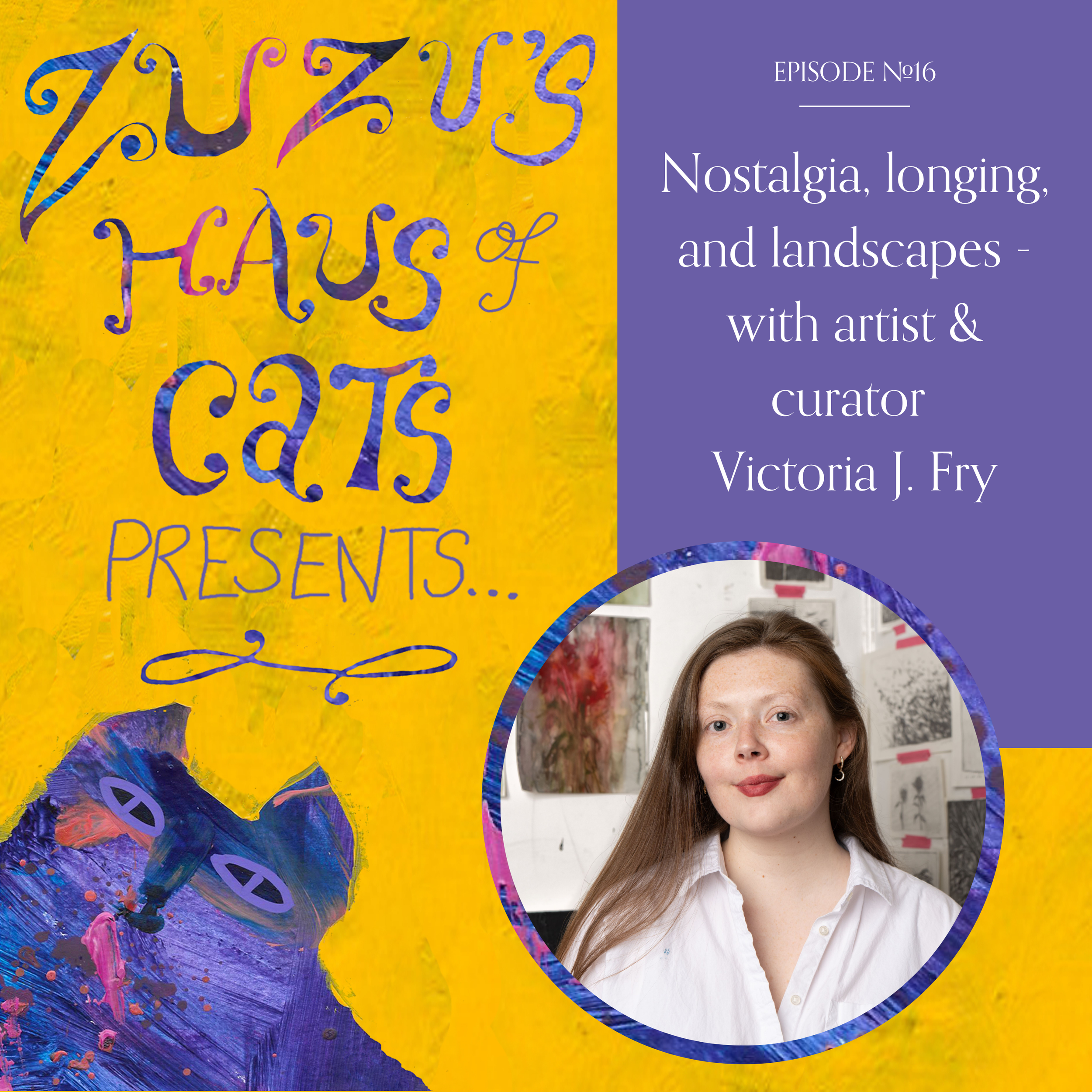
In this episode, Victoria J. Fry opens up about her journey from art school graduate to successful multi-passionate creative entrepreneur. Based in New York City, Victoria is not only a talented landscape painter but also the founder of Visionary Art Collective, New Visionary Magazine, and Warnes Contemporary Gallery. She shares candidly about the post-graduation depression that many artists experience when the supportive bubble of art school suddenly disappears, and how it took her nearly a decade to find her artistic confidence again.
Victoria's landscapes are infused with a profound sense of longing and nostalgia, rooted in her childhood experience of leaving the English countryside at age seven. Her dreamlike paintings, dominated by blues and greens, capture what she describes as an eternal yearning for something just out of reach - a feeling that resonates with the Welsh concept of "Hiraeth," a homesickness for a place that may not even exist. Through her intuitive painting process, she transforms these deep emotional experiences into work that speaks to universal feelings of displacement and the search for home, both literal and metaphorical.
Our conversation also explores the practical realities of balancing multiple creative pursuits with running a business. Victoria shares her strategies for maintaining both her studio practice and her various enterprises, including setting firm boundaries around weekends and evening hours, embracing the cyclical nature of creativity, and allowing herself the freedom to experiment across different mediums. Her advice for aspiring full-time artists is refreshingly practical: develop multiple income streams, transition gradually from full-time employment, and most importantly, allow the journey to unfold organically rather than forcing overnight transformation.
Listen to the episode here (click the arrow at the bottom right to play), or find it wherever you get your podcasts:
Find out more about Victoria:
Victoria J. Fry is a New York City-based painter, educator, curator, and podcast host. She is the founder of Visionary Art Collective, New Visionary Magazine, and Warnes Contemporary Gallery. Fry has supported hundreds of artists globally, providing resources and opportunities to help them further their art careers.
As part of her mission to increase visibility for emerging artists, Fry partners with renowned curators and gallerists to present both in-person and virtual exhibitions at Warnes Contemporary and beyond, as well as to publish quarterly issues of New Visionary Magazine, a contemporary art publication showcasing artists from around the world.
Fry has been a guest speaker for the Women’s Caucus for Art in Washington, D.C., Superfine Art Fair in NYC, Photo Trouvée Magazine, The Art Queens Society, and the Huron River Art Collective. She has curated exhibitions for organizations such as Create! Magazine, Arts to Hearts Project, and The Artful Collective, and has served as a juror for the Women’s United Art Prize.
Fry holds a BFA from the School of Visual Arts (2012) and an MAT from the Maine College of Art & Design (2014).
Visit Victoria’s website
Find Victoria on Instagram
Also on Instagram: The Visionary Art Collective and New Visionary Magazine
-
Introduction
Hello and welcome to Zuzu's Haus of Cats Presents... I'm your host, artist Eli Trier, although you can call me Zuzu. On this podcast, I talk to my fellow artists about the magic of the creative process. We'll talk about what they make and in particular, how they make it. Their rituals and workflows, inspirations and disenchantments, ebbs and flows. We'll even take a peek behind the scenes of their businesses to see how they're using their creativity there too, and how they balance the needs of their business with the needs of their art.
If you're interested in getting a behind the scenes look at what makes artists tick and enjoy conversations about art, creativity, neurodivergence and business, then you're in the right place.
I am so excited to be talking to Victoria J. Fry today. Victoria is a New York City based painter, educator, curator and podcast host. She's the founder of the Visionary Art Collective, New Visionary Magazine, and Warnes Contemporary Gallery. She has supported hundreds of artists globally, providing resources and opportunities to help them further their art careers.
As part of her mission to increase visibility for emerging artists, Fry partners with renowned curators and gallerists to present both in-person and virtual exhibitions at Warnes Contemporary and beyond, as well as to publish quarterly issues of New Visionary Magazine, a contemporary art publication showcasing artists from around the world.
Fry has been a guest speaker for the Women's Caucus for Art in Washington DC, Superfine Art Fair in New York City, Photo Truvé magazine, the Art Queen Society and the Huron River Art Collective. She has curated exhibitions for organisations such as Create Magazine, Arts to Hearts Project and the Artful Collective and has served as a juror for the Women's United Art Prize.
Fry holds a BFA from the School of Visual Arts and an MAT from Maine College of Art and Design. She is also, although she doesn't mention it in her bio, an absolutely fantastic fine artist specialising in the most beautiful landscapes. I can't wait to introduce you to her, so let's just dive straight in.
The Interview
Eli: Hi everyone and welcome back. I'm so happy to welcome Victoria Fry here to the podcast with me today. Victoria, thank you so much for joining me.
Victoria: Oh, thank you so much for having me. I'm really looking forward to our conversation.
Eli: Brilliant. Why don't you kick us off with giving us a little bit of background about who you are and what you do and how you came to be an artist?
Victoria's Artist Origin Story
Victoria: Yeah, absolutely. And thank you so much for asking. I think most people at this point probably know me from my work for Visionary Art Collective, which is the company I started about five years ago. I'm happy to share more about that journey as well. But I always say I'm an artist first and an educator, a curator, a gallery owner, all of those things come after that. But to my core, I'm an artist and have always been a painter.
When I was growing up, I think like many artists, I was literally always drawing. I grew up in a big family and there was just always so much happening that I wasn't even fully aware, but I kind of created my own world where I could have time alone to be with my thoughts. I just remember drawing and painting all the time and not even thinking about it. It was just part of what I did.
I think when you get to that place in school - I noticed around middle school, which for us in the U.S. that's around maybe 10, 11, 12 - my friends that I would draw with a lot when I was in elementary school weren't doing that as much, but I still wanted to do that. It's interesting, I feel like that's the age where you start to go different directions. Some of my friends started to play sports, but I remember still really just wanting to be in the art room and draw.
But also like many artists have shared, I had a little bit of a traumatic experience with an art teacher around that time, which is tough because it's such a tender age. I know she probably didn't mean it, but the way that she taught was following a very kind of formula, like a way of working. And if you didn't follow that, then you weren't doing a good job. It was very much centred on wanting to impress parents versus anything like creative exploration. So I kind of dipped out of it for a little bit, but then pretty early on in high school, I returned to it.
Just a few years later, it got to the point where during my high school years, I was literally taking every art class possible and I was doing really well. I remember even my guidance counsellor was like, just take as many art classes as you can because you're actually getting the best grades in your art classes. We were thinking about college applications and I just remember stacking my schedule with every art class I could possibly fit.
I knew very early on that I wanted to go to art school for college. It was something I just knew and didn't even question. My parents were very supportive, which I'm super grateful for because I've spoken with so many artists who have shared with me that they didn't necessarily have that same level of support. Especially coming from an immigrant family - we moved to the United States when I was seven, just before my eighth birthday, and we had lived in Singapore for two years before that.
Eli: Oh, wow.
Victoria: Yeah, so I was living in England, where I was born, kind of my first impression of the world, then two and a half years in Singapore before moving over to the United States. Having some friends that also had families that came here later on, I've grown to understand that there can be added pressure there as well. But my parents were so supportive and they were - I think they were just so excited that I wanted to go to college because I was the first person in my family to go to college and to graduate from college, and also the first person in my family to get a master's degree. I think my parents were just so thrilled. They didn't care that it was art school. They were like, you need to go, we're so excited that you want to go.
Through art school, I was painting and drawing and finding my own voice. I graduated in 2012, so 13 years ago, which is crazy. It's just been a continual journey, trying to prioritise my studio practice as much as possible since then. Always a tricky thing, especially when you've got multiple things going on that you have to juggle. it's - I've been talking about this more on my podcast recently. I'm happy to share that experience and any thoughts that might be valuable.
The Post-Art School Reality
Eli: Yeah, please do.
Victoria: I mean, it's tough. You leave art school, when you're in art school, you're in this bubble where you're really young and you kind of think that this is going to be what the rest of your life is going to look like. Looking back, I see how separated from reality I was. It was such a privilege to be able to live in that space and just make art for four years. Then I went and got my master's degree and it was a different kind of experience. But nothing really prepares you for when you graduate and it's like, okay, now go get a job and figure it out. It's like, oh, wait, I didn't think it was going to go this way. I wasn't prepared for this.
I felt actually the year after I graduated from School of Visual Arts in Manhattan, I was - looking back, I can see I was in pretty much a depression. I didn't know at the time, but I look back, I even see photos of myself and I barely recognise myself. I think I was so shocked. I felt like when I graduated, the rug was pulled out from under me. I literally had no idea what my next move was.
But my saving grace was that I knew I loved teaching. I did some internships through college. I did internships at David Zwirner, which is a really big gallery here. I did internships that were very much in the art world, in the gallery world, but I also did internships and volunteer work for organisations where I would work with kids. I absolutely loved that. So I had some direction of what I wanted to do, but I felt really - it was just a very jarring experience and I'm sure so many artists can relate because it's not just the lack of preparation for life beyond school.
It's also like a total loss of community. You're seeing classmates every day. Engaging in creative rhetoric is just part of your typical Monday. You're going to class and chatting about your work with your peers and then your professors sharing their suggestions. That's all you know for four years. Then it completely ends and changes. It was really, really hard for me.
What I found after I graduated, I did struggle to maintain a consistent studio practice. In fact, I felt that I kind of lost my way artistically. It took me a full four years when I was pursuing my undergraduate degree to get to a point where I felt confident in my work. I remember my senior thesis show, I had reached that level. I was so proud and I was like, finally I've gotten to this place where I feel confident - it's a lifelong journey, but I felt that and that only happened my senior year of college.
But then as I was trying to figure out adult life and how to do that, which is a very big and complicated challenge, I lost my way a little bit with my art. I didn't really know if I wanted to continue making the same kind of work that I had made in art school.
Eli: And was this the work that you're making now, the landscapes and things? Were you still doing something in that vein?
Victoria: I was, but it's starting to come full circle now, which is really interesting because when I was in art school, I was doing a lot of encaustic paintings that were referencing landscapes. So there's always been a connection to landscape. But then after I graduated, I felt a little bit - there was a lot of uncertainty and I didn't even know with my own work, I started to feel kind of fragile and vulnerable. I was exploring with different things. I would never say that I stopped painting or drawing, I just didn't really know. I didn't have a clear direction.
It took me years. I would actually say I only started to get back to that place recently, which is crazy. It's like a decade.
Eli: Yeah.
Victoria: But in terms of - I mean, there's a lot that I could share, but what I have found over the past decade and longer than that of working and then building my company and all of these things is your practice goes through seasons. I'm sure you can relate to that too as an artist.
Eli: Absolutely. Yeah.
The Cyclical Nature of Creative Practice
Victoria: I think it's so important to embrace persistence over consistency because I go through - I just went through kind of a six month period of very intense creation where I made a really large volume of work, tons of drawings, a lot of paintings, and I'm starting to exhibit them now. But now I'm kind of in a period over the past month or so where it's slowed down and I'm like, what's going on? I don't feel the same pull and I'm like, oh, this is just - it just ebbs and flows. I just need to embrace that.
I think what's so important, and I often share this with artists is just not losing the connection. It will look different, but still maintaining some connection to your practice as much as you possibly can.
Eli: Yeah, I find it works very cyclically, like there are some periods where I'm just making, making, making, making, making, and sometimes where I'm more consuming, like I'm gathering inspiration and I'm composting ideas and there's a lot happening up here and not much happening in the studio, but it's all part of the process. I've been at this long enough now to know that it always swings back up and suddenly you're like, all of this stuff in my head has to come out now.
Victoria: Totally. And I think there's a level of trust there, exactly what you're describing when you're in that period where you're just downloading information. I feel like I'm in that period right now. I'm still doing a sketch every day, just as part of a promise I made to myself. Some of those daily sketches are literally two minute, maybe even 30 second contour line drawings just to stay active. But it's trusting - when I'm in that period where it's not coming as easily, or I'm just taking a lot of reference photos and journaling and downloading - I think is one of the best ways to describe it. I heard an artist describe it that way a few years ago and I was like, oh, that really resonates.
It's knowing that, as you said, it's going to swing back up again, but you kind of have to accept and embrace the process. It's not always linear and it's not always like, oh, I'm making X amount of paintings per month. It's just not really how the creative process works. Maybe for some artists, but not for me.
Eli: No, no, me either. Yeah.
Balancing Multiple Creative Pursuits
Eli: So how do you balance? Because you are - I don't know where you get the energy, but you have a number of different things going on, as well as your creative studio practice. How do you balance out your creative needs with your business needs? Do you give yourself grace to be sometimes more businessy, sometimes more creative? What does it look like for you?
Victoria: Yeah, absolutely. I appreciate this question and it's definitely one that I tend to get a lot. Because I do have a lot of irons in the fire. I'm a really multi-passionate person. I think what I realised was that I wouldn't necessarily be fulfilled to be in the studio all the time. I am a pretty social person. I'm a triple Libra.
Eli: Wow. That's a lot of air.
Victoria: It's a lot of air. I love talking with people. I love connecting. I need that personally and I need to feel that connection. That's a huge part of what I love about life. But also my studio practice is for sure a priority. What I noticed is that if I let it slip, I use this analogy a lot. I didn't come up with it, but it was shared with me by Beth Pickens, who is an amazing author. She said to me sometime last year, if you go a day or a week without making anything, you probably won't feel it. But eventually it's like the frog in boiling water. You will start to feel really down. In my case, I start to feel kind of depressed and disconnected from myself and I don't know what it is. I'm trying to figure out what it is and then I'm like, oh, that's what it is. Unfortunately I've learned that the hard way several times.
So yeah, it's a balancing act. Most days I'm pretty stacked with meetings and sessions and programmes. All of this happened really organically. I never set out with the idea that I would create an educational platform, which is Visionary Art Collective. It's where I mentor emerging artists and teach programmes and courses and things like that, and open a gallery in New York City and start a podcast and a magazine. It all just happened one at a time. I was following curiosity and it was kind of like, it started with the educational courses.
But then coming out of COVID, I was like, I really want to see work in person more. I think every artist felt this way, this yearning. It was like a thirst to see art in person and to connect with artists more. So I knew I had to open a gallery and the magazine I had started maybe a year before opening the gallery. And then I wanted to do a podcast because I just felt like everything was aligned with what I wanted to do, but it just ended up being a lot of things.
What I have found is that it is possible to do all things. You just have to be very, very mindful of managing your time. I have to be so mindful throughout the day with maximising every window, also maximising time for breaks in between, even a 10 minute reset between sessions, a walk around the block. I have some non-negotiables. I don't work weekends. I stopped working weekends maybe two or three years ago. On a very rare occasion, if I have an event or something that's really urgent that I just have to take care of on a Saturday, I will, but otherwise weekends are for my painting, they're for my studio practice.
I also make a sincere effort not to work past eight o'clock at night. At least then I can have an hour, maybe two or maybe even just 20 or 30 minutes, depending on my energy levels, but I have some time, I at least have the option to paint or draw or do something creative. So I've gotten into a rhythm now where I have these windows every week that I know are dedicated to my creative practice, but it doesn't look the same every week.
Truly there are some days and I've been - it's art week in New York city right now as we record this, which means the energy is insanely high. There are so many art events. I'm not surprised I'm getting sick because you're just out all the time. You just have to - on days like today or this week, I just had to be really mindful and give myself grace and say, the painting might not happen this week, but I can do some quick sketching. I can bring my sketchbook down to the park and just do 10 minutes or whatever.
I think what it comes down to is just progress over perfection and it's embracing whatever you do have the capacity to do and not judging yourself. I mean, I do - I spoke about this in a recent podcast episode. I do have moments where I wonder what my life would be like or where I might be in my art career if I did have more studio time because I have so many ideas and I want to work larger and have all these things I want to do, but I do have a very full work schedule. But I just try to remind myself, I chose this path. I chose - it's taking full responsibility as well. I chose to open a gallery. There's responsibilities that come with those choices. So now it's just a matter of maximising any time that I can in the studio and really focusing on my progress rather than comparing myself to other artists that might be further ahead at this point.
Eli: That's so wise. That's such a wonderful way of looking at it.
Context Switching Between Business and Art
Eli: Do you find when you're - do you struggle at all with context switching when you're coming out of a day full of socialising and admin and meetings and teaching and all of that? Do you then have any sort of bridge that gets you through into that creative mindset? I know that's something that I struggle with quite a lot - if I've been full on with people-ing or doing businessy admin-y things and then trying to get into the head space where you can slow your brain down enough to sink into that creative place. What's your method of doing that?
Victoria: It's a really good point and I have a couple of things that work for me. What I noticed is that it's much easier for me actually to switch my brain off and transition into painting than the other way around, which is why I don't paint in the morning during the work week. Because once I start painting, I am not going to want to go into meetings. I will paint all day. I don't know how to turn that off, actually, once I start. I can do a quick sketch. For most of last summer and fall, I would start every morning with a five to 10 minute drawing, which was really nice. But if I'm going to be painting or something that's more intensive, I need to know that there's nothing else on the agenda for the rest of the day because then I truly can release - if there's anything hanging over me, it impacts my ability to create.
But one thing that I try to do is at least take even just a walk around the block. I try to do more of a 20, now that it's nicer out, a 20, 30 minute walk. I live close to the water in Brooklyn. It's beautiful. There's a view of the Manhattan skyline and going down there just helps me to reset. Then usually I'll come back and put some music on and paint.
But it's interesting because some days I do that routine and when I sit down to paint, I can't, it's just not flowing. That's the other thing, right? You can set aside the windows of time, but sometimes you sit down and you're like, I don't know, it's not flowing. I'm in a good head space, I feel relaxed, but it's not flowing and I just have to say that that's what it is for today.
I shared this recently too. Sometimes it goes the other way where I get back from one of those walks, I sit down to paint and I'm really tired and I don't even know how I have the energy, but I'm like, let me just show up for 15 minutes and it just literally pours out. I'm looking at the canvas like, how did that just happen? I don't even really have any energy right now. You just never know. It's really unpredictable.
Eli: It really is. It really is. Yeah, I can definitely relate to that. You can't go by how you're feeling in any given moment. You just have to show up to the page and see what happens.
Victoria: Yeah, for sure. I think depending on how you work - I never want to generalise, but some artist friends that I have or that I work with, that tend to paint more methodically through with a reference image - I find that maybe it can be a little bit easier for them. But I think when you're working intuitively, which is how I work, and you're pulling from that place, you truly don't know when it wants to come out and when it doesn't, you just kind of have to be there. It's just showing up. It's showing up over and over again. Sometimes you'll have an incredible breakthrough and many times you show up without yielding any, quote unquote, real results in terms of a finished piece. That's part of it. I used to get really, really frustrated by that and I've had to learn to fully embrace it as just part of the process.
Eli: Yeah. I think remembering that we all have a creative practice and it's the practice part that's important. You show up and you do whatever and all those tiny little steps add up. That's the nature of it.
Victoria: It's so true. It's funny because when I had that moment - I mean, I've had many of these moments, but the one that I was thinking of where it was a month ago and I came back from a walk, I sat down, I was working on these two small paintings, five by seven, and I couldn't believe what I painted because I really, really loved the paintings and they happened so quickly and so harmoniously. It was like, wait, I almost didn't even show up because I was really tired that day. I was so proud of them and I didn't even really know where it came from. But looking back, I actually had a few studio sessions leading up to that where I just couldn't seem to get to that place. That wouldn't have happened without those previous sessions. It's what you're saying. It's all part of the practice and it looks different every single time.
Eli: Yeah, it's part of the magic of it, I think. We're weaving something every time we show up to the page, it's another stitch.
Victoria: I love that.
Victoria's Creative Process
Eli: So what's your typical process for completing a painting? Do you have a series of steps you go through or you said you work very intuitively? Is there a framework around that or is it pure chaos?
Victoria: Oh my gosh, that's such a great question. I definitely work intuitively. I mean, I do drawings on paper, which I've leaned into over the last six months.
Eli: Your drawings are beautiful.
Victoria: Oh, thank you. I want to share more of them. The drawings, it really is like one drawing leads to another leads to another. I never when I started, it just began with one drawing of a rabbit or something like that and then it turned into, I think, 50 drawings or something. But I never knew what the next one was going to be. It was always determined by whatever came before, which I think we can apply to how many of us paint as well.
But typically, I think I've gotten really into, and there's still so much I can learn, but I think a lot about colour and how colour can evoke different emotions. So usually when I'm getting started with a painting, even selecting the colours is really intuitive, but making sure I have a range of blues, a range of greens, whatever colours I tend to use the most.
What helps me quite a lot is to look at my other - rather than always looking at reference images, it's actually to look at paintings I've done before. Because so many times, and I wonder if you can connect to this and relate to this too, but there's little moments within paintings I've done before where it's like, oh, this could be a whole painting or this moment here. But it's super intuitive. I find that the painting, as silly as it sounds, it just kind of tells you what it wants to become.
Eli: Oh, it's not silly at all. No, it's - I feel like painting when you're doing it intuitively, it's so much like a co-creative process that you have your input and then the materials, the painting itself is speaking back to you. It's a co-creation.
Victoria: It's a co-creation. I love that description. I think it was Samuel Dunson, he's an artist based here in the States. He talked about it's a series of responding - you put down a mark, you respond to it. You put down a mark and respond to it. I find that because sometimes I sit down and I'm like, oh, I'm going to create a landscape that is inspired by one I did last year, but I'm going to use a different colour. I have an idea. Then it's like, it wants to be a botanical or wants to be a floral or wants to be whatever. I'm like, we'll just go with that.
What I find is that, and I'm sure you and many artists can relate to this as well, if you allow it and you don't resist and you just go with whatever direction it's taking you, that's usually when you make the best work. It's when I fight it, like, no, I wanted to paint this, then I tend to suffer the most.
Eli: Yeah, absolutely. Yeah.
The Dreamlike Quality of Victoria's Work
Eli: So, colour, you mentioned colour there. I think your landscapes have this wonderful dreamlike quality to them. I think that's a lot to do with the qualities of the colours that you're using. Can you talk a little bit about where that comes from?
Victoria: Yeah, absolutely. It's interesting because blue is not my favourite colour. But for some reason, I'm so drawn to it in painting. I think early on, I started to observe what - and I think many artists do this as well, but I started to notice what paintings I was having really visceral responses to when I'd go to a gallery, go to museum, what colours were evoking those emotions. I think many of us have had those experiences where we stand in front of a painting and just literally cry or get emotional and we don't even know where the emotion's coming from.
I found that I could really do that through blue and green, especially because so many of my paintings are rooted in this idea of a longing for something more. There's a lot of longing in my painting that just comes out. It's like a yearning for - I think when I left, and this relates to the colour choices, but when I left England as a child, growing up in the countryside, that was my first impression of the world. I think I had this idea for so many years, especially when I was growing up here in the States, that my life would have been better if I stayed there because it was so beautiful and I was so happy.
I was always romanticising and yearning for this life that I had as a child that - not that I - I mean, I had so many amazing memories and experiences here in the United States and I'm very grateful that my family moved me here because I think I have more - I think in a lot of ways I have more opportunities than I would have had if we stayed there. But I realised that over the years I was really longing - even taking England out of it, it wasn't even about so much a place. It was longing for something that maybe I felt disconnected from or didn't have.
I remember feeling a little bit growing up like it's just my family and I in this country. My grandparents, my cousins, everyone is in England. So growing up here in New York, I remember feeling a bit envious of my friends who could go see their grandparents on a weekend. I just didn't have that from the age of seven onwards. So I would always look at photos of where I grew up. We literally lived in a cottage in the countryside, it was so beautiful. Every time I go back to England, I visit our old house, but it was ivy covered, it was just gorgeous. It was so idyllic. It was out of a storybook.
I just remember as a child feeling so connected, even at such a young age to that kind of landscape and environment. Then it completely changed. We moved to Singapore, which was a metropolitan city. Then we moved to New York, which was very different. It was my first time being in a forest. I had never experienced that before, which also, I think, has impacted some of my work.
But it was this longing, constant longing for something that I felt had been lost. It's interesting because now when I visit England, I think, oh, it's beautiful, but I'm really happy I live in New York City. I don't think this would work at this point in my life. It's emotional too. I think my landscapes, so the colour choices that I use often evoke that kind of nostalgic yearning.
They almost look - I think - filtered through a lot. What I've started doing in my landscapes is painting them, but then taking a large brush and just sweeping it across the whole thing. It looks like you're driving past a field or, it's just in motion. It lends itself to this feeling of it being out of reach and out of your grasp.
Yeah, I think over the past year, for sure, my paintings have started to become less about a physical place. So they've actually become less about literal depictions of the English countryside, and more about internal emotional experiences. Because I always have felt like I've longed for something in my life that I couldn't quite pinpoint and I'm able to channel that and better understand where that's coming from in my work.
So one of my paintings that I have on view right now at spring break in Manhattan is called Finding My Way Home. It's very much a reference to the English countryside, but it's also an internal quest of finding my way back to myself, not just literally finding my way back to where I grew up. I think it's an ongoing lifelong journey of finding our way back to ourselves. Often that's finding our way back to who we were as children, because that's the purest version of who we actually are.
Hiraeth - Longing for What Never Was
Eli: I can relate to that so much. I've been going through something similar recently. It's funny, when you're speaking, there's a Welsh word. I think it's pronounced Hiraeth, which is a homesickness for a place that doesn't exist or a place that you haven't really been to. I can't remember the exact definition, but it's that exact feeling that you're describing, that yearning for a nostalgia for something, but it's not necessarily something that you've experienced or something that you want to go back to. It's just this sort of ache inside that's not attached to anything.
Victoria: Oh my gosh, I just got chills when you said that and I'm making a note of it. That is exactly how it feels because I've had it at other stages of my life. It's a kind of grieving in a way, sometimes for something - I was researching recently about how you can grieve for something you've never even had, which I was like, oh, that's interesting. But I found it throughout my life in small ways, like grieving friendships that I had in my teen years that I no longer know those people, but we were so close for those really important and very tender years of your life.
I find that, I don't want to say I'm in an existential crisis, but I'm always thinking about the transience and temporality of everything. I have to really turn my brain off sometimes because I am the person that's laying in bed at 2 a.m. thinking about how just impermanent everything is and how are we not all thinking about this and how are we even living our daily life? That is constantly my brain, but I find that in my painting, I can - these heavy emotions that can feel so heavy and overwhelming. I have moments where I'm like, I don't understand how we're just going about our days when this, this, and this is happening.
I have a lot of those moments and days too. I think artists are typically a little bit more sensitive and in tune with these things. My art and my painting for me is a place where I can channel these things. I think that probably is why when I don't do that for a long period of time, I really feel it.
Eli: Yeah, I think creating art is a real process of self-knowledge as well. We're much more introspective. We have the opportunity to, because we're excavating ourselves so much, even if we're painting whatever we're painting, just the act of being creative is such an excavation process. I think we're much more in tune to having these kinds of thoughts and to being a bit more existential and thinking more deeply about things, because we have to, if we're going to pull it out and translate it for everybody else.
Victoria: Totally. I think what you're describing - the excavation is a word I often use because it does feel like that. I always say you create your best work when you pull from the deepest part that you can, and then you go even further and you just - it is an excavation. It's like as soon as you think you've reached that place, go further and then go further and go further. It's never ending.
But I think that's why, especially when I look at my art, my paintings over the last six to nine months, I definitely feel like they've matured and gotten to another level because I've started to - I mean, I was joking with my mum. I had kind of an intense family situation that happened about six months ago that was really painful and difficult for me, but I made my best work after. So I was like, it was really terrible and I don't want to never want to go through it again. But it was really good for my art. It really helped my creative practice. You have to find the silver lining because otherwise it can be so crushing when we go through these hardships. If those kinds of experiences can help you get to a deeper place in your work, then that is the silver lining.
Eli: Yeah, and I think that's where the connection side of things comes through as well. That's when you can show a piece of work and it will really resonate with somebody else because there's an energetic frequency to it. They might not have been through exactly the same thing, but they can feel the honesty in it and connect to that.
Victoria: Yeah, 100%.
Why Landscapes?
Eli: So I'm curious as to - I mean, I know you've talked about this sort of landscape as a sort of emotional metaphor, but why is it the landscapes that hold that for you?
Victoria: I don't know. It's so interesting because I come back to the land over and over and over again. I spoke about at some point last year how we have to trust what we're drawn to because we don't always know why or fully understand. I actually thought, and I've shared this previously before, that I thought I was going to be a portrait painter. My entire portfolio applying to college were figure drawings and portraits, only portraits. I was so in love with painting people, but it was capturing their expressions and their mood. So it's interesting because I think I'm doing that now in landscape.
But there's something about - and then of course the irony is that every landscape painting class my parents would sign me up for as a teenager, I was like, get me out of here. I'm not painting leaves and sticks, what is this even? But for some reason, I could just continue to come back to land over and over and over again. I think for me, it's like the land is a place that can hold these emotions and all of these questions come up for me.
Can the land reflect back to me the emotions that I'm projecting onto it? This relationship between internal and external terrain has been a big part. So I don't know, I just - I'm just drawn to it. I feel like anytime I set out to start something new, to paint something different, I come back to it.
But I have been recently on a journey to embrace all curiosities related to my practice. I have been doing a little bit of, well, I've been doing much more drawing. I do these really colourful marker drawings from life observation that are really just for me, but I try to do every day or at least most days because that just connects me to something different. I do want to actually get back into portraiture a little bit, just drawing and sketching. The series of drawings that I did over the last six months of rabbits and birds, looking at my wall to see what else I create, trees and rocks and things, and a lot of sunflowers too, which sort of became a metaphor in my work for relationships.
But I'm allowing myself - so this is the other thing I think is when we don't hold back. I don't want to jump around too much, but I watched this video and I cannot remember the artist's name, but it popped up on Instagram or something back in the fall. She was like, art is meant to be the thing that sets you free. I watched this video and I actually felt a little bit hypocritical because I was like, wait, I feel like I'm so tightly cohesive in my work that it is actually limiting me a little bit.
So that's when I started the marker drawings. That's when I started the graphite drawings of different elements connected to the landscape. That's also when I started branching out into more botanical paintings too that still carry the same kind of mood and weight as the landscapes, but in a different way. Then I was like, oh, now I'm creating the best work that I've ever created because I've set myself free in that way.
The Balance Between Consistency and Freedom
Eli: Yeah. Yeah, that's fascinating. There's this interesting dichotomy between being a commercial artist whose work sells and having to think about all of the sort of marketing things that go in. You want to have a style that people can recognise. You want to be able to, for a piece to show up and for everyone to say, oh, that's a Victoria Fry, you know? But then there's the reason that we become artists in the first place, which is this joy of expression and exploration and curiosity and following all of those threads. I think particularly in this age of the internet where everything is so curated, we have this real balancing act to be like, well, this is me, but this is me then and this is me now and this is where I'm going and following those through lines without being held back by this idea of style or cohesion or what have you.
Victoria: Yeah, we have to. It's something I talk about pretty often actually, because I do think there's something to be said for finding your voice, but your voice is constantly changing. It's a bit like developing a style and developing a signature, as you said, something that's recognisable and identifiable when people see it and they can connect you with that work. But I always say to artists, and I really try to follow this myself, if it ever starts to feel like you're holding yourself back, or it's holding you back that you become so tightly cohesive, which is what happened to me, that I almost felt like - it sounds so dramatic, but kind of like a prisoner of my own creation, or just kind of - I had created this thing that now I was stuck in. You have to paint your way out of it.
That's why I always say to artists have a sketchbook, have some place where you're just exploring because there's so many times where I'm drawing or sketching something that's actually completely unrelated and it sparks an idea for something, a landscape or whatever it might be. But also we just have to honour our curiosity and we have to honour the different ideas that we have.
So typically what I recommend to artists is thinking of your practice as having two branches and it could certainly have more, could have multiple. But for me, I think of my practice as having my professional body of work that I'm working to be known for, quote unquote, and my more experimental work, which would be my marker drawings, my graphite drawings, maybe some portraiture that I might start up a little bit.
I did a collage the other week at a gallery event. There was a back room where the artist had painted paper and scraps and glue sticks and you could just - it was make your own collage kind of thing. I'm not kidding, I made this collage and I was like, I think I'm meant to be a collage artist. I actually was - I'm pretty hard on myself actually when it comes to my own work, but I was so impressed. I took a photo and I was like - I know you were supposed to leave it there, but I wanted to take it with me because I was like, I don't know, I can't believe this again. Maybe I meant this whole time I was meant to be a collage artist and maybe this is really my calling.
It's easy to get swept up in that. But what came out of it was I decided - I still haven't done this yet, but I've decided to have some collage materials here where if after a day of a full work day and I just feel like I can't make it over to the canvas to paint something serious, I can just work on these collages and who knows there might be a composition that I'm like, oh, that - everything is all different branches and parts of our creative practice connect and lend themselves to each other.
Eli: I love that. I love that so much. This has been an absolute treat. I've enjoyed talking to you so much and hearing all about your work.
Final Advice for Aspiring Full-Time Artists
Eli: The final question that I ask everybody is what advice would you give to anyone who was looking to make their art and their creativity into their full-time gig?
Victoria: Allow it to happen organically because I think that becoming a full-time artist is such a beautiful thing. But with that comes certain pressures that you are now asking and expecting from your creativity. There's nothing wrong with that. I have plenty of friends who are full-time artists and crushing it, loving it. But they allowed it to become - they allowed that journey to unfold organically.
So usually, I mean, I can get really practical with the advice, but typically what I recommend is if you are working in a full-time job, I would recommend that the first step is how can you dial back on your full-time? How much would you need to make from your art sales to dial back on your full-time job to maybe part-time? Then you do that for a while and then maybe you can - you won't need to work part-time. I think just allow it to be - it doesn't have to happen overnight and understanding that as a full-time artist, when you are relying on your work for your income, it can be a really beautiful and empowering thing, but just understanding what the challenges are there too, because there's this saying that I love, which is choose your hard because I think sometimes we romanticise certain things.
I actually released a podcast episode recently on the benefits of having a day job as an artist. You can be more experimental with your work. Typically don't have to - for me, I took two and a half years off of exhibiting. So because I was going through a phase where I really just wanted to develop the work without any sales and exhibitions, I just wanted to be tunnel vision in the studio. I was able to do that because I had income from my company because I'm working. There are benefits to that too.
So I would say though, but if there's an artist and I work with a lot of artists who have that as their dream and as their goal, first it is absolutely possible. And secondly, hold that vision, but also put in a concrete plan for how you can get there and what it might entail and just allow it to be an organic process.
Eli: That's such good advice and so deliciously practical as well. I love it.
Victoria: It's possible. I was just going to say, sometimes it feels like this really out of reach thing. I've worked - I've met a lot of artists who say I didn't even know I could be a full-time artist. You can, you totally can. It's just, you have to really think about how much do I need to make, to sustain and what different revenue - oh, so if you don't mind, I'll just add one thing that I think is really connected to this and it's have multiple income streams. So the artists that I know that are full time, it's usually that they're not just - this might be the case sometimes, but most of them are not relying on one income stream, just selling their originals. It's usually that they also release prints. They might do commissions as well. They might do educational workshops for artists. There's a whole umbrella. So also think about multiple income streams.
Eli: Yes, absolutely. Good point.
Where to Find Victoria
Eli: Victoria, where can people find you online if they want to find out more about your work and also about the other things that you do with the visionary art collective and that side of your work as well?
Victoria: Yeah, absolutely. So to view my paintings or to look at any of my work as an artist, my website is victoriajfry.com. My Instagram handle is also Victoria J. Fry. For my company where I work with emerging artists to help them build and grow their careers, it's Visionary Art Collective. So website, Instagram handle are both Visionary Art Collective. Then I also have a gallery called Warnes Contemporary, which is located here in Brooklyn. We have a website and Instagram. The very last is that we have a quarterly publication that we release. We highlight between 50 and maybe 70 artists in each issue and that is New Visionary Magazine. So all of that is linked though on the Visionary Art Collective Instagram. So that's usually the place I recommend going to.
Eli: Fantastic. And of course, all of these links will be in the show notes as well. So you can just come over there and check them out. Victoria, thank you again so much for being with us today. It's been an absolute treat.
Victoria: Thank you so much for having me. This was wonderful and I'm super grateful for the opportunity.
Closing
What an absolute delight. I really, really love this conversation with Victoria. If you're interested in finding out more about her, her artwork and the incredible range of things that she does supporting other artists, then make sure to go over to the show notes at Zuzu's Haus of Cats. That's H-A-U-S dot com and that's where you'll not only find all of Victoria's information, you'll also find all of our episodes to date. Thank you so much for listening today and I will see you in the next episode.
Where next?
Back to the podcast page
Visit the Salon
Sign up to get new episodes straight to your box