Ep #8: Why it’s your job to be delusional & unrealistic - with writer Amie McNee
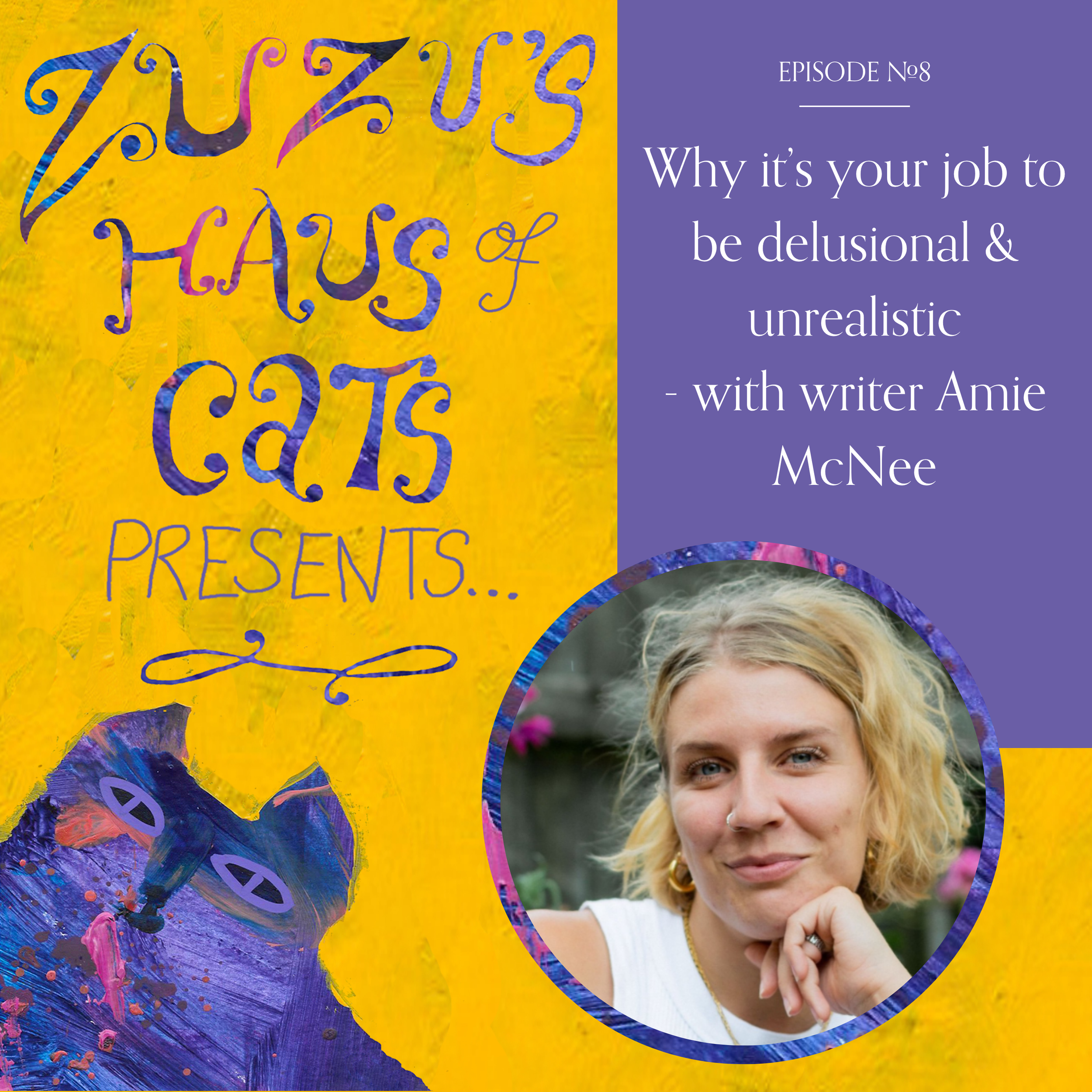
This week's chat is with the absolutely brilliant Amie McNee, author of the brand new book We Need Your Art: Stop Fucking Around And Make Something – which, by the way, is hands down one of the best books on creativity I've ever read. Seriously, I put it down halfway through just to go make some art, which is exactly what you want from a creativity book, isn't it?
Amie is first and foremost a storyteller and fiction writer, but over the past decade she's also developed this beautiful side career championing artists and documenting what it actually means to do the brave thing of making art and putting it out into the world.
We dive deep into so many juicy topics in this conversation. We talk about why creativity is literally your birthright (not something you need to earn or prove you deserve), the relationship between art-making and healing, and why perfectionism is the absolute worst trait an artist can have.
Amie shares her beautifully unromantic approach to creative practice, we nerd out about the brain chemistry of creativity and what art does to our nervous systems, and she shares all the goss about her experience with traditional publishing versus self-publishing.
But perhaps most importantly, we talk about why making art – in any form – is genuinely revolutionary when the world wants you scrolling on your phone instead. Why artists sit at the very centre of making this world a better place, and why we absolutely must be delusional and unrealistic in our creative ambitions.
Listen to the episode here (click the arrow at the bottom right to play), or find it wherever you get your podcasts:
Find out more about Amie:
Amie McNee is a Creativity Coach, Speaker, Podcaster, and Author of We Need Your Art: Stop Fucking Around & Make Something.
Sharing her books, courses, workshops and a dedicated creative community with her partner James, their mission is to dismantle the limiting narrative surrounding creatives so that we may each become the Artists the world needs us to be.
When she’s not writing her books, you’ll find her speaking, teaching and writing love-letters online to creators of all mediums and art-forms.
Visit Amie’s website
Buy Amie’s new book
Find Amie on Instagram
Find Amie on Substack
-
Introduction
Hello and welcome to Zuzu's Haus of Cats Presents. I'm your host, artist Eli Trier, although you can call me Zuzu. And on this podcast, I talk to my fellow artists about the magic of the creative process. We'll talk about what they make and in particular, how they make it. Their rituals and workflows, inspirations and disenchantments, ebbs and flows. We'll even take a peek behind the scenes of their businesses to see how they're using their creativity there too, and how they balance the needs of their business with the needs of their art. If you're interested in getting a behind the scenes look at what makes artists tick and enjoy conversations about art, creativity, neurodivergence and business, then you're in the right place.
Hi everyone, welcome back to Zuzu's Haus of Cats Presents. Today, the Haus of Cats is very proud to present the amazing Amie McNee, who is the author of a brand new book, We Need Your Art, which came out in March and just an all-round champion of the creative cause. Thank you so much for being here, Amie.
Amie: Truly a pleasure. I feel so at home already and I can't wait to have a very juicy conversation.
Eli: Why don't we get started by you introducing yourself and presenting yourself the way you like to be presented?
Guest Introduction
Amie: It's such an interesting one, isn't it, when you're asked to intro yourself? And I've been doing it a lot for this book tour. And it's curious what parts of yourself you want to show. And I've got what I choose to repeat and how I do it differently each time. It's such an interesting thing, but basically the general gist is my name is Amie McNee and I'm first and foremost a storyteller and I write fiction.
And during this journey of telling stories and trying to take up space as a creative, I started documenting the creative process and what it was like to do the very brave thing and make stuff and put stuff out there because I felt incredibly alone on this journey and I was navigating so much anxiety and depression and struggles with doing the brave thing and making and telling stories. And I was like, no one's talking about this.
So over the last decade, I've been recording and talking and discussing with other artists what it means to be an artist. And alongside my storytelling career, I developed this beautiful magical side career of talking about art. And so I've got this book coming out now, it's out right now called We Need Your Art. And it is a manifesto for the creative, a little creative Bible to take care of you and to champion you as you make things.
Eli: And I have to say, I read it over the weekend in preparation for this chat. It's one of the best books on creativity I have ever read. I think I've read all of them.
Amie: That is such a huge compliment. Thank you.
Eli: It's amazing. It was so good that about halfway through I put it down to go and actually make some art.
Amie: That's what you want to hear. I love that.
Eli: So yeah, I've been recommending it to everybody. I was surprised. I wasn't expecting anything new, but you impressed me. It was brilliant.
Amie: Thank you. You know, it's so interesting. There are so many books, well, not so many, but there are books about the creative process. And I know that I share so many themes with the greats like Julia Cameron, and Elizabeth Gilbert and Rick Rubin, but sometimes we just need it from a slightly different perspective, you know. And so it's a real privilege to hear you say that. And I'm so grateful. And I'm so glad you liked it.
Eli: Oh no, it's magnificent. And I think it's interesting, actually, I think possibly because so many of the books about creativity that are sort of out there in the mainstream are written by American authors.
Amie: Very interesting, isn't it? Yeah, there aren't many with a non-American perspective. I'm trying to think of any, like, you know, we've got Austin Kleon. He's at least Canadian. Definitely that sort of region, that arena, I have no idea where he's from actually. Yeah, you're right. And it's a very different culture over there. I just came back from NYC and I do think we need some alternate perspectives from all over the world and creatives harking from all different places.
We Need Your Art!
Eli: So can you tell us a little bit about how the book came to be? How did you find writing it? Was it a different process from your fiction writing?
Amie: Yeah, nonfiction for me is very different to fiction. And I enjoy both thoroughly. But it feels almost like a totally different craft. But I also felt like I'd been preparing to write this book for about a decade. It feels like a culmination and an accumulation of all of the thoughts and ideas and lessons I'd been learning about the creative journey for a whole 10, 11, 12 years. And so I was asked by the publishers to write it, but I'd already sort of been writing it, you know, in pieces for years.
And so they gave me a very short turnaround. I'm not entirely sure why, but I only had three months to write it. And it's, you know, 65, 70,000 word book. So it was tight and I just, I was like, I've been preparing to write it my whole life. I was ready for that challenge and I did it. And yeah, I cried a bit through it. It was hard, definitely. It was also beautiful. And it really, I showed myself what I was capable of.
Eli: That's beautiful. That's really beautiful. Because this is the first book that you've had sort of traditionally published?
Amie: Yeah, it is.
Traditional vs Self-Publishing
Eli: What was that experience like? Do you like it? Or do you prefer having the creative control of self publishing?
Amie: There are definitely pros and cons to both. And I will always self publish, I think. And I would consider going traditional again. It's really lovely to have a team that want your book to do well. It's nice to have just other people with skin in the game, honestly. It feels like it's going to be such a solitary experience to self publish because only you care. And even, you pay editors and you pay people to get on board, but they don't have skin in the game.
So when someone else has bet on you, and that's essentially what the publishing houses do, they bet and they say, we are going to, we want your book to do well. There is something about that and you feel like you have slightly more of a team behind you, which has been really enjoyable.
But yeah, there's been some things that are definitely harder for me. I don't actually, the communication between so many different people is hard. I'm used to being a solitary creative and checking in with people's difficult having their expectations on me, particularly after launch. That's a whole other pressure that's there. And so yeah, it's really different. Both of the processes are different. And both of them definitely have their pros and cons. And I will be doing both.
Eli: That's perfect. I mean, it's all the wonderful thing about being a creative is that you can have all of these different sort of little streams in your portfolio, can't you?
Amie: It's amazing, isn't it? And I think that we get to ask the question, what is going to serve me? And what's going to serve my art? And that's the question we should definitely be asking. And I think, you know, ego and stories about being chosen can get very involved when it comes to like, oh, should I go the traditional route or should I just take up space on my own?
And it's important for me to keep asking the question, is the traditional space still serving me? Is this still worth it? Because it would be very easy to be like, oh, now they've finally picked me and that's what I want to do. I want to go that traditional route because it makes me feel very affirmed. So I just keep coming back to the question, is it still serving me and my art? And if it is, then we can keep going. But if it ever stops, then I want to take fully back the reins.
Eli: Yeah, absolutely. Were there any major compromises that you had to make that made you uncomfortable or anything that you wish hadn't happened? I'm being really nosy now.
Amie: No, not at all. I love to talk about it. And I really want to be incredibly transparent. Because I think authors can get very secretive about these processes. And I think it's because they feel a great deal of pressure to be quiet by publishers. And it happens in the music industry, acting industry, in the fine arts, you can feel pressure coming from top down. So it's definitely my intention to be very transparent.
There was a lot around my swearing that we had to navigate. And they were very respectful about that.
Eli: I loved your footnote that every time you read the word screwed, I'm actually saying fuck.
Amie: I was like, if we're going to take all the f bombs out, then I demand a footnote that explains that that's what's happened. And so, yeah, that was interesting. And then the US market and the Aussie market wouldn't have fucking around and make something on the front. Thank fuck the UK guys had it. They allowed me, I know. So I've got at least one copy with the word fuck on the front, which is important to me.
So the swearing was there, there was other stuff like we had to be very careful about the criticism of Amazon. That was less about the publishers. It was more that, you know, historically Amazon have taken away the buy button of books that are critical of them, you know, which is fucking insane. But they were like, this is the reality. So we need to be careful about being brazenly anti-Amazon in your book. So that again was very interesting. I mean, if I had self-pubbed it, it would have probably been a similar situation because if it was on Amazon and they figured out that I was shitting on Amazon, they could have, they have the power to do whatever they want.
Eli: Awful. Yeah, a true, I think a lot of us don't truly understand how bad the situation with Amazon is. It's truly scary.
Amie: But yeah, so there were a few things like that. And then communication wise, it was very difficult. I think, you know, it's a debut book for me. So I didn't fully understand a lot of what I needed to do to show up with them. There was lots of communication errors. Expectation wise, there was a lot of things that needed to be more explicit from the publishers to me. I've had a really hard time.
So I have worked with a lot of authors and I know the state of the publishing industry and I know it's in shambles. And so I was ready to be disappointed by them. But there were still things that got me, even though I was the most prepared author that has ever been. My book is very hard to find in US and UK bookshops. And I needed them to tell me that. Because on my book launch day, I went to all the bookstores and I was like, I'm going to go sign books. They weren't in any of them.
Eli: Oh my God, that's awful. Why not?
Amie: And I asked them, I said, I need you to explain to me why and they didn't have a good answer. I don't know if the sales team struggled to get We Need Your Art in bookstores. I honestly don't know. They told me that, you know, Amazon and the big online stores is really where it's at these days. But I'm like in these bookstores and I'm like, well, there are a lot of books in here. Why aren't my books in here?
Yeah, that was a really hard morning for me. My little inner child was like, oh, and again, that was just an expectation that needed to be told. Yeah, it was really sad. And I felt so vulnerable. I was like this book launch day and I went around to three or four bookstores and they were like, No, we don't have it. I'm like, do you have to order it in? No. You know, so that was just that little Amie I was just like, so I spoke to my publishers about that. And I was like, you need to be telling authors what to expect when it comes to bookstores because especially as a self-published author. The one big difference I thought for being traditionally published is that it will be in bookstores because it's very hard to get self-pubbed in physical bookstores. So I was very excited for that.
So yeah, I felt like part of my job was to talk to publishers and say, what's not working? And so I had a good conversation and I said, you need to tell authors about this because otherwise they're just going around and their little hearts are going to break.
Eli: Oh, my heart goes out to you. I can literally feel the disappointment in that.
Amie: I had my photographer because I was in New York for my book launch day and I had my photographer come around and I was like, can you take photos of me signing books? Oh, I just you know, the vulnerability of being an artist doesn't go away.
Eli: No, no, it's always brutal. It's always brutal.
Creativity as a Birthright
Eli: Shifting gears from your sort of publishing experience, you talk a lot about the idea of sort of creativity as a birthright. When did you first kind of realise this? When did you recognise this as truth sort of for yourself in your own life?
Amie: I kept trying to validate my right to create because I felt so undeserving of a life filled with art. And it was years and years of what can I do to deserve a life full of art? How can I prove that I'm worth creativity? How can I prove that I'm worth devoting myself to these stories? And it felt so wrong for so many years. And I thought it was because I didn't deserve it, but it's because I didn't realise that the right to make art is granted at birth. It's a human right. that is granted immediately. And you don't need to fight for it. You don't need to explain it. You don't need to tell people why you're allowed to do it. It is your right immediately.
And once I think it was because I didn't get it so much that I suddenly had to have this realisation that this fight, this desperate, trying to prove myself worthy of the creation act was never going to get me anywhere because I had it already from the very beginning.
Eli: I love that. It's so often the things that are the hardest to learn that end up being the kind of the core of what you teach.
Amie: Totally. 100% my whole life is just every all my core messages are all the things I absolutely sucked at and did not understand.
Showing the Process
Eli: I think we also have this really elitist attitude to artists and I do a lot of sketchbook tours and things on YouTube. And I always have to caveat it with like, don't expect a finished polished thing. This is my working document. This is where I make messes and I'm trying new things. So most of it sucks.
Amie: Oh, you are so fucking generous to let us witness you in that. No, so few artists let us see people in that, in that sucking phase and I want more and more of us to do it. I love that you do that.
Eli: Yeah, I think it's so important. It's so important, particularly on the internet, particularly in this kind of age of Instagram where everything is perfect and curated and you're only supposed to show the best of what you do. The best of what I do comes out once or twice a year and the rest of it is just scrabbling around in the mud, figuring shit out, you know?
Amie: I love that. I just, I put you up there right now. That is just the fucking coolest thing. And I love that. And I want all of us to do that. I'm already thinking I need to go find my worst written sentences and put them out there in the world, you know, it's such a beautiful thing to share your shitty art.
Eli: It's so important. It's so important. Because I can tell from the comments, people are just like, Oh, my god, I've never seen anything like this before. Thank you for sharing this. I'm so worried about working in my sketchbook, because I know I'm not good enough yet. For fuck's sake, it's a playground.
Amie: Oh, my god, yes. I love visual art. I do play around with it a little bit, but that's not where I spend most of my time. But when I speak to visual artists, there does seem to be a huge amount of worry about wasting materials, which is interesting because as a writer, we have this blessing of the backspace button, you know? So interesting, yeah. How do you find your relationship to materials and what feels like waste? Do you see that in the community a bit?
Eli: Yeah, absolutely. Like you don't want to use the good stuff. Yeah. My attitude is like this is tools for making art. Even if what comes out the other end is absolutely shit, A, I've probably learned something and B, I've had a great time.
Amie: My God, the value. I think we're so used to looking at art as having value in only one or two ways. And that is the quality of the outcome. And also does it have monetary value? But we don't understand the huge amount of other sorts of value that art gives us in the process of making it. And there's so much experiential value that's happened, even if the end product is fucking terrible.
Eli: One of the things that I love about materials is that I find it to be like a sensory stimming experience, using, you know, particular kinds of paint or pastels or something like that. I find just the physical sensations of that really exciting and delicious and lovely.
Amie: My God, look, that's another type of value. And I love that. I understand what you mean. I just got new pens and God, yeah, they're delicious. The feel of them. So cool. So I mean, the process, especially when we are doing more physical painting, crafting. Yeah, there's such a sensory value there. It's so beautiful and not spoken about enough.
Art and Neuroscience
Eli: One of the things that I really liked in your book was the way that you pulled out the research about what creativity does to your brain chemistry. And that's something I've been really nerding out about lately and how cool just absorbing art has an actual biochemical effect on your neurochemistry.
Amie: It's so cool. No one's talking about it enough. We're so fucking obsessed with what ice baths are doing to our inflammation levels. Why are we talking about what art is doing to our inflammation levels because they're dropping them, you know, and it's so exciting. But I don't know, Andrew Huberman and the wellness crowd, they're just not about it, apparently, but they should be consuming and making art. It's the missing pillar of self development, without a doubt.
Eli: It really is. Absolutely.
Art and Healing
Eli: Which leads me on to my next question very nicely. In your experience, what's the relationship between making art and healing personal wounds? I know that journaling for you was a catalyst for you sort of healing, doing a lot of self healing and coming to art. I don't know if you consider journaling as art, but it's writing.
Amie: I do, It's an excavation process, which is so important to creativity. Yeah, I think this is actually why a lot of people avoid art is because it demands healing. And it helps healing and it supports healing, but it also demands it. And I do think that when we commit to our creativity, we start seeing things that are broken within us and they become so apparent and our fear becomes so apparent and our internal voices become so apparent. And you just have to look at all the shit that's not quite right.
And so art is an invitation to do profound healing. But for many, I think people see it as just a revealing of our trauma and a revealing of our pain. And it's whether you just want to see art as something that reveals pain or an opportunity to heal pain. And it will and it can. And we see the research, it can be profoundly transformative and healing for us both emotionally and physically. But for a lot of people, I think it's so confronting because when we do decide to write a book or when we do decide to put pen to paper or, you know, start knitting. We see stuff, we see stuff internally, and that can be very difficult. And that's why a lot of people just run away.
Eli: Yeah, absolutely. So say more about that, please. Where does the healing come? What do you have to bear in mind when you're presented with this revealing of the pain? What kind of mindset do you need to have? What tools can you use to then use that to take the next step into the healing?
Amie: Yeah, beautiful question. I'll speak to just my journey. I think all of us are going to navigate this differently. And I think all of us have a slightly different experience with how art intersects with our own stories and pain.
For me, I felt like art did something to my central nervous system. And there was almost an unspeakable, not quite explainable way in which when I'm writing stories, my body lets go and my body releases and I come down into a very restored state that I couldn't get myself in no matter how hard I fucking tried. And I have a real disconnect and I'm still really working on it between my mental state and my physiological state. I'll feel absolutely fine and dandy up here in my brain. And my body is like, we are at war.
And art, I think there's something unconscious about the creative act. There's something about what art does to our brains and to our bodies that allows my body to kind of get on the same level as my cognitive thoughts. And we see that all the time. It is a mechanism to regulate, which is so beautiful, so unbelievably beautiful.
But I think before I've been using my words and my writing my painting to regulate my body, you know, I did hear a lot of inner critic stuff, and it brought up a lot of resistance. And I had to face the fact that I had the most rude, cruel, inner critic ever. And so I had to listen to these thoughts as I created and wrote and she was saying the meanest fucking shit, you know, she was brutal. You're not worth it. Why are you doing this? You're so childlike. Can you just grow up? This is so shit. Why are you, why are you wasting your time? Just nonstop chatter.
And I could have either looked at that and thought, well, I believe her. I listened to her and I give up. I don't want to do this anymore. Or what I did was I learned how to take care of that voice. And art demanded that of me. If I wanted to keep telling stories, and I did, I was going to have to figure out a way to take care of the voice who was obviously very afraid every single time I wrote a sentence on that page. And I did that mostly through journaling. And I rewrote that internal monologue literally by writing a new internal monologue on the pages of my journal. And so I always listen to the scared voice inside my head, but then I now I always have a response.
Eli: I love that. And I think there's so much your gut reaction to when you hear those voices just to kind of squash them down or tell them, oh, yeah, they're the enemy. And I think letting them have their voice, but also, you know, having a rational conversation with them, I suppose.
Amie: I just get down on their little level, you know. I mean, this is, you know, I talk about it a lot, but I mothered them. And I get down onto my knees and I'm like, Oh, no, what's wrong? I just treat myself like a child. Oh, you think you're really shit and you think you're a fucking lazy piece of whatever. I'm like, Oh, are you feeling scared? Oh, and it's just that very gentle. What are you afraid of? Oh, my God, I totally understand. Okay, well, what's happening here? What would make you feel more safe? I just talked back to it as though she's an eight year old who's fucking losing her mind.
Eli: I love that. I love that. And it takes all the power out of it. It's not something that is then controlling you. You have agency in that moment, which I think is really important.
Amie: So beautiful. And then we can keep doing what we want, need to do, which is make art. But it is hard. And I think a lot of us come face to face with our inner critic and think that they are the truth bearer, that they have something important to say, and that that means that we should stop. But art is an invitation to look at the narratives that are keeping us small.
Eli: Yeah. Yeah, I really appreciate that. And I have to say, from a sensory perspective, art is the best anti anxiety thing I have ever come across, better than meditation, better than anything. It's just, yeah.
Amie: I mean, again, the research behind it is just delicious, isn't it? I love that you're nerdy about it too.
Art in Fight or Flight
Amie: I'd be interested what you think of this, because I have spoken about this before, and it gets a lot of backlash. And I almost don't know where I'm sitting on it at the moment. But because I'm someone who has bad anxiety, I have OCD and I used to have panic attacks. And I wrote one day and I wrote one of my little classic Amie signs and it said, it's fucking hard to create in fight or flight. And because in my panic attacks, in my moments of acute anxiety, it was very hard for me to get into a place where I could create. It was too heightened, too stimulated. But a lot of the people who consumed that message was like, no, I need art to come down from that heightened state.
And it's an interesting conversation, because what I was trying to say is we need to regulate our nervous systems in order to create art. But what a lot of other people were saying was, no, don't say that because I got a very angry response, which I thought was interesting in itself. They were saying, I use art to come down from up there. And I'm wondering if it's just a personal perspective. I think my problem is, if I'm having a panic attack, you can't get me to do shit. And that I need a tool to get down to a certain state before I create. But it's an interesting conversation.
Eli: Yeah, and I think people on the internet are very keen to see things completely in black and white. Yeah, no nuance, no nuance at all. And I think it depends on the person. But I think it also depends on the situation. If you are in a prolonged period of survival mode, where your nervous system doesn't know which way is up. it's very difficult to create anything meaningful. But it might be doing some colour swatching or playing with materials or something is a soothing thing that will calm you down. You're probably not going to create your next magnum opus in that. But just dipping your toe in or something or having something that just brings you down that tiny bit next level maybe is something that's useful.
Eli: Yeah, interesting conversation. Yeah, but I think when you're in the middle of a panic attack, no, absolutely not. you can't, you can't do anything you can barely breathe.
Amie: Yeah, exactly. I'm like, I can't be writing novels. I'm like, I can't see I'm crying too hard. Yeah, it's very interesting. I think where I was trying to go with the idea was looking at how many of us are in survival mode right now, and how incredibly challenging it is to have creative abundance in survival mode. And so I was thinking about how we needed collectively to find ways to regulate in order for us to have art. But I think, you know, ironically, art may be a part of the process of regulation.
Eli: Absolutely. And maybe it's consuming other art.
Amie: Yeah, the consumption, because so much of the research is about the consumption of art, not just the creation of art and what that can do for us.
Eli: I love that. Yeah, yeah. Look, at a beautiful painting or listening to a beautiful piece of music or escaping into a favourite novel or all of that helps you regulate, although regulate feels like a very sort of linear masculine sort of...
Amie: Yeah, befriending the system. Yes, I love that. Yeah, really interesting. Yeah, the research around consumption of art really intrigues me as well, because it reminds me and it reminds all artists that, yes, the creation process is important. But also when you share your art, you are doing a huge service to other people. Because people need art in order to thrive, they need to consume art in order to thrive.
Eli: Yeah, absolutely. Absolutely.
Art's Role in Revolution
Eli: I'm absolutely thrilled that we're getting to have this conversation because it's so important, particularly at this particular sort of the juncture that we're at globally. What do you think the role of art is in the revolution, in our current social and political climate globally? Where does art, both creating and the consumption of, where does it stand? What's its role?
Amie: At the dead center of what's happening and how we're going to move out of this. And I think a lot of people, because of the global apathy we are feeling right now, are opting out and saying there's nothing to be done. And it is the artist's role to say there is much to be done and we are going to dare to create and make and use our voices and make impact and take up space right now in a world that just wants to be on their phones and consume and be depressed and be hopeless. The artist is so the job of the artist, it's not the job. because it happens without even trying. If we make art, we are hopeful. Making art is a hopeful act and that's exactly what we need right now.
And I think it's very easy to think that this is not a time for art. This is not a time for creativity. Why should I be doing knitting projects when everything is really bad? And there's never been more of a time for knitting projects than right now. And I think I really, I feel very strongly about this message at the moment because I'm seeing more and more artists say, what's the point? And I'm like, this is... There's never been more point. There's such a huge need for artists to create when the world is on fire.
Amie: Yeah. And because it regulates us, because it regulates those around us, because we get to design, we get to create a world that we want rather than just accepting what is happening to our world, because it gives us agency and purpose in a world that seems to be existentially depressed and has no vision. Artists have vision. We have desire, we have momentum and we want to move forward. And so I truly think that we're all going to have different, unique ways in which we are part of this revolution as an artist, but artists and creatives sit at the centre of making this world a better place right now.
Eli: Preach sister, I love it. To the barricades. Amen. Yeah, absolutely. I agree with you. Art is the revolution as far as I'm concerned.
Amie: Yeah, agreed. You know, Zuckerberg and these billionaires would much rather you spend your 30 minutes that you have in the evening without your kids scrolling. So when you knit or when you craft or when you take that time to, I don't know, read your book that's fucking revolutionary. And it's outrageous that it's revolutionary, but it is. It's a form of rebellion. And I want you to claim it. And I want you to understand when you're doing your colouring in at 9:30 p.m., that Zuckerberg's a bit upset about it. And that's a good thing.
Eli: Yeah, they're not making any money off you if you’re doing your own thing and making your own art.
The Biggest Myth About Creativity
Eli: So if there's one thing that comes up or has come up in all of your years of doing this, what's the one myth about creativity that keeps people from making their art? What is it? And what would you say to that?
Amie: Delicious question, Eli. I'm going to say that perfectionism is an OK trait for an artist to have. because I see it all the time and I can sniff out perfectionism within seconds. All the artists don't even have to open their mouth. I'm like, you don't make enough shit art. I think that it's the one excusable sin for the creative and it isn't it is the worst and it will cock block you from all sorts of joy and creative mastery and creative abundance.
But artists think it's okay to have extremely high standards for themselves. I think it's okay to demand excellence from themselves every day. And I'm not saying, and I don't believe in a culture that doesn't ask for excellence. I love excellence and I love mastery and I love the pursuit of greatness. And I love when I see an artist who's just hungry. I'm like, this is so exciting. I'm so excited to see what you want to do with your life and with your art, but are you making mess along the way? Mess is mandatory. You have to fuck it up. You have to fail so often. You have to mess it up. You have to hate stuff you make all the time. There's no graduation from this.
And I see artists who kind of get it, but then they think that they should have moved on from it by now. I'm like, no, this is it. This is it forever. This is forever, baby. You never stop doing this. Because if you want to be brilliant, it demands crap.
Yeah, and I think even though I think a lot of artists have heard that before, it takes, they often think, oh, but not for me. I understand that makes sense, but not for me. Yeah, and it's just, yeah, I have to be better. And there's a huge amount of pain and trauma behind that. A lot of us have been told that we need to be perfect in order to be loved. And so again, this is one of the things that's like, wow, I'm creating art and now I have to deal with all my parental trauma. Yeah, unfortunately, you do. It doesn't seem fair, does it? It does. It's a lot. It's a lot.
Eli: Yeah, perfectionism is brutal. And it's so antithetical to making great art, ironically, to achieving excellence or mastery or anything.
Amie: Oh, my God. And I just I don't think people believe me when I say it. And I think, you know, we get a lot of very well known artists who they trick us, I think, into thinking that their journey has been one of just demanding perfection and reaching perfection. And it's not true. And we are not seeing the whole picture. And I think even if you are someone, an artist who has succeeded by having extremely high standards, I can guarantee you they fucking hate their life. It isn't fun. It's not maybe you can squeeze success out of it. Maybe. But first of all, you've missed a lot of your potential. And second of all, you're not having a good time. And if you're doing something perfectly every single time, you're not pushing yourself. You're not evolving.
Hope for the Future of Art
Eli: So what gives you hope about the future of art, the future of creative expression? Are you seeing any kind of sea changes? Is there anything that you hope is going to happen?
Amie: It's very hard to squash the artist out of humanity. You know, and even as we look down the barrel of this AI revolution, and it can feel very scary, you just can't truly stop us from having this urge to create. And I think as we see people trying to squash the artist, not just with AI, but with, you know, so many different mechanisms, this culture tries to keep artists small and undervalued. But as we see them squish us more and more, I think you can almost feel the fire of us more acutely.
And, you know, I was at my London book launch event last night. These artists have got something to fucking give and you can feel it. And I have so much faith that we're going to take up space and that we're going to fight for what is our birthright and for what it is we need as a culture. And so even though it does feel dire, I think at many times, I want it to make you thrive.
Someone asked me the other day, how did you deal with so much rejection? Because I've been rejected a lot. And I was like, a little bit it was because every time someone told me no, I got a tiny bit stronger. I got a tiny bit like, well, fuck you. And that's the kind of energy I want for artists now. Every time someone says no, every time someone says, AI is going to be the next big thing every time someone says, it's better to just stay quiet and compliant and be on your phone. I want you to say no, and get a tiny bit stronger.
Eli: I like that. I like that. Yeah. Rejection is, it's galvanising in a way. I mean, it also can be a tool. It definitely can be a tool. And I always feel like if you're getting rejected a lot, that means you're in the fucking arena. If you're not getting anything, you're not doing anything.
Amie: Oh my God. As soon as I sniff out a little bit of perfectionism to two things I ask is when was the last bad thing you made? And when was the last time you were rejected? Because if it wasn't in the last week, you're not doing the work.
Eli: Yeah, absolutely. Absolutely. But it does. I think every single time you get rejected, it turns you a little bit more I'm trying to articulate this in the right way, but it gives you a little bit more of yourself and a little bit less of the external validation. Does that make sense?
Amie: Love. Every time you're rejected, it's an invitation to pick yourself. Yeah. Yeah, that's true. But it's kind of not what you're saying. I like what you're saying almost more like you're like, it's saying, yeah, I don't know, you're getting somewhere with that. Keep thinking about it.
Amie: Yeah. Yeah. And the problem is, is that, you know, it's an invitation to pick yourself, but there's also an invitation there to think less of yourself and to think that you are not worthy. And there's a real two doors you can go down there when you're rejected. And that's not to say you need thick skin, I'm very anti-thick skin. I want soft artists and I want to fiercely defend the softness and vulnerability of artists everywhere. When I get rejected, I am very upset all the time. It's heartbreaking. Yeah. I will cry and I will feel sad for myself. And I protect that softness so much. But then after I cry, I'm like, fuck you. Just like. And I think it's a little bit of that both allowing yourself to grieve it. But then instead of choosing to believe that they had the answer and that they knew that you didn't have it, to instead believe that you get to pick yourself and that you have something incredibly important to give and fuck them, let's go.
Eli: Yeah. Do you know the artist Ashley Longshore?
Amie: I don't, should I?
Eli: Yeah, she's my absolute hero of picking yourself. Oh. She's a painter. She was rejected by every single commercial gallery that she pitched to for being not commercial enough. And she now runs a multi million pound empire. She has celebrity clients. She's worked with Gucci, Diane von Furstenberg, all of these high end fashion brands. She has her own gallery in New York City, which I love to hear it.
Amie: She's an absolute legend. We need to see these people everywhere. And we need to understand that true, beautiful, joyful success can come through picking yourself because I think there's been a story that has been fed to us. And if I do be so cynical, I think it's been fed to us for a reason to keep us quiet. But picking yourself is a really fucking good financial decision.
Eli: Yeah, it's a good business decision. Yeah, and it's very hard. And you know, there's a lot of work, but it's a very valid way to do this.
Creative Process and Workflows
Eli: So this is a podcast about the creative process, yours and what you're encouraging other people to do. So I would like to shift gears a little bit and talk a little bit more about how you make your art. So do you have any sort of rituals or specific workflows around your art making? Do you kind of get into that space?
Amie: So I have whole chapter on how I'm deeply unromantic about my creative practice. And it's because whilst I love romance in my life and I do romanticise basically everything, I'm fully delusional. I found that having a lot of stories about how I could create and what was the best conditions for me to create was leaning very closely towards perfectionism. So I write 300 to 500 words every weekday and that's it.
Eli: That's amazing.
Amie: And yeah, I don't know what else to say. There's no I mean, there's no rhyme or I mean, I do it in the morning, because I like to put it first so that it shows that this is a priority in my day. But that's about it.
Eli: Do you do that before or after you do your daily journaling?
Amie: I journal first. Journal first, check in with myself, then I write and then whatever the day does after that. Whatever, I've done the two most important things.
Eli: I love that. That's so good. It's so pragmatic.
Amie: It's so pragmatic. I think it puts people off, you know, I do wonder, I think about, you know, Rick Rubin's book, which is so ethereal and so, you know, spiritual. And then I'm just, I just pared it all back. And I think, you know, I love the idea of and it is something very spiritual and holy about the creative act. But I also think that when we deify it too much, we forget that this is a very, very human act that should be messy, and it should be imperfect. And sometimes you're going to have really, really bad ideas. And sometimes you're going to miss things. And it's I don't know, I love the humanness of art. And I want to bring it back down to that earth, gritty, let's just fucking do it because it's important.
Eli: I love that. I love that. And I mean, in a way, that is a ritual that is a workflow. You do your words.
Amie: Perfect.
Balancing Art and Business
Eli: So I know that you're not just writing, you also have a business that you run with your with your husband, who sounds amazing, by the way.
Amie: He's a lovely boy. He has really been on form lately with this book. I've just basically like, toddler that he ushers around and feeds.
Eli: Hurrah for husband carers who take to make sure we eat right! My husband said it's like owning an exotic pet. Yes, very high maintenance. High maintenance. Artists can be very temperamental.
Amie: So, I mean, we built this business around creativity, really. And I think we've kind of treated our careers as authors as businesses, which I think, again, is I don't think a lot of us do that and understanding ourselves as artists as business, but it's been really great for me. And to me, business is an art. But yeah, we've built around, we've got beautiful creative membership where we have, we meet with creatives every week. We've made some beautiful courses to support artists, but it's been a big and beautiful journey, just taking one little curious baby step at a time. And this beautiful thing has bloomed out of that.
Eli: How do you manage to balance your time then? What is a typical sort of day or week look like for you? Because I know that you're also struggling with, you know, various physical and mental complications. Things a little bit more difficult.
Amie: Yes. You know, when anyone asks me about my days, I'm like, I don't know. And I'm not sure if this is because I have ADHD and I have a memory retention situation happening. I don't know. I don't know how I do it, Eli. You know, my to do list was so long. the beginning of the week and then if I look at it right now everything's crossed off and I'm like when who how did that happen? The work few yes. Do I have some sort of goblin that I put to work?
I think it's something about my neurodivergency definitely and that I can kind of switch off and I feel like I'm almost in some sort of unconscious state a lot of the time, but because I front end my work with I journal and then I write. that's the important parts done. And then I end up having a movable day in terms of, okay, so what needs to be done? And then I have a few anchor points. So I always make sure I move my body. But that's only because of James. He just ushers me into the car and takes me to the gym and then says, you need to do a bicep curl. I'm like, okay, got big arms now, thanks to James.
But I think it's yeah, it's very day to day in terms of what needs to be done. And I think I have a neurodivergent brain that really works with that because it's very different stimuli. And that really keeps me alive and keeps me excited. But honestly, if I'm being very honest, I have no idea.
Eli: That's the most beautifully honest answer I think I've ever had. It's brilliant. I love that. So I mean, I think you've kind of already answered this, but how do you balance your sort of creative needs with what your business needs? Because you know, as an artist entrepreneur, there are things that needs your attention at various different times. And I know that you're front loading your writing, but there's also there's a whole bunch of other stuff that goes along with supporting that. Yeah. And then your business still needs attention as well.
Amie: I don't know. I mean, I've been doing this now for quite seriously since 2019. So we're six years in. And I think I've just found rhythms and I'll be out of integrity and out of balance sometimes. And I just feel it. I'm like there is and right now I'm a bit out of balance. But I understand that that's because I'm doing this book tour. But I have a very, and me and James have been talking about this a lot. I think a lot of artists are incredibly sensitive to balance and being out of integrity. And when something's just, not giving enough time to this, you're not giving enough time to that. I'm like a very finely tuned instrument. And James is even more finely tuned. As soon as James is out of balance, you will know about it.
But I think it's difficult, but it's also very beautiful because you can keep readjusting, keep doing tiny little pivots. And so I feel like a super malleable life that we're constantly just rearranging, with one degree turns, very, very small turns every day. But right now I'm doing way too many emails, there's too much communication. But that's what my business demands of me right now, because we're doing very logistical things with the book tour.
Eli: Yeah, absolutely. And I think it's often, I mean, obviously, I'm neurodivergent myself, I'm autistic, I have ADHD, I speak to a lot of neurodivergent people. And this idea of the sort of movable feast of workflow comes up so often. And I think that's really interesting. You have, like you say, you have your anchor points throughout the day, throughout the week, your the things that absolutely have to get done. And then everything else is around it.
Amie: It's I have such a workflow. And because I can trust myself to follow through on everything. Yeah. I think that's why I'm allowed a fluid workflow, I trust myself. I know I'll get everything done, something will slip through cracks. In fact, you know what, I'm just going to put something on my to do list right now because as soon as I said that I was like, oh my God, I have not done that. But mostly, you know, I can pretty much trust myself that what needs to be done will be done. So I'm allowed to be fluid with it.
And I speak to a lot of ADHD creators and I've only been newly diagnosed. So this is still new for me. Ironically, I was working with a lot of neurodiverse creatives through most of my career not understanding that I was also neurodiverse.
Eli: Oh, we flock together.
Amie: And when I got diagnosed, everyone was like, yeah, we know. But a lot of especially creators with ADD ADHD asking me what routines they want to know my routines, they want to know the hacks and I'm like, I don't know what I do. And I don't think there's any hack here. There is that just like, there's self trust. And then there's that fluidity that really serves me. And might not be for everyone, but for me, it really works.
Eli: I think the self trust really is the key there. Knowing, having faith in yourself that if you say that you want to do something, it will either get done or will you will choose that actually you don't want to do it.
Amie: Exactly. Oh, yeah, yeah. Sometimes stuff goes off the list because I'm like, well, I guess it wasn't as important as I thought it was. But knowing that it leaves the list, not because I'm being negligent or not because I'm betraying myself, but because I trust myself. And I've decided that is genuinely not as important as I first believed. Yeah. And building that self trust has been hard because I was someone who chronically avoided my art, but it's happened slowly over years and now I fully trust myself. And this is the proof over years and years and years. It's proof.
Amie: Yeah, it's just proof. You build that a little bit more. And in the book, I do the two week research, which is this idea of getting that consistent practice, which is tiny promises that you can absolutely follow through on. And what I'm basically asking you to do is I'm asking you to trust yourself again. And the way we do that is by following through on really, really small asks.
Eli: Yeah, I really appreciated that. And I also love the way you framed it as not so much getting things done, as just reaffirming your identity as an artist.
Amie: Yes. I thought that was a really valuable thing. It's just we get so finicky about the word artist or the word writer or the word painter. And it's like, all right, here's two weeks. We'll just prove it to that little gremlin in your mind who absolutely won't believe you that you absolutely are one. And I mean, I speak to artists who are, you know, really successful at the peak of their careers. And they're all the amount of times that I hear oh, but I'm not a real artist because I don't do, you know, X, Y, Z. It's like, this is ridiculous. What is happening? What are we doing this to each other?
It's so funny. I mean, I think you spoke about elitism at the beginning, especially in the art world, there is so much elitism. And the word artist has been pedestaled, but for too long, baby, that's our word. That's our human word. And it should be yours to claim and it is yours to claim if you are so brave.
Eli: Yeah. If you make art, you're an artist. If you write, it's so fucking simple. Just a verb.
Amie: Yeah. That's such a great way to say it. Yeah.
Final Advice: Be Delusional
Eli: So our final question, and I think you probably have so much to say about this that you have already said, but what's the one piece of advice that you would give to aspiring artists. And I want to say the thing that the most important thing that I have gotten from you and from absorbing your work and that I repeat to myself almost on a daily basis is the idea that you have to be delusional.
Amie: The juicy one, isn't it? Because that's the narrative that plays in my head. I have huge ambitions. I'm doing all of this crazy, amazing stuff that I love. And sometimes I'm like, Oh my God, am I just delusional? Am I just and we love that important. And every time your voice comes into my head saying, No, you have to be delusional. Being delusional is how you get there. And it's just it saved my ass on so many times. So thank you, Eli, you answered the question.
I love that one, We need to be unrealistic. We need to be delusional. That's the artist's job. And I think when we spoke about why is it the artist's job to be in the center of this revolution, it's because we are delusional. We're insane. We are about being unrealistic because we don't want anything to do with reality. We want more than reality. And that is why we are so powerful and so potent. And I think a lot of artists are constantly told to rein it in and it just squishes us. Be realistic. It's ridiculous. I need everyone to lean very hard into delusion. I need everyone to be deeply unrealistic. And I need you to understand that you're the artist and you're the one who can make the unrealistic very realistic. And that's our incredible power. And you have that power within you.
Eli: Yeah. We're the world makers.
Amie: Amen. Love that.
Closing
Eli: Thank you so much, Amie. This was such an exciting conversation. I can't wait to share it with people.
Amie: It was. Thank you. You shine. I love your cat that's been sitting on your shoulder this whole entire call. And I'm just, yeah, very, very grateful, delicious. I said it was going to be a juicy conversation and it was.
Eli: Absolutely, yeah, we nailed it. So where can people find you if they're interested in finding out more about you and what you're doing in the world, where can they come and find you on the internet?
Amie: All right, I'm quite all over the internet, if I'm going to be honest. So you can find me on Instagram, at inspired to write. You can find me on substack at Amie McNee. You can find me on my website at amiemcnee.com. You can basically just Google my name and you'll find me in an array of different places. But We Need Your Art is out basically everywhere. Not at most bookshops. Although you can go to your bookshop and demand that they get it in for you. And you know what, that is such a blessing. So if you feel like pottering down to your independent bookstore and saying, I would like a copy of We Need Your Art, that would be both a blessing to the indie bookstore and to Amie and to you, hopefully, because this book is intended to take incredible care of you as you do the brave thing.
Eli: It's a wonderful book. I highly, highly recommend it.
Amie: Thank you, Eli.
Eli: Oh, my God. Amie is just such an inspiring human, and I so appreciate the work that she's doing in the world for all of us artists and creatives out there. Do go and find her book. And of course, all of Amie's links and a transcript of this episode and a whole bunch of other stuff you can find in this show notes at Zuzu's Haus of Cats. That's Haus H-A-U-S dot com forward slash podcast. So don't forget to go and check those out. And thank you so much for listening and I will see you next time.
Where next?
Back to the podcast page
Visit the Salon
Sign up to get new episodes straight to your box