Ep #11: Patterns, performance, & painting the vibes - with artist Kyla Yager
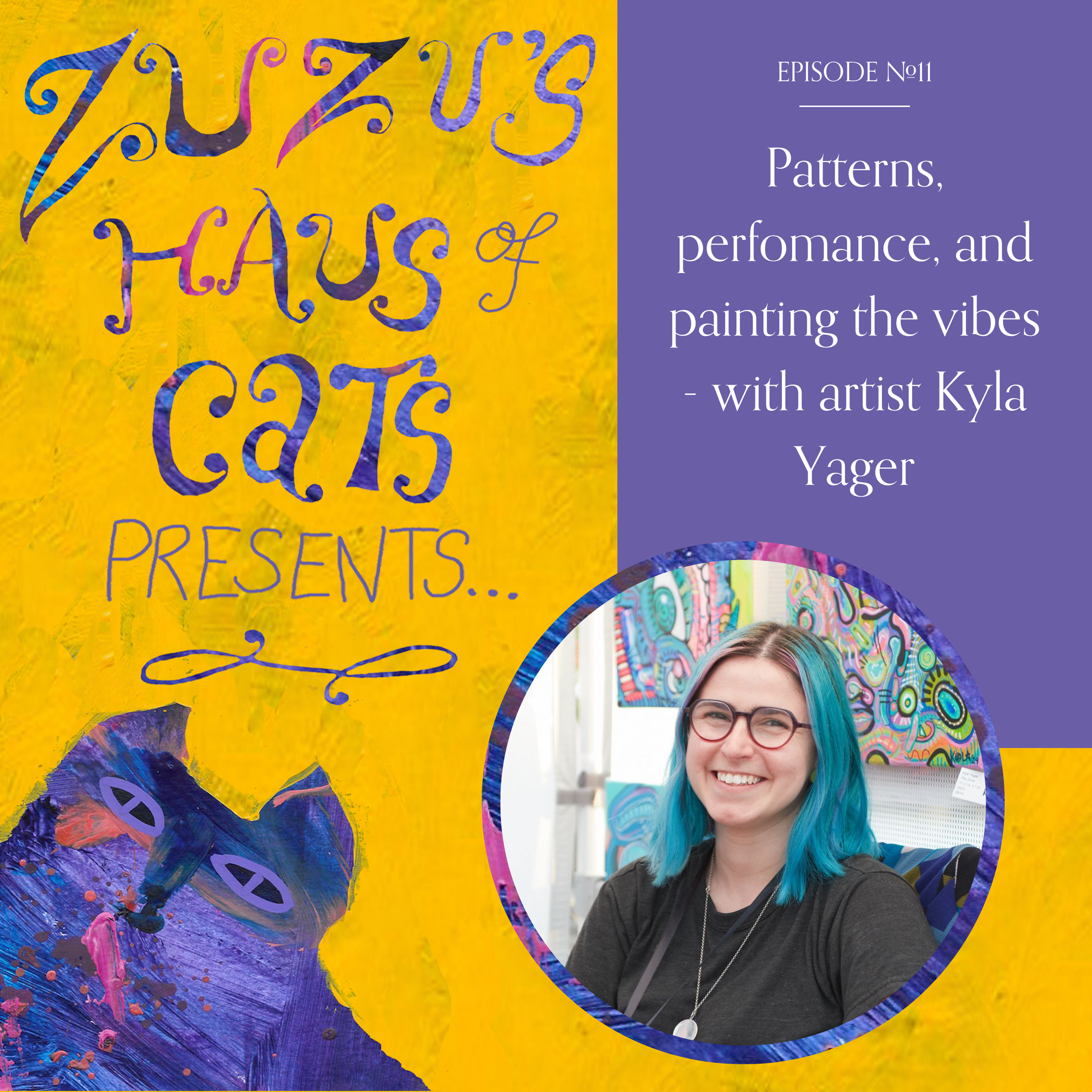
In this episode, I sit down with the incredible Kyla Yager, a Toronto-based artist who has turned her ADHD into her creative superpower.
Kyla creates what she calls "intuitive ADHD art" - maximalist, pattern-rich paintings that capture the energy and emotion of the moment. Her work is a celebration of neurodivergent experience, transforming the hyperactivity of her mind into stunning visual expressions that invite others to unmask and connect with their own authentic selves.
Kyla shares how her artistic evolution mirrors her journey of unmasking her neurodivergence - from hyperrealistic portraits in her youth to the explosive, pattern-filled canvases she creates today. One of the most fascinating aspects of Kyla's practice is her love of live painting and speed competitions. She describes the rush of creating in front of audiences, how she channels the energy of a room into her work, and why performing whilst painting makes her feel most alive.
We explore Kyla's belief that art speaks louder than words and how she uses her practice as both personal therapy and a tool for connecting with others. Her work creates safe spaces for people to explore their own emotions and experiences of otherness.
Mentioned in the episode:
Lewis Rossignol’s artwork
Kyla’s ADHD Menu printable
Listen to the episode here (click the arrow at the bottom right to play), or find it wherever you get your podcasts:
Find out more about Kyla:
Kyla is a Toronto based, New Orleans bred, full-time Artist who utilizes her ADHD, emotions, and mindset to intuitively guide her paintbrush. Kyla often live and speed paints at events and competitions, alongside working as a face painter, muralist, and workshop facilitator. Her process is playful and expressive, capturing the energy and vibration of the room while she paints. With elements of abstraction intertwined with funky faces, Kyla's style aims to uplift the collective vibe while seeing viewers through "eyes of empathy", allowing a safe space to unmask emotions through creativity.
-
Hello and welcome to Zuzu's Haus of Cats Presents. I'm your host, artist Eli Trier, although you can call me Zuzu. And on this podcast, I talk to my fellow artists about the magic of the creative process. We'll talk about what they make and in particular, how they make it. Their rituals and workflows, inspirations and disenchantments, ebbs and flows. We'll even take a peek behind the scenes of their businesses to see how they're using their creativity there too, and how they balance the needs of their business with the needs of their art.
If you're interested in getting a behind the scenes look at what makes artists tick and enjoy conversations about art, creativity, neurodivergence and business, then you're in the right place.
Hello and welcome back to Zuzu's Haus of Cats Presents. Today, the Haus of Cats is proud to present Kyla Yager. Kyla is a Toronto-based, New Orleans-bred full-time artist who utilises her ADHD, emotions and mindset to intuitively guide her paintbrush. Kyla often live and speed paints at events and competitions alongside working as a face painter, muralist and workshop facilitator. Her process is playful and expressive, capturing the energy and vibration of the room while she paints. With elements of abstraction intertwined with funky faces, Kyla's style aims to uplift the collective vibe while seeing viewers through eyes of empathy, allowing a safe space to unmask emotions through creativity.
I'm so excited to speak to Kyla today and I think you will love our conversation. Let's dive in.
Getting Started as an Artist
Eli: Hi everyone and welcome back. I'm so excited to be speaking to the amazing Kyla Yager today. Kyla, hello, welcome. Thank you for being here.
Kyla: Thank you so much for having me. I'm so excited.
Eli: So do you want to start us off by telling us a little bit about your background and how you got started as an artist?
Kyla: Yeah, so hi, I'm Kyla. I was born and raised in New Orleans, Louisiana in the States, and I am currently living in Toronto. I've always been someone that's been interested in anything creative, specifically visual art. But as a kid, I did theatre, I did dance, I did music, visual art. I was always that kid that was just so hyper-focused in art class. It was like the one thing that I was really good at and I stuck to that. Always had my sketchbook, always doodling in the margins of my papers. It was sort of like my stimming. I always had a pencil or pen available at all times.
Eli: That's cool. And now you are a full-time artist and that's your livelihood. You're doing all sorts of really cool stuff with it as well. We'll get to that in a moment. And you describe your style as intuitive ADHD arts. We were actually introduced because of the neurodivergent connection, which is fun. Can you talk a little bit about how your neurodivergence influences your art? Because I know for those of us who are neurodivergent, it's such an integral part of how we express ourselves. How do you feel about that?
Neurodivergence and Artistic Evolution
Kyla: Yeah, so my neurodivergence is a huge impact on my art because in the way that my art has progressed throughout my life, it's been me simultaneously unmasking my neurodivergence. So as a kid and up until late high school, for reference, I'm 30 now. It was mostly hyperrealism. So I was doing like portraits and landscapes and I felt like I could take on any challenge when it came to realism.
And then it was my senior year of high school. I was 17. And when I was 17, so right before my senior year, I got my ADHD diagnosis. I had like three mental breakdowns in a row. And I was like, mum, I need to get tested again. I'd gotten tested several times as a kid. And what happened was, I hated sitting in rooms for eight hours straight. So whenever I would go into these testings, I would think to myself, okay, how can I get out of here as fast as possible? And so I wouldn't, it wouldn't be an accurate testing. So I think that's why I wasn't getting this diagnosed.
As my art progressed, in my senior show in high school, I did an all abstract show called Marginal Boredom. And it was basically about all of the abstract things that I did in the sides of my paper. When in the meantime, in all of my art classes and everywhere else, I was doing hyper realism. And then for undergrad, I did realism classes and abstract classes.
And then it wasn't until COVID, summer 2020, when my mental health was really bad and suddenly the faces from my portraiture background started emerging into my abstract paintings. And since then, my style has emerged into my signature style, which I call intuitive ADHD art or intuitive ADHD maximalism. It's just kind of like I paint the vibes and emotions of the room because I'm so unmasked and so in tune with who I am at this current moment in time. Whenever I am painting, especially when I'm painting live in front of people, it's just that unmasked energy completely just like brain vomited onto canvas.
Live Painting and Performance
Eli: That's incredible. And I am so impressed by you being able to paint live in front of people like that. I don't think there's anything more likely to make me just shut down completely than doing something like that. You obviously thrive with it though?
Kyla: Oh, it's my favourite, favourite, favourite thing. Like if I could live paint on a stage every day for the rest of my life, I would die happy. So I think it's because I was a theatre kid as well. Like I love to perform and I love to sing. I loved being on a stage. I was a middle child. Maybe it's the middle child syndrome, but I think it's less about the attention now as an adult. It's more about the way that performing just simply makes me feel so alive.
Eli: And do you actually perform while you're painting? Does it feel like it's a performance?
Kyla: It depends on the live painting gig. So if I'm doing live competitive speed painting in a competition, I am locked in, in the zone, like a little bit dancing to the music, but when it's just sort of like, I've got three or four hours and there's like a DJ set or something like that, then I just kind of flow and play and maybe do a little bit of dancing, just kind of feel in the moment. And it really just depends.
I have specifically like an hour time slot, that's when it's like, I have ones that are 20 minutes and then I have ones that are like four hours. But when I have like in between that, that's when I feel like it's a performance. Because 20 minutes, I have to be like, it's a competition. You have to be in the zone.
And I also recently had a solo exhibition called Alive and it was a solo exhibition of all live paintings. And I hadn't had that idea for years. It was like, live, alive, I've been alive. It just kind of happened. But the opportunity kind of just fell in my lap because I don't know, I didn't plan on having a solo exhibition right before tax season, but here we are and I still got my taxes done.
Eli: That's impressive.
Kyla: I know, I'm very impressed with myself. It is not typical ADHD behaviour.
Pattern and Repetition in Art
Eli: That's amazing. I'm really intrigued by that. You mentioned the repetition and pattern and it's obvious in your work, there's certain motifs and things that come up over and over again and your work is very much patterned. You talk about that being a form of stimming for you. Can you talk a little bit about how that manifests in the work and how it affects the way you paint? You mentioned getting into the zone with it. Do you go into like a special place when you're doing that?
Kyla: Oh, yes. Yeah, yes, one would call it the zone. I love the zone. It's my favourite place to be. Yeah, wherever I go, like, nowadays, I always have a sketchbook on hand. I always have a couple paint markers if I want to do a little bit of doodles in bathroom stalls. No, that's okay. I only do it if there's already graffiti there and I make it prettier.
But when it comes to the stimming nature of my pattern making, so when I used to do abstract patterns in my work from like high school to undergrad, it was always one pattern and it was the same thing over and over again. And I felt like I had these set rules in my mind that if I did an abstract painting, it needed to be all circles. It needed to be all swirls. It needed to be this, it needed to be that.
And then as I was starting to unmask, I realised I can make these patterns as my thoughts are moving. So as my brain is going from thought to thought to thought to thought, and like 17 things happening at the same time, I can keep shifting patterns and keep shifting subject matter. And now that I add a little bit of realism, I guess more so surrealism into my doodles and drawings and things like that.
Suddenly there's a nose, but then the nose is growing another nose, and then the nose is growing an eyeball, and then it has repetition and pattern, and it just feels good. I'm not as fidgety as moving. I'm more fidgety as in brain patterns. So when I get to just repeat those lines off of those tangent thoughts, it's almost as if I'm having a conversation with another ADHD person and we're going subject to subject to subject, it's great.
Eli: And do you find that it helps regulate your system in that way?
Kyla: 100%. I mean, if you look at my studio space slash apartment, it's head to toe art everywhere. I can't stop making art. It's pretty much an addiction. I guess it's a healthy one. I just, I've always just been creating something no matter what. I don't know if you have that problem too.
Eli: Absolutely. Absolutely.
Detailed Work and ADHD
Eli: I'm curious because your work is quite detailed. There's a lot of stuff going on, obviously, but there's a lot of detailed work as well. And you mentioned doing hyperrealism. And I'm curious as to how the hyperactivity of your brain translates to that very focused detailed work. Those two things seemed at odds to me.
Kyla: Yeah, it really... People always ask me how my style got to be how it is and how those two merge. I think it's because when I've been in my darkest moments, like mentally, I found a way to connect like opposing thoughts and opposing feelings. So if I'm feeling really happy versus feeling really sad, they found a way to sort of live in peace. If that makes sense. Yeah, like it's okay to be feeling super depressed, but it's also okay to be grateful for the moment and enjoy it and feel happy about it.
So I'm actually working on this. Funny, the newer stuff that I'm working on, it's less busy and I'm allowing myself to stop, but I think the speed painting that I've been doing over the past year or so has been helping with that because it forces me to just step back and stop. 20 minutes. That's it. You're done.
So I'm doing a couple of patterns, but also muting my palette. So for those of you listening, I'm showing it. It's not done yet. I don't think, but I'm only using greens and blues and whites and blacks. And it's different than my normal stuff. But I think it's because this past year specifically, I've had like an entire mind, body, soul healing kind of thing happening. And therefore my thoughts have become a little bit more clear. Therefore, what I'm projecting onto the canvas is a little bit more clear as well. It's less busy, it's less maximalist, even though it's still totally maximalist. But in my mind, it's like, this is like a step up.
Eli: That's fascinating. And have you seen evolutions like that, that run concurrent with your emotional state? Is that a thing that happens often?
Kyla: Oh, yeah, like, even if you look on my portfolio page on my website, I was actually just editing it yesterday. Each of my collections. Well, it's not like I necessarily made them all in a certain period of time. I sort of organised my collections by what I was thinking when I was painting these certain pieces or the time frame in my life. And each one kind of embodies literally what was going on in my head in that moment. So when I look at all of it in front of me, I'm like, okay, I'm glad I was able to process this in a healthy way like this. But I'm always still learning things about myself and the goal is for people to look at my art and sort of be connecting with it in a way that suits them. So they don't actually necessarily have to have the same kind of mental thing going on, but if they see it and if they feel like the emotion of the piece is speaking to them, then that's the goal. It's not just about me releasing my emotion, it's about encouraging others to unmask and feel those things too.
Art as Connection
Eli: Yeah, I really appreciate that. And I think that there's an energetic frequency that comes through in the work and that's what people connect to when they're looking at visual art. And I always feel like the pieces that people really connect to are the ones that are on their frequency. So, and it may be that they're feeling the exact same thing that you were feeling when you were making it, but that's unlikely. It's more that it's just that they're picking up on the vibe. They're picking up on the energy of it.
Kyla: It's all about connection and same thing when you connect with people in real life, like making eye contact, just having deep conversations. Like, that's what we're just trying to do as a society, right? Is we're just trying to connect and understand each other. And I feel like art's the perfect pathway in all its forms, really, to bring that collective connection and healing to light.
Eli: Yeah, say more about that. I'm curious on your take about art as a tool for connection.
Kyla: Art is one of those things, okay, when you have regular conversations with people, there's always someone's right, someone's wrong, but really right and wrong don't exist because everybody has different life experiences. And so everything is perception. But when it comes to art, especially visual art, some people want to understand it. Some people allow themselves to understand it. Some people think that art has no meaning. There's one piece of art and a thousand different opinions, which is wild.
Usually you see a cup and everyone's like, this is a cup. There's nothing to argue here. It is a cup. But when it's art, there's so many trains of thought that your mind can go in so many different ways that we can explore connection and have tough conversations, have lighthearted conversations.
It can even inspire music, music can inspire art, writing can inspire art, art can inspire writing. And you put a bunch of creative people in the same room with all the different art forms and then magic happens, boom. Like, that's the thing, that's how you start creative movements.
But, I don't know, I'm in a place in my art career where I'm really starting to get connected with the artist community in Toronto and beyond too. Because when I travel, I make an effort to meet other artists in different communities and just connect and collaborate together and all kinds of stuff. And it just, it's really hard to explain, I guess, verbally, but it's just beautiful. It's a feeling. It's the feeling of like, wow, I'm supposed to be here. Wow, I feel like this is right.
Personal Art and Public Reception
Eli: Yeah. Do you feel... I mean, your work is incredibly personal, because it's coming directly from your feelings, your emotional state, your mental health. Do you ever feel like if somebody doesn't like your artwork, it's difficult for someone to like you but not like your artwork? Do you feel that connected with it?
Kyla: I do find that, so yeah, not everyone likes my art. Like, 100%. It is very niche. It's very busy. It's very colourful. There's a lot going on. Some people, I'm not their cup of tea when they meet me personally. Usually when people see my art, it's 50/50. Like say you have a couple and then one half of the couple is obsessed. The other is like, I don't know if this is going to go in my home.
So there's that, but when it comes to connecting on a personal level, usually if someone does... for example, one of my best friends, my art is not her cup of tea, but she supports me wholeheartedly. I'm competing in Art Battle Pittsburgh this month and she's actually flying up and we're gonna split a hotel together and she's gonna be my plus one at the event and filming and stuff. But she likes monochrome. She likes one tone, that is her style. She likes my style, but not with all the colour. So I've done a few commissions for her and made stuff like that. But you can still support and love an artist without necessarily having their art on your walls.
Eli: Yeah, there are so many ways and we're so fortunate these days that we have the internet that we can do all of these extra auxiliary things around physically creating a painting that hangs on the wall. I've been really excited about making zines at the moment. And I'm actually partway through about 15 different zines at the moment. But yeah, looking at ways of building a world for people to step into with multiple art forms, multiple price points, multiple mediums, multiple entry points for people to support you in whatever way feels good for them.
Kyla: Yeah, and it comes through conversation, creative coaching, there's workshops, there's speaking, there's so many ways to inspire and be inspired in whatever capacity is your thing.
Eli: Yeah. And I love that idea of creative interconnectedness, you know, it's like we have our own little creative economy going on that's separate and safe.
Creative Process
Eli: I'm curious about your... I mean, obviously, this is a podcast about the creative process. So I want to hear more about your creative process, because I'm just fascinated. Like the fact that you do speed painting and all of this stuff just, it's thrilling to me. It's so alien to the way I work. I find that really exciting. But we both start, I think, in a very similar place, which is this abstract play place. I like to call it the chaos layers that go underneath the painting. So can you take us through the creation of a piece from idea to finished piece? Like, where do you start? Are you a process artist? Or are you an ideas artist? Tell me everything.
Kyla: I am 100% two year old playing with paint artist. I'm very much the process in general to specific. I tell people it's like finding shapes in the clouds, but in paint. So with both speed painting and regular painting, which by the way, in my regular painting, I will have paintings sitting unfinished for years sometimes until I'm ready to work on them. I have this rule that I only work on paintings if I feel 100% inspired. And this also goes with practice speed painting. So if I'm having an art battle come up and I need to do a timed speed painting, I gotta be in the mood. I can't force it. It doesn't work that way.
But if I have a live painting gig, it's less about, am I inspired? It's more about, well, I've already got the box of paint and the canvas in front of me, so we're just gonna go. And the environment, so instead of waiting for something within me to feel inspired when I'm live painting, it's like, okay, let's take the energy that is surrounding us and alchemise that through this piece, rather than when I'm in my own home or my studio and I'm just staring at a canvas. I don't do the thing where I stare at the canvas. I just go when I go. And that's why I love live and speed painting because it forces me to be just like, okay, this is the time, everything's ready to go. You're supposed to be here to paint. Hence why I want more paid live painting gigs so that I can actually make more of a living off of that aspect of it because it's just so fun to live paint.
Back to the process. I have four steps, especially when speed painting. Step one, play. Step two, find. Find things in paint. Step three, render. Step four, outline. So it's very simple. I've only learned that that is my specific process in the speed painting sessions because you have to think fast and then that's how you do it.
In my regular painting process, I do the same thing, but sometimes I'll render and then I'll find things again. And then sometimes I'll outline and then I'll find things again. But usually the last step is going over everything with paint markers and just doing that repetition and pattern, stimming, kind of maximalist, just fill it up until there's no space to breathe.
But in that energy, what I'm realising after this year of healing is maybe I do need some space to breathe because I felt like for so long, I actually couldn't breathe. But the thing is I still like those maximalist works and I still show them in my shows and everything because that unhealed portion of my mind that used to exist is still so important in my practice. Because not everyone has done this year like I tore my ACL last year and I went on a whole mental, physical, spiritual, everything kind of journey. Like a lot of things sort of fit together. I had to lose something to gain something. I didn't believe in anything. And then now suddenly I'm like, okay, thanks, universe. Like it's great.
And now, but the thing is, it's like not everyone has those moments where they lose something and then suddenly have this epiphany about life. But those pieces are about the journey of you got to go through this stuff to get to a place where you feel at peace. And I want to have conversations with people about those tough moments so we can help each other and we can talk about it. Because I'm just tired of hiding who I am and having surface level conversations. That's not who I am.
Eli: I love that. I love that. And I love that you're using your art as a catalyst for that as well. I think that's the point of it for me anyways, is it comes back to that art as a tool for connection, a tool for communicating with people.
Kyla: Oh yeah. I often say that art speaks louder than words and inspires action. I used to say art speaks louder than words and action, but then I realised it's not all about just looking at art. We have to take action into what we wanna do next with that art that we've been impacted by.
Art as Therapy
Eli: Yeah. Do you think being an artist has helped you in terms of your self-knowledge and being able to work through everything that you've been through in a more constructive way because you have this practice to come back to?
Kyla: Oh, yeah, art is 100% one of my many therapies that I participate in, in addition to writing in addition to regular therapy. And I've recently got into meditation, which is hard for an ADHD mind. Oh my god. As long as it's a short guided one, like short as in under 20 minutes, and they tell me what to do because otherwise I'm gone. I'm thinking about the dream I had last night and what I had for breakfast the day before. But yeah, it's definitely, I forgot the question, but yeah, lots of things that are very helpful with the therapeutic sense of the creativity.
Eli: Yeah. Yeah. And I think because artists were always excavating the self to a certain degree, because art is such a therapeutic process and because it's such a... I want to say like a still quiet process and I don't necessarily mean that in terms of the environment that you're in, but there's something, there's a place you have to go to in your mind in order to create. And I think having access to that place, it just helps. Like for me, I find it's better than meditation, it's better than any anti-anxiety meds I've ever tried. It's just... it gets my head on straight. And I feel really sorry for people who don't have a creative practice.
Kyla: But the thing is about the people who don't have a creative practice is every time someone walks into my art booth, or anytime I'm at any kind of show, I'm like, so are you a creator or are you an artist or an art lover or both? And they're like, oh, I'm just... I'm not creative. I'm like, well, we can't exist without you. Artists can't exist without people that love to enjoy and look at the art, right? And if everyone was an artist, then we'd just be creating, creating, creating, and there wouldn't be enough people to fully... there's one thing when an artist loves a painting, we're like, we understand the practice and oh, I see what you did there and all these things. You kind of know all the secrets in a way. Yeah. And then when you have someone that art's kind of foreign to them, it suddenly opens a door in their mind to like, I never thought about it that way. Regardless of what your subject matter or medium is. And I think that's what our purpose on this planet is, is to shift perspectives and not change minds, just open minds, creating that pathway towards again, connection through creativity.
Eli: Yeah. I mean, I firmly believe that creativity is a part of the human condition. I think everybody is creative in a myriad different forms, but also there is something special about the people who are called to alchemise the internal into the external, I think. And whether that's in visual art or music or writing, literature, like any art form, I think there's something really magical in that.
Kyla: I love the people who have both sides of the brain, the people who are like engineers and visual artists at the same time, like, how do you do that? So cool. But I'm definitely just the creative side. I've got maybe street smarts, I'm good in social situations, at least I think I am. But when it comes to the technological, more analytical side of the brain, that's why I also love working collaboratively with other people too, because I'm like, there's certain things that I feel like I lack, but I have enough of the creativity, I'm exploding with it. So when I merge with someone who's a little bit different in that way. It's really exciting to see what kind of conversations we have.
Collaboration
Eli: Fantastic. Have you done any fun collaborations with people?
Kyla: Oh yeah. I've been collaborating with other artists since around 2015. Visual artists, but in the past few years, I've been very intentional about trying to collaborate with other forms of art. So actually, once I started in 2020, I started live painting to music sets during their shows. I did a collaboration where a friend of mine did a dance number and filmed it. And then I did a drawing in response to that dance. But mostly I meet up with other visual artists and we just kind of have two canvases and then we just swap canvases whenever we feel like it and just draw on top of each other's stuff.
Oh yeah, I actually even, I curated a show last fall called Collab O'Clock. And I think I want to expand on Collab O'Clock into doing something even cooler because it was basically an exhibition of all collaborations. Every single piece in the show was a collaboration of some sorts from different artists, from myself and other artists, but also other artists with other artists. But it goes to show that magic can surely be made when you combine creative forces.
Eli: Yeah, I think that's so cool. It's so interesting. I've seen some wonderful collaborations with artists who have worked together on the same canvas and you get all the best bits of both of their styles, but it creates something completely new and completely magical. It's amazing.
Kyla: A lot of times I collab with artists, it's their first time ever collaborating with an artist. And a lot of times those artists have that perfectionism thing still in their head. And I'm like, but there's no wrong answers. Like we can just go, there's no mistakes. If you think that there's no such thing as a mistake, it doesn't really matter what we do next. And then allowing each other to draw on top of each other's stuff and all those things. I've worked with artists and then they tell me that they've let go of their perfectionism. And I'm just like, yes, mission complete.
Breaking Through Perfectionism
Eli: I think it's such a powerful thing to be able to tap into that lack of perfectionism. And I remember very early on in my journey with painting, the best piece of advice, which I still have to repeat to myself a lot, is just paint. Like it doesn't matter what you do, it's just paint. And it's crazy how hung up people get on art having to be good or perfect or to have to look a certain way to be valid. And it really is, I mean, I know that you know this as well. Like it's about the doing of it more than what comes out the other end. That's just a bonus.
Kyla: It's not about how it looks, it's how it makes you feel.
Eli: Yes, exactly. That's the thing, art's subjective. Like no matter what, even if it's perfect in your mind, someone's going to hate it.
Kyla: Yeah, absolutely. You know, so nothing matters. But at the same time, it's like, I would much rather spend hours on hours on a piece that fuels my soul than spend hours and hours on a piece that gives me stress and anxiety.
Eli: Oh, God, yeah.
Kyla: I think that's something I really particularly learned from art school. And part of me is like, ah, art school was a waste of time, all this stuff. But I think back, I'm like, actually it wasn't a waste of time. Because it taught me what I didn't want to do. It taught me what wouldn't work for me. It taught me, okay, this is the way that it's structured. Let's basically, they say all the time, you learn all the rules so you can break all the rules.
And that's what I'm doing actively. People see my art and they're like, some people who don't know much about art, they're like, she doesn't know what she's doing. Like she has no idea about composition and everything. But then when an artist sees my process, they're like, oh, wait, you know what you're doing. But I'm kind of masking it by all the busyness, but that's just my mind. So in a way, it's the opposite. It's really weird, hard to explain. You got to see it.
Eli: No, I get it. I get it. People don't know. I feel like it's almost easier to draw something realistic or to paint something that's realistic. Like it's so much more difficult to override that part of your brain and to create something that's... I'm always striving to draw like a child, to paint like a child. Like that's the purest form of expression for me. And I love artists like what's his name? Rossignol, I think his name is. Do you know him?
Kyla: I'd have to see his work.
Eli: Oh, I'll send you a link afterwards. I'll put it in show notes as well. He just does these. They look like a child did them and they're utterly, utterly joyful. They just make me so happy. And he's constantly fielding "oh, my five year old could do that" kind of questions and comments.
Kyla: Oh, yeah. That's my entire TikTok is like my five year old could do this, my two year old could do this. And I'm like, sure they could. That sounds awesome. You should paint with them.
Eli: Oh my God, there's a brilliant company in Denmark that does, they put children's drawings, like anyone can send in their kids drawings and they will turn them into art museum posters. So with all, as if it was from an art museum with the typography and everything. And before I realised what was happening, what it was, I had saved so many of them thinking, oh my God, this is amazing. Like, I really want to find out who this artist is. Like, they're great. And then I realised, oh no, these are just random people's kid stories.
Kyla: Yeah. Kids are low key geniuses. And that's the thing about being a creative professional is if you're able to tap into that inner child through your creativity, that's when I feel like you've personally made it. Making it is such a weird term, but I've come to realise through the healing that making it is simply feeling like you've made it within.
With the inner child and everything, I allow myself to be a kid. And sometimes I'm like, what am I doing in this vortex of adulthood? Like, where am I? How did I even get here? But it's like, oh, but I'm having so much fun. And I get to play with paint all day, I get to eat pasta whenever I want. I don't know, that's a random thing. Just, I'm a grown up, but with the kid energy and it's so much fun.
And I think people are frightened of that. Like people are really threatened by that. Society is threatened by that. Like you're not playing by the rules and you're over there doing whatever you want and having lots of fun. Like that's not allowed.
Eli: Yeah, but it totally is. That's the secret. The secret to the universe. Do you feel like your ADHD kind of helps with that with the lack of perfectionism and the being able to be more childlike? Because I certainly feel like my combination of autism and ADHD, I'm very, very tapped into my inner child.
Kyla: Yeah, so at first, not so much because I was so focused on the perfectionism aspect. But once I let go of it, and unmasked through my art, yes. It's just, it's like breathing. Painting is like breathing for me. And the ADHD manifests in a way that I just get to, again, like those thoughts moving a mile a minute with the way that I stim through my art, the way that my patterns and imagery just kind of flow out the brush or out the pencil. It's just very unmasked brain onto canvas. So it's hard to explain, but it's also not hard to explain. It's just like, that's it. It's just like, I'm opening a door for my brain and I'm like, here you go, canvas. Pouring it all out.
Eli: Yeah. That's magnificent. That's magnificent. You have a real gift there.
Balancing Art and Business
So switching gears a little bit. I'm curious because you are also a full-time artist. It's how you make your living. It's your livelihood. So how do you balance your creative needs with the needs of your business? Because it is basically like having two full-time jobs.
Kyla: Yeah, it's definitely hard. I've been a full-time artist for almost two years now. I mean, one could say three years because the year before that, half the year, I worked for like a... I was like the art program leader at an extracurricular company. So I was making curriculum for a company while also being a full-time artist-ish. It's complicated. I wanted to be a full-time artist since I've finished my BFA, but then someone offers you a teaching job and you're like income. So I stopped doing that because I realised that working for people causes me more stress and anxiety than I need when I am in charge of my own schedule.
And I feel like I've just finally gotten into a flow of the creator schedule where I allow myself a day for rest or I allow myself a day just for meetings. I allow myself a day just for creation. I allow myself a couple of days a week only for gigs, no other days. And as long as I don't do too much of one department of things. So for example, if I'm resting all week, like I'm sleeping every single day of the week, that's also gonna put me into a deeper burnout in addition to doing a gig every single day of the week. It's all about balance. I have to listen to what my body needs. I need to make sure I always have groceries and I'm really bad about that because the grocery store gives me anxiety.
Eli: Online delivery.
Kyla: Yeah. Yeah, that's the thing. I also like going to the grocery store because if I have time going through the aisle and like, oh, this looks good. Oh, that looks really good. So it's like the dichotomy of what kind of mood I'm in today.
So yeah, it's definitely a tough balance, but I couldn't see my life any other way because I'm at a point where it's just me. I have one brother here in the city and he just moved here. So it's always been like, no family around, I have my core friends, but in the last couple years, I also found my community. So with the balance of having people I care about in my circles, and then having a lot of alone time that makes me feel nice and safe. And then equal balance of painting and drawing in public and painting and drawing in my own space. It kind of just balances it all out. It's really, it's again, it's another one of those things. It's hard to explain, but it's also very simple. And as long as I add balance in some way, or form to my life in a super long self-care routine. Even if I'm not, so I used to work all day trying to do admin work, social media, running around like a chicken with my head cut off kind of energy on my art business. But then I allowed myself to just chill out and be like, okay, just spend half of your day on your self care routine. And those two hours that you have available will be so productive, rather than stressing out that you're not doing enough. And it's working.
Daily and Weekly Rhythms
Eli: That's awesome. That's awesome. So what does that look like over the course of a typical day or a typical week? Are you spending a whole day painting and then a whole day on business stuff? Or do you kind of weave your tasks throughout the day?
Kyla: So now that I do a lot more live painting at events, I don't work on a lot of large scale pieces at home. Usually I'll bring a large scale canvas to a three or four hour live painting event. And I paint a lot faster now. So it's very easy for me to finish large scale painting in that amount of time. It used to be I would always have one or two bigger pieces that I could add a little bit here, a little bit there, but now I have much more smaller pieces. Also understanding my audience is that people, at least in Toronto, have smaller spaces because it's a really big city and expensive to live in. So wall space is limited. So it's like, well, why am I making these giant paintings? People can't put them anywhere. So I'm working on much more mid-sized and smaller pieces. And then also it's easier to ship. There's all kinds of things.
So every morning I do a short meditation. And then after my meditation, I do a little bit of journaling and within my journaling, I do my daily manifestations and then to-do lists and what I need to do. So it's in the energy. And then I eat breakfast, I do the stuff. And then suddenly I'm like, okay, is it gonna be an admin day or creation day? And then I make my choice and then I do one of those things and then I make sure to feed myself. And then suddenly the day is over and then I either go into creation mode at night or I go to an event, whether it's my event or a friend's event.
I used to be a lot more like, I got a network when I'm out, but now it's like, disconnect. And then I used to give my business card to everyone I met and they wouldn't leave a conversation without one. But now I'm more so in the energy of I'm just going to connect. And then if they want one, they can have one. So it's less pressure of going out every time and being like, I got to do this. I got to be that. But no, you just got to do your thing. And the people who want to know more about you will inquire.
Eli: I like that. It sounds much more chill.
Kyla: It is. I am so grateful for the 17 different revelations I've had the last six months.
Eli: That's so relatable. The revelations come thick and fast.
Kyla: Oh, and then, you know, that's what happens when you're in recovery mode from knee surgery is you just sit there in your thoughts. You're like, oh, wait, oh, wait. Okay.
Creative Rituals and Workflows
Eli: So do you have any specific workflows or rituals or anything like that around your art making? Do you have anything that gets you straight into the zone or signals to your brain that you're going into creation mode instead of admin mode?
Kyla: I love summertime. I live in Canada so in the winter it's harder to get into creation mode. If the weather's nice I'm like oh I'm doing my setup outside so I get all my things together then I paint outside for a while.
Also, sometimes it just starts by getting out my sketchbook and doing a little doodle. And then I'm like, okay, now I want to work on something bigger. Also depends on my space. If my space is a hot mess, then it's hard to get into painting mode because there's no space to put my paints. So sometimes when I'm waking up with the intention of a creation day, it ends up being an intention of a tidy day.
And to be completely honest with you, I don't know if this is my neurodivergence, probably is. Whenever I wake up with an intention of this is what I want to do today, if it's not specifically a deadline that I have to meet or something like that. It's like, I'm going to do this today, and I end up doing something completely different, but it's also productive. So there's maybe five main things I got to do, as long as I pick one, even if it distracts from another one, at least it's one. So it's okay.
Eli: That's a really good system, actually, as a productivity system for people with ADHD, having a buffet of things that you can pick and choose from depending on what you feel like, rather than being specifically like, okay, I have to do this today, which always without fail makes me want to run 100 miles in the other direction, you know?
Kyla: Yeah. It's interesting that you said buffet because I actually have these things that I made called ADHD menu. So basically, I use Procreate, I just made this menu that you can laminate and then use an Expo marker on and it's the chill version of a routine. It's not the prep. I don't know that people can't see, this is my today's menu. I have them as printables on my website. I don't know. Websites are weird. Sometimes I feel like people don't really see my printables. Like it's one of those things, but regardless, before I got into more of an intuitive daily routine, I would use this and just put simple things like hygiene, food, whatever on this list. So I wouldn't get hyper-focused and distracted by actually doing the things I needed to do. And then it's like morning, midday, evening. So you can, so I have must-dos, feel-good, get it done, want to do, finish it, and then self-care. And then I have sections for random ideas and daily recaps. But it was a great way to sort of get me into that mindset of I can do this without having to write it down. So.
Eli: That's really cool. That's really cool. Send me the link to that and I'll put in the show notes for people to have a look at because there are so many random out of the box tools and resources and things that really work for neurodivergent brains where your average productivity advice is completely hopeless.
Kyla: Oh, yeah, that's the thing is, you've got to listen to your mind. What does it need to pretend like your brain is a baby and you know it's just crying you don't know. It's like the inner child again isn't it? Really yeah like what do you need how could I help you and then it's like I need breakfast like oh yeah oh yeah food is a thing and then once you got your breakfast it's like okay now I know what I want so yeah.
Eli: I'm very fortunate to have a husband who comes in at regular intervals comes into the studio and is like do you need to eat something have you eaten anything today like what is food?
Kyla: One of those would be lovely.
Advice for Full-Time Artists
Eli: So the last question I ask everybody, and it's always such a goldmine, is what advice would you give to any artists who are listening to this who are interested in making creativity their full-time gig?
Kyla: Okay, my advice would be if you decide to go full time with what you love, make sure it's because you love it and not because people would like it. I think a lot of times we get feedback from our peers or our community. They're like, oh, you should make this a business. Oh, this would be great. This would be that. And well, yes, when people love to give their opinions.
Eli: Oh, don't they just?
Kyla: Which is great, but at the same time, if you take what fuels your soul and do that full time, I can promise you the people that will support you, they will find you and you will find them as long as you are being authentic with what you love to do and doing it as much as possible. And if you get burnt out, allow yourself to take breaks and dive into other creativity things. So like, for example, if you're a painter, and you're feeling a little bit burnt out from painting, you don't want to lose that because that is your thing. That is what fuels you. So go to a poetry open mic, go to a play, go to an improv class, go to an open jam with musician friends, do something else to fill that cup, because you don't want to empty the cup that fuels your soul.
Eli: Brilliant, brilliant advice. It's always gold.
Kyla: I love it so much. I just love art so much. So I can't miss it. It's the most important thing.
Eli: Yeah, absolutely. Absolutely. And the consumption of arts in any form is as fulfilling to a certain degree as the creation of arts. Like, so you can, like you say, you can go and fill your cup by taking in other people's art as well as creating your own. That's fantastic advice. I love that.
Kyla, this has been an absolute treat. Thank you so much for spending time with me and sharing your insight and your secrets with us. It's been lovely.
Kyla: Oh, thank you so much for having me. This has been such a pleasure.
Where to Find Kyla
Eli: Where can people find you online? If they are as intrigued as I think they will be, where can they find your wonderful work?
Kyla: Awesome. So my website is kylayagerartwork.com. I believe that'll be linked somewhere. Yeah. So everything is linked to everything as well. But on TikTok, I am at Kyla Yager artwork. And then on Instagram, I am art by dot Kyla Y. And I am pretty active on both Instagram and TikTok. I also have an email list if you would like monthly updates on my newsletter about my career happenings, website drops and fun things and upcoming shows and I've got a lot of upcoming shows this summer slash early fall and I would love to see some of your beautiful faces.
Eli: Fantastic. All of those links will be in the show notes so you can come and keep up with everything that Kyla's up to. And it's incredible. You have so much energy and so much fun stuff happening. It's so cool to watch.
Kyla: Thank you. Appreciate it.
Eli: All right. Thank you so much for this Kyla.
Kyla: Thank you.
Closing
Eli: Wasn't that wonderful? I am so in awe of Kyla's energy and her enthusiasm and her just complete conviction in who she is and what she's doing. I find it so inspiring. If you would like to find out more about Kyla, then please come over to zuzushausofcats.com. That's H-A-U-S forward slash podcast. And that's where you'll find the show notes and all the information you could possibly want to find and follow the amazing Kyla Yager online. Thank you so much for listening and I will see you next time. Bye bye.
Where next?
Back to the podcast page
Visit the Salon
Sign up to get new episodes straight to your box