Ep #7: Art, activism and the long game of self-trust - with artist Andrea Schroeder
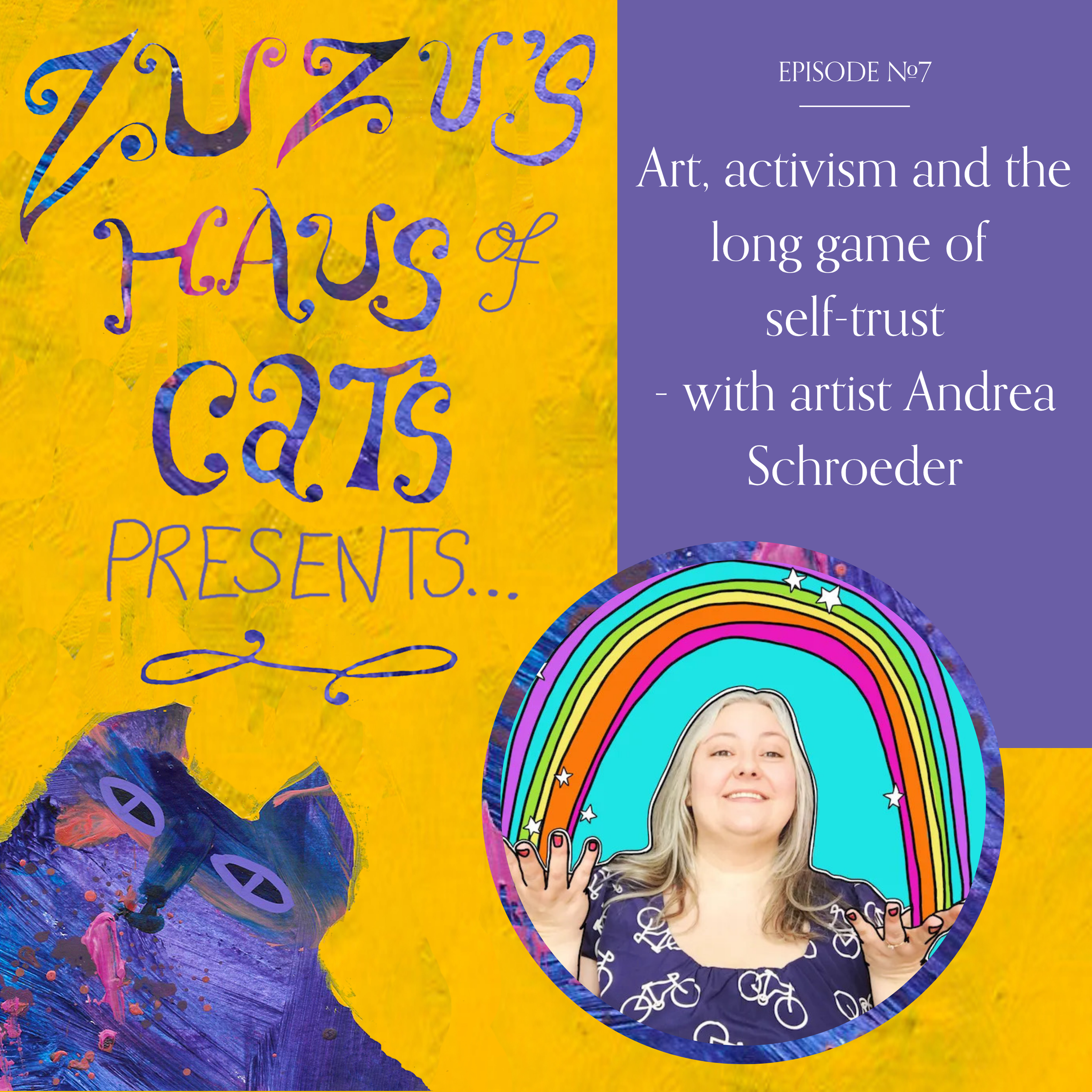
We kick off season two of the pod with this gorgeous conversation with Andrea Schroeder, founder of the Creative Dream Incubator. What I love about Andrea is that she goes DEEP! She talks about doing the real work, the deep work, the kind that takes years and changes you from the inside out.
We dive into some seriously meaty territory here. Andrea talks about learning to sit with self-doubt instead of bulldozing through it, and how that practice has made her unshakeable even when the world feels chaotic. She shares the difference between making art for approval versus accepting your creative expression as it is - because how you do one thing is how you do everything.
But perhaps my favourite part is when Andrea talks about her hope project for 2025. In a world that feels increasingly scary and divided, she's filling an entire planner with hope. Sometimes painting, sometimes writing, just spending time thinking about hope and inviting others to do the same. It's such a beautiful act of resistance.
We also talk about being ‘women of a certain age’ on the internet and the tension between wanting to show up authentically but also feeling the pressure to conform to conventional beauty standards. Andrea's take on being "dishevelled" right now (and questioning what's wrong with anyone who isn't) feels both permissive and incredibly sane.
This conversation is for anyone tired of hustle culture who wants to build something sustainable that honours who you are. Fair warning though - Andrea's advice about going towards what you most want to avoid might be the most terrifying and necessary thing you hear all year.
Listen to the episode here (click the arrow at the bottom right to play), or find it wherever you get your podcasts:
Find out more about Andrea:
Andrea is the founder of The Creative Dream Incubator. She’s an artist, writer and mentor to artists, healers, activists + visionaries who are MAKING IT HAPPEN.
She has a Bachelor of Applied Arts in fashion design from Ryerson Polytechnic University in Toronto, Canada, and is an officially accredited spiritual counsellor (which means - 3 years of training + 1 year of interning).
She started creating her own courses and workshops, combining creative journaling with meditation and healing circles, in 2008 in Winnipeg, Canada. She has been working full time online with the Creative Dream Incubator since January 1, 2011.
Visit Andrea’s website
Find her on Instagram
Find her on Facebook
Find her on YouTube
-
Introduction
Hello and welcome to Zuzu's Haus of Cats Presents... I'm your host, artist Elinor Trier, although you can call me Zuzu. And on this podcast, I talk to my fellow artists about the magic of the creative process. We'll talk about what they make and in particular, how they make it—their rituals and workflows, inspirations and disenchantments, ebbs and flows. We'll even take a peek behind the scenes of their businesses to see how they're using their creativity there too, and how they balance the needs of their business with the needs of their art. If you're interested in getting a behind-the-scenes look at what makes artists tick and enjoy conversations about art, creativity, neurodivergence, and business, then you're in the right place.
So we are back for season two! Season one was absolutely amazing. The conversations were incredible. The guests were incredible. It was such a wonderful experience. So I'm back for season two and this time I have more guests, more incredible conversations to share with you, more inspiration, more just fabulous joy. And this is our inaugural episode of season two.
So today, the Haus of Cats is absolutely delighted to kick things off again with the incredible Andrea Schroeder. Andrea is the founder of the Creative Dream Incubator. She's an artist, writer and mentor to artists, healers, activists and visionaries who are making it happen. She has a bachelor of applied arts in fashion design from Ryerson Polytechnic University in Toronto and is an officially accredited spiritual counsellor. She started creating her own courses and workshops combining creative journaling with meditation and healing circles all the way back in 2008. And she's been working full time online with the Creative Dream Incubator since 2011. She is an absolute beacon of light in the world and I can't wait to introduce you to her. Let's take it away.
Andrea's Background
Elinor: So Andrea, why don't you take us away, tell us all about yourself and your background. How did you come to be here?
Andrea: Well, first, hello. Thank you so much for having me. I love our chats.
You know, I've been reflecting a lot lately because I've been doing this work with the Creative Dream Incubator for over 14 years and I haven't done anything in my life this long. I also just turned 50 and I'm getting divorced. So it feels like everything's changing and I've just been reflecting and looking at how I want to be and what wants to change for this new chapter.
So I have been reflecting a lot on how I got here because for a lot of self-employed people, it's not a direct path. I went to university and took fashion design because that was the most creative thing I could kind of reach for. I feel like if I knew myself then, I would have taken art therapy. But we don't know ourselves when we're young.
I was thinking, I don't think it's helpful to think about "I wish there had been a more linear path." I did what I did. I love sewing my own clothes. Fashion design taught me a lot about creativity. And I feel like a part of that—it was also very hard for me in university. And a part of what was hard taught me a lot about the ways that creativity and spirituality are linked for me and how important that is.
And then after university, I was a textile artist. Every stereotype of a starving artist was me for the whole time. There wasn't really an internet, but there was no social media. There was no way to sell online. It was all galleries. It was hard. So I got a job when I was 30. I ended up staying there for seven years, but that really helped me become a bit more stable, give myself some chance to think about what do I really want to do?
I started taking my healing more seriously. I realised that self-doubt was really holding me back with my art. And I ended up becoming an accredited spiritual teacher, not from trying to, but just from taking so many classes myself. And then I started teaching and bringing creativity into those courses. This was all on the side while I was working. And I was like, oh, this feels like what I want to do. And that was about 17 or 18 years ago. So then I just worked my way into the Creative Dream Incubator.
Elinor: It's funny, isn't it? So often we end up teaching the lessons that have been the hardest for us to learn along our journeys.
The Creative Dream Incubator
Elinor: Tell us about the Creative Dream Incubator. What is it that you do there?
Andrea: Well, right now it's all I do—an online membership. So I have coaching classes, I have meditation and healing circles, and I have a very intensive two-year programme for navigating the path between where you are and where you want to be. And that's all in this online membership, which is also changing all the time, because I'm working with the people who are in there and seeing what they need and adding things. So it's been a really great mix—there are parts of it that are very stable and stay the same, and then there are parts that are always changing with new things coming in. So it's been a really great mix of being grounded but also having space to create.
Elinor: And can I just say how unusual and fantastic it is that you have a programme about getting from where you are to where you want to be that lasts two years and not like a month. I think that's unheard of in internet land.
Andrea: I know. And it's funny because I didn't set out to make it be two years. But once you're really engaged in the process of listening to yourself about what you want and working with the obstacles and really just trying to be your true self in the world, there isn't an end. So people get that first initial dream, whatever they joined to work on, they get that. And then they're like, "Oh, what else is possible?" But also just, "I just want to keep living as attuned to myself as I can."
Elinor: And any big change that you make in your life—making the change is the easy part, but dealing with the transition takes such a long time.
Andrea : And I love that we normalise that for each other in the group as well, because I feel like the life coaching on the internet is often like, "You better get to six figures in your first month or else there's something wrong with what you're doing." And that's just not how it works for most people. And a lot of us—I identify as a highly sensitive person—and so a lot of the people I work with are as well. We don't want—not to say we don't want money—but the work that comes with it and the overwhelm... do you have the right systems and structures set up? Generally it takes a lot longer than a month for that to happen, to really be in place.
The Role of Art in Social Change
Elinor: So you're working with sensitive people, you're working with a lot of creative people, you're working with artists, you yourself are an artist. We're obviously living through a time of great social and political upheaval. And one of the things that you talk about a lot is that visionary creative people bringing their dreams to life is going to help save the world, which I think is such a wonderful concept. Can you talk a little bit about that? What do you think is the role of art in this current moment in time? And how does that manifest in the work that you're doing?
Andrea: Yeah, first I want to say when I say that sentence about visionary creative people, I'm just naming that visionary creative people are the people I work with. In terms of my beliefs, I believe everyone's dreams matter. I don't think artists are more important than scientists or journalists. Everyone really listening to themselves really matters. And so I just call out the visionaries and creatives because those are the people that I work with.
But I think it really speaks to listening to our authentic self and really our values. Because especially one of the things that's really blowing my mind about our current world is the level of propaganda and how easily swayed people seem to be. It's horrifying. And you know, I read about things like this in history, and I understood that political propaganda is a thing. But when it started happening here, it really took me by surprise. And the people that I know and love in my life who fell into those rabbit holes and can't seem to get out.
So there's that, which is very much a part of the political climate that also has all of this dangerous stuff happening—not every human being being honoured equally. And so I don't think human beings are meant to live in these hierarchical ways where certain people have more rights than others and certain people's lives are more important. And certain people get to dream and others just never really have that time and space because they're trying to get by financially.
So I just feel like all the ways that dominant culture isn't good for us, our dreams help us find what is good and true for us. So in the deepest sense, I do believe that our dreams are a way that our souls are telling us, "This is who you are. This is what you're here to do. This is what you're capable of." Not that you have to make your dream happen or else you failed on a soul level, but it's like, "This is an invitation and this is what you're actually capable of."
And the world is telling us what we're capable of from the moment we're born and it's mostly not true. There are ways that we need to free ourselves in order to deal with what's happening that go really deep into a lot of different aspects of who we are. It's really deep work, I think, to properly meet this moment.
Art and Personal Healing
Elinor: And I think there is an element of personal healing. If we all have the opportunity to work on our own personal healing, then that together is something that can help save the world, without trying to be too reductive about it. But I'm curious, what's your experience with your creativity and with making art and your personal healing and doing the deep work yourself?
Andrea: I think a lot of times we think of art as this great healing thing. And I think it can be, but it's not a guarantee and it's not necessarily that art will heal us because there's that phrase, "How you do anything is how you do everything." And so often we can bring our perfectionism or people pleasing—for me it's trying to perform in ways that get approval from the external world in order to feel good about myself. So then I'm putting all of that into the art I'm making and I'm doing what I think will get me that approval. Or we can do what will try to get us fame or money.
And so in that way, I think every time you make art, you can touch that—there's something magical here. There's something transformative about it, but we're not necessarily really deeply engaging with that unless we bring a lot more intention and awareness into how we're doing it. And then the work is more about allowing our expression. And so then we're not in control of what the art looks like. And that sets us on a really different path.
Elinor: Can you say more about that? What do we need to think about when we come to the work in order to take that kind of extra level of engagement and intention?
Andrea: Well, there's the intent—stopping and thinking about what is my intention before you start, because often we go to it knowing, "I'm trying to make this look this way." But it's the idea that we can be working on our art and changing and making things and we're trying to get it to look a certain way. And what if instead we were trying to accept our creative expression as it was? And what if we put as much effort into accepting our creativity as it is, as we do into trying to make it perfect, in whatever way we define perfect.
Elinor: That's some pretty hardcore stuff right there.
Andrea: Yeah. Which doesn't necessarily take you down the path of easily selling your art.
Elinor: No, but I think art serves so many functions. There are those of us who make art and then sell it and make it our livelihoods. And then there are so many more other people who just love to sit down and draw in a sketchbook or love to play a tune on the piano every now and again. And I think that something very different happens to your creative process. It's not a good thing or a bad thing. It's just coloured by commerce in that way, or by doing it in public by the attention and the eyes on it. And I don't think that's necessarily the sort of work that does the deep work, that does the healing. It's sort of like the difference between writing a novel, writing a book and your journaling practice. They both have really important places to play, but I would be mortified if anyone read my journals out loud. They're not for public consumption. And I think we don't really have such a clear distinction between the art we make that's to be viewed and the art we make just for the process of making it.
Andrea: Yeah. And that's what a sketchbook should be, but often, especially with the ways that social media has evolved and the way the algorithm is destroying everyone and everything good in the world—we're being kind of... the sketchbook is just another place to show. And then we're left without those spaces.
Because I think really just doing that work and continuing over a long time—give it two years, take my whole course about being in the process of accepting your own creative expression as it is—that can also change it. And that can actually also make it easier to do whatever is working for you in terms of how you're selling your art. It's just another layer to it.
Going Towards What You Want to Avoid
Elinor: And this is something you talk about a lot, doing the deep work. And one of the things you mentioned is going towards the thing you most want to avoid, which I think is an absolutely terrifying thought, but I can also feel the thrill of it, the excitement of what's on the other side of that. Can you talk a little bit about that and how that's worked for you and maybe how you're teaching that to others as well?
Andrea: Yeah, I love the way people in my classes show up and will do that with me because we have calls every week and everyone watching the calls can also hear it. You get that permission from other people because people in the world are not doing this, and if you feel like "Oh there's something for me there but this is so weird or scary," it really helps to see other people doing it.
But pretty much every time if someone is stuck on a project and I ask "What have you been avoiding?" that's always exactly the answer. It's kind of like a cheat code for coaching.
Elinor: It's so confronting, isn't it? It really is the thing you need to do.
Andrea: Yeah. I recently had someone who was new in the group and I had given her these journaling prompts. So she had this question that was, "What haven't you tried?" And she got quite upset just at the thought of writing about it. And then we had this conversation and she wasn't happy with it. And I was like, "Well, you can pick a different prompt," but she's like, "No, if there's something for me there, I think you're right. The things we want to avoid."
And I didn't hear from her for a few weeks. And then she came back and she'd had this huge breakthrough by sitting with the things she was avoiding, but it took her a few weeks. And that's often what I say. If you ask yourself a question and you don't have an answer, of course we're all going to panic that we don't have an answer, but a real answer takes time. And it takes time of you continuing to show up and sit with it. You can make art about it. You can write about it. You can just meditate on it. You can just go for a walk and think about it. It doesn't matter how, but the hard questions need more space.
And then if we are actively avoiding everything that's uncomfortable, it's harder to give that space. And also, a lot of the life coaching or life hacking world is all like, "Think positive, be very confident, don't succumb to self-doubt, just keep going forward." I feel like for myself, when I first became self-employed, I was terrified because I had had that experience in my twenties of not making money with my art. And then I saw how good it was to have a steady income from my job. And I was afraid, but I also knew I was listening to myself and was like, "It's time, you can do this."
But I had to sit with that self-doubt very regularly for those first couple of years. It kept coming up and I could just visualise that I'm going to be successful and try to do that Superman stance to feel confident. There's a lot of ways we can hype ourselves up and they're very good, but to completely avoid ever sitting with our self-doubt keeps it in us.
And so especially now where I live in Canada and every day we're threatened with being taken over by the United States. We're in a trade war that's tanking our economy. This is a horrifying time to be self-employed and I haven't worried about it. I'm like, "I know what I'm going to do." And that comes from years of really working with that self-doubt and trusting myself.
And so I think that's the biggest example of how helpful it is to face those things. But when I say spend years sitting with your self-doubt, a lot of people don't like that—they're just looking for faster solutions.
Elinor: I mean, the idea of sitting with your self-doubt is a pretty scary prospect to actually engage with that part of you, especially when the cultural narrative is so much like, "Just suck it up and do it anyway." Feel the fear and do it anyway. And the thing that most people sort of avoid there is the feeling part—you have to feel the fear.
I was speaking to somebody earlier and they were talking about sort of negotiating with their inner critic, like it was a small child, just being like, "Oh, is this a bit hard? Are you scared? Do you want to talk about that? What would make you feel safe?" And I just love that idea of being so gentle with yourself. So much of our cultural stuff is about battering ourselves into submission almost.
Andrea: That's it. And then we also have a culture where midlife crises are normal. I wonder if... everything we have inside us is inside us. We have the self-doubt, the fear, whatever it is, all of these attachment traumas from our childhoods—it's all there. And so it doesn't matter if we're ignoring it or sitting with it, we still have it. Ignoring it doesn't make it go away. And so the less you are really in touch with it and working with it, the more it can impact you.
Elinor: Absolutely. The more you try and ignore it, the bigger and scarier it gets, I find, in my own life anyway.
Andrea: Yeah, for sure. We need to be so gentle and patient with ourselves when we're doing that work.
Elinor: That's why I'm like, it takes the time it takes. Don't rush yourself. And when I say I sat with it for years, it's not like I sat with it for years before I felt any benefit. It was an ongoing process. It built resilience, I suppose. You build a coexistence. Because I don't think you never get over self-doubt, you never get over imposter syndrome, you never get over fear. You just learn how to be with it without freaking out and ruining everything.
Andrea: Yes, when you said resilience, it's like weightlifting. You wouldn't expect to go weightlifting once and be done. You understand if you want muscles, you keep doing it. And yet somehow we're horrified by the idea of doing inner work as a consistent practice.
Elinor: Oh God, it'd be so nice if you could just do it once and be done with it. "I fixed my trauma in an afternoon, now I'm fine."
Andrea: That's another red flag in coaching. If someone says, "Oh, I've dealt with that," then you know there's something to look at.
The Hope Project
Elinor: So obviously the antidote to this kind of fear and all this scary deep stuff is hope. And that is something that you're all about in 2025. Could you tell us about your hope project and share what's going on there?
Andrea: Yeah, I decided somewhere around early November—and this was actually when I felt more hopeful, there hadn't been the US election yet, and so I didn't think we'd be where we are. But I still felt like we needed more hope. It became more important as it went on. But I just got this idea of having a year of hope.
So it came to me as two things. And the first is my own project. I got a 9 by 11 inch daily planner. And it has a page every day, plus there's an extra page every week. So it's a lot of pages, it's a big heavy book. And I'm filling this with hope next year. And that's not necessarily filling a page every day—some days I'll do four and then some days I get behind—but that over the course of the year, I'm filling this big book. And sometimes I paint in it, sometimes I write. It doesn't matter what I do, just that I fill pages and spend time thinking about hope.
And then I wanted to invite people to do this with me, but I know that a daily practice is a lot. So in the membership this year, we have one prompt every week. And then I made an alchemy meditation for calling in hope and holding it in your body. And then a meditation for sitting with hopelessness and processing some of that in a gentle way where everyone can just choose for themselves. And even if you just read a prompt once a week and give yourself five minutes a week to think about hope—those five minutes feels like it's not enough and it didn't change the world, but it builds that muscle over time.
And I think it's just about making that choice. Because I've really struggled with perimenopause, especially the last few years, and my brain doesn't work the way I want it to. And I wanted to feel more optimistic and more confident. And I felt like hope was a thing that really helps with all of that. And everyone can pick their own quality. If hope isn't for you, you could change the word to just have something to go into this difficult year with a quality that you want to hold onto and a way of doing that—make art with it every week.
Elinor: I just love that. I think it's such a beautiful idea. And the image that came to mind as you were talking was fireflies—a field of fireflies. Everyone is just a tiny, tiny little spot of light. But together, you get this almost floodlit effect. And I feel more and more like that is the hope that we can overcome everything that's going on with the human race at the moment and the planet and everything else. And I think it comes down to this almost microcosmic idea of we need to take care of ourselves. We need to find hope, we need to find joy, we need to find creativity, because then we're so much better resourced to reach out to the person next to us and reach out to the person next to that. We serve evil, we serve fascism, we serve the people who are trying to strip away our humanity by being completely exhausted and under-resourced all the time. That's what they want.
Andrea: Yes. I have a lot of activists that I work with as well. And there's that place where we do want to get into action. But a lot of the times we're frozen and we're freaked out. And then we feel like we would need so much to change so fast, which probably can't happen. But when you are a little calmer and have some hope in you, you can see—actually there are really smart people working on everything and we can go help them. And there are small things, because each person is small, but we can go help someone else who's got this great idea about this one thing. There's so much we can do together, but not from this frozen, terrified place.
Elinor: And I think the world needs people like you so much these days—people who are offering these helping hands, these tools and resources that we need to get out of that fight, flight, freeze, trauma response, and be able to get into action, whether that's just taking care of your immediate family, or writing letters or making phone calls, or joining the picket lines or whatever it is. You can't do it when you're frozen in panic. And you also can't do it when you're hopeless.
Andrea: Yeah. And when I started my business, it was 2010 when I decided to do this as my business, the world was so different. And it was like, I created all these tools to help because going for your dreams means leaving your comfort zone. And it was like, "How do we bring comfort and peace into the work of expanding our comfort zone?" And so it's been really wild to me since 2020 how all of those tools actually also help when the world is incredibly unstable to bring that peace and comfort and stability to yourself. Because you don't even need to leave your comfort zone to be extremely uncomfortable.
Elinor: As we have all learned over the last few years. Oh, that's wonderful. It's like you were training for this your whole life. Your time has come.
Creative Process and Branding
Elinor: So let's divert slightly into your own sort of creative process because as you say, you are an artist, you are hugely creative, you're constantly making and writing and you make all your own clothes, is that correct? Phenomenal. I just love that. So I want to start off by talking a little bit about the branding of your business and everything is beautifully hand drawn and it has this really distinctive, playful style. I think it's absolutely beautiful. Can you talk about the story behind developing that sort of visual language?
Andrea: You know, I never thought in terms of branding. And then I took a branding class somewhere around 2018 and I realised, "Oh, this is what I've been doing all along." And it kind of gave me that permission to know—because I was thinking, I don't know that artists need branding because we are just expressing ourselves. And this is kind of funny, I didn't really realise how much this lines up with everything I've been saying, but around 2014, I decided I wanted to start doing journaling sheets and to send them out—a few sheets every week. And so for about four or five years, I did that. So it's a big commitment to keep making journaling sheets. I didn't have a style for how I was doing them. So I was looking at other people, I was looking at different fonts. It was just like the creative process—starting from zero. And over those four or five years, I developed my writing style of the hand lettering. And it just felt like every year it became more me. And then over time, now that just feels like the only way that I express myself.
Elinor: Does that feel restrictive or does that feel comfortable for you?
Andrea: It feels really comfortable. It feels like I could do something different, but this is my voice. And then I am always making little changes. I don't necessarily have brand colours and stuff, but I do have certain ones that I work with. I mean, I do have colours on the website and stuff. And so that stuff is changing very slowly over time as what I'm interested in changes or as what I'm drawn to. So it always feels like I'm just really expressing myself. And at the same time, some of the work I do is around connecting with the soul of your dream or the essence—what are the inner qualities of your dream. And then the same thing for the inner qualities of your business, which is a little different. It's not quite you, it's not quite your dream, it's this entity on its own. And so learning to understand, having an inner relationship with the soul of your business helps you know how to express that as well. So I feel like what I'm doing there is a combination of the two—of my own creativity and the soul of the business.
Elinor: That's so gorgeous. And I love speaking to people who appreciate the inherent creativity of business. I think business is an art form in and of itself.
Balancing Creative Needs with Business Needs
Elinor: So it brings me beautifully onto my next question as well, which is how do you balance your creative needs with the needs of your business. So how are you balancing those things? And by balance, I mean that constant motion. What does a typical day look like? What does a typical week look like? How do you make sure both of those things are fed?
Andrea: I am in the process of recreating all of my routines. I started in January just stopping doing everything I was doing and then noticing what falls apart. And so for a long time, when I started my business, my primary concern was: what can I do to help myself feel my best and do my best work? And so I thought that needs to come first. And then so that I'm in a position to think good thoughts in terms of my strategy and do good work. And so that's still a philosophy that has been really important to me.
So for example, one of those things is going for a walk to a coffee shop in the morning, getting a coffee and a treat and writing in my journal. And I just love everything about that. And so that's how I would start my days. And as now at this juncture in my life and really being in midlife, my needs are changing. And I actually don't want to do that every day anymore. It started as this magical thing that was so helpful and then it kind of became a routine, but it wasn't working. So I feel like I have to keep looking at those things.
So now I do that a couple of times a week. And I always do that on Monday morning. And with my journal, I'm meeting with the soul of my business and being like, "How are you doing? What do you need?" And then it's a very nice gentle way to get into a Monday. And then I do look at my schedule and I feel like one of the biggest things for me to be able to take care of myself and my creativity is to be extremely organised about my business projects. Anything that's on the go—I use Notion as a project management app and everything is in there. So I don't lose threads and you can see exactly what needs to be done. So I check in with that every Monday. So if there are administrative tasks that I need to do that week, I know about them.
And then I don't necessarily schedule when I'm gonna do those things. It's more trying to stay present with myself and my creativity. So roughly I give myself mornings for my creative time. And then afternoons more for structured work time. Saying that, I just—this last weekend, I was so inspired I worked 12 hours a day, Saturday, Sunday. I wanted to get something done and I love it. So that happens. But I feel like those Monday meetings and then Friday, I also have journaling prompts to reflect on the week. So I have those bookends and then being super organised with my tasks so that my time can be quite flowy, if that makes sense.
Elinor: That makes perfect sense. That's exactly how I work as well. I have a rough outline of the tasks I'd like to get done that week, the projects that have to be done, and exactly the things that absolutely have to be done. But I have to go very much day to day with "What do I feel like doing now? What am I called to? What feels fun?" And sometimes it's sitting down and doing data entry. And sometimes it's, "You know what, I'm gonna blow everything off and spend the whole day making art." It's completely fluid. And I think trusting yourself to follow through on the stuff that's really important is the secret sauce to making a schedule like that work.
Andrea: Yeah, and I think some experience—if you know that you have followed through, and if you have that container of a weekly check in with it. And I usually check in again every morning just to not forget things, but those kinds of containers. But that self-trust—that's a huge part of being self-employed.
Elinor: Absolutely. And self-compassion as well, I think, right? Self-trust and self-compassion—just the two pillars of being a person who is able to run a business. Because you're going to mess up and you're going to be nice to yourself about it. And you have to trust that even if you mess up, you'll be okay. And you will do things even though you don't want to. Yeah, it's intense. It's a trip.
Andrea: I love it though.
Elinor: I love it too. I think there's a particular type of person, particularly the artist entrepreneur, that gets off on the creative challenge of running a business. I find that I get to exercise my creativity there almost as much as I do with making my actual artwork.
Rituals and Workflows
Elinor: So have you got any rituals or workflows? You mentioned your sort of time management system in Notion, but do you have any ways that you kind of transition into your art making time from your business time or do you have anything that you use to switch your brain into a different gear?
Andrea: I do the—so getting out and getting exercise in fresh air in the morning gets me into creativity mode. So that really helps me for my mornings where I'm gonna be more creative. And then what I tend to do, and I wish I had a more interesting answer, I just tend to eat lunch. And then after lunch is more practical things.
Elinor: I think that's wonderful. I mean, it's pragmatic, but it works and it's the thing you do. It changes the vibe, and I think that's wonderful. It's one of the reasons I ask this question, because so often I think we have this romanticised idea of the creative process and the creative rituals and things like that. And I always ask this question of artists and I always get a very similar sort of pragmatic, slightly bemused response. And I'm like, yes, that's exactly it. You just go to work and you do the work and then the work is done.
Andrea: I have lunch. I go into my studio. That's it. I love that you said that because I was like, I wish I would light a candle and set an intention, maybe pick a tarot card. That's just not what I do. And I haven't seemed to need it.
Elinor: No, no, I would love to do this. I've got piles of tarot cards and things in the studio. I've got candles in the studio, which I like sometimes. But usually for when I'm doing YouTube videos and I want it to look kind of aesthetic. But most of the time I'm just wandering in in my pyjamas just being like "Oh no actually I want to do a bit on this now."
Andrea: Yeah that's another thing I do—I wear my pyjamas or very sloppy clothes but I have this fantasy of making... I bought my first French terry—it's this very soft fabric—and I made a sweater out of it and I was like "Oh I want a full pyjama set out of white French terry that I get paint all over as my paint outfit." But I kind of imagine, I don't see it a lot, but for some reason I imagine an artist influencer should have some amazing outfit that they wear while they're painting and yet I don't, you know.
Elinor: I have a floor length floral kimono that I put on over my clothes. It's mostly because it's the only chance I get to wear it because it's such an impractical garment to do anything else in. But for standing in front of the easel and getting paint on, it's perfect.
Andrea: Oh, I love that. And doesn't it feel different to put it on?
Elinor: It does. It feels special. It feels like I'm making the work important, which sometimes has the opposite effect.
Andrea: But yeah, now you've got pressure.
Elinor: Yeah, the more paint it gets on it, the more it's just like, "Oh, no, this is just what I wear to cover my clothes. It happens to be fabulous." And that just makes it even more fun.
Andrea: Oh, I love that. Yeah, I'm all for the practical things in our lives—the practical objects that we use every day being also beautiful. That feels really nourishing to me.
Authenticity and Beauty Standards Online
Elinor: So I want to talk to you about something that we've discussed in the past, which I think is a really interesting topic. And I'd love to hear your take on it. So as we are both women of a certain age, showing up on the internet and sharing our opinions and doing things. One thing that we've talked about is the sort of—and I described it in my email to you as a sort of edge or tension of wanting to show up and be your authentic self as an older woman, you know, to show up without having to worry about makeup or what you're wearing or anything and just for the meat of you to come from your ideas from what you say from what you do. But also still feeling enormous pressure to conform to conventional beauty standards, i.e. to be thin, young, white, pretty, et cetera, et cetera. Can you speak to that a little bit? Because I'm sure we have lots and lots of people in the audience here who are also on that knife edge.
Andrea: Yeah. And even if it's not your age, but just any way that you're not conforming to conventional beauty standards, right? And I just feel like diversity is our strongest strength as humans. And yet we just have this absolute nonsense culture that categorises people the ways that it does.
And I love seeing so many younger people. Maybe I don't know if I'm generalising or this is just how I see it because of my age, but it feels like younger people are seeming to be a bit more free about just showing up. And I know when I started my videos, I would put makeup on and I wasn't trying to look a certain way. I was trying to be professional as a way of respecting my work, which does feel like a quality of dominant culture now. But at the time I was just genuinely, "I want to respect what I'm doing."
And now I feel like, I mean, I don't give a shit about makeup anymore. I like it on the days I like it, but I don't want to wear it every day. I'm dishevelled in my life. And if you're not dishevelled right now, what is wrong with your mind?
I want to see more people online, older people, especially being authentic and the way the algorithm works, really, you're just not seen as much. So there's that real tension. And I mean, in my marketing, sometimes I'm like, "Well, why do I even care about the algorithm? Can I just put my work out there?" Some people will, if they haven't seen you in a while, come to your social media and look and see the people that I'm sharing for.
But it's really messed up. I think that we have to conform to cultural standards to be more visible in social media. When if you remember when social media started, it was kind of like the democratisation of media and everyone had a space. And it really was that way for a while. And it has become this, right? And so how do we bring it back? There are some movements towards that, but we're trying to make a living in the world as it is right now. So it feels very complicated.
Elinor: Yeah. And I think social media—not only does the algorithm like the way people look a certain way. There's also a huge skew towards a sort of homogenisation of visual images. If you're out there trying to do anything that's different or weird, or isn't trending, you're automatically penalised, which means the artists who are out there trying to innovate and say interesting things are automatically penalised because they're not doing the same thing as everybody else, which is something else that social media has a lot to answer for.
Andrea: Which is so—I was thinking when I started as an artist in my twenties and I had to go to galleries to find representation and all that work and how the internet and social media made that so much easier. And then now it's becoming difficult again in a new way.
Elinor: Yeah, everything expanded and now it's contracted again.
Andrea: Yeah, because you're like the trends—the way just everyone's gonna make a video doing the exact same thing. And that's what the algorithm is going to push. It's contributing to the dumbing down of humanity. It's heartbreaking.
Elinor: It's heartbreaking. It's interesting, actually, because I've really been enjoying Substack lately, as it feels like the way social media used to be before the algorithm and TikTokification of everything. And it has its own set of problems. It's certainly not gonna be the answer forever, but right now it feels like a really nice space. And one thing that I have noticed is because it's not so visually led, it's more led by ideas. I have so many more diverse voices in my feed. And I'm finding that really, really exciting. So it feels like there are glimmers of light in the current ecosystem. I'm hoping that other places will open up that are a little bit more democratised again, I suppose.
But how are you navigating the tension of all of that?
Andrea: The dumb thing is I try sometimes to make a reel that I think looks like what the popular reels look like. And they take—it's like I can't get any views. But if I just keep making more honest—sometimes I'm just sharing what I'm actually doing in my journal or just me talking. Those do, if I post those consistently, they do start to get a bit more attention. And I have noticed I've been sharing very honestly about—I was freaking out when I was in a situation where using the word anti-fascist was controversial with this person. And I was just like, "My brain is exploding, my heart is breaking." And so I started a craft project to help myself process it. And I started recording videos of myself doing that and talking about what I was doing. And those are getting out to new people. And I wasn't doing it to try to do a popular video to get viewed. I was just sharing in a really genuine way. And so I am seeing that these genuine videos can reach people sometimes—nowhere near the way that I used to be able to reach people online 10 years ago. But there are glimmers. And so I'm just trying to hold on to that for now.
Elinor: That's wonderful. More hope. More hope for all of us out there. It's really broken my heart really to see the internet suddenly be the same. And as a neurodivergent disabled queer woman in the world, the internet and social media at the beginning was just an absolute lifeline for me. And I loved it. I loved old Twitter. I loved getting to meet people that were like me, that I never would have met in real life. And then the grief, I suppose, of having that sort of slowly taken away has just been really, I found it really, really difficult to deal with. They are my people and I can't get to them because of somebody else.
Andrea: Yeah. And I just, it feels important to me that we not stop trying—not leave all the spaces and not be trying to put our authentic selves out there.
Elinor: No, I think that's really, really good advice. No, yeah, it is, and it's just demoralising to see sometimes what does become really popular.
Andrea: Yeah. That is the world that we live in. I mean, it's always going to be kind of lowest common denominator stuff. That's just the way that the media works. And that really comes back to what we talked about in the beginning about how art can help save the world—we're needed. Even though it's demoralising for us and it's harder and we're not getting the results we used to get, it's actually really important that we continue to share our work and to have it be there somehow.
Andrea: Yeah, absolutely. Absolutely.
Final Advice
Elinor: So following on from that, our final question: if you could go back and give some advice to yourself right at the very beginning of your journey as an artist entrepreneur, what would you say? What would be the one thing?
Andrea: I think my answer to that would have changed a lot over the years. And you think about what's the one thing that could have maybe gotten you somewhere faster. But now, genuinely, what I would do is say thank you so much.
Elinor: That's so lovely.
Andrea: The courage it takes to start your own thing and to believe in yourself is huge. And I tried to work through my self-doubt as much as I could and believed in myself and built this life that now is—I feel very solid and stable as a self-employed person and I believe in myself and I trust myself and I couldn't have gotten here without the rocky bumpy things that my younger self went through. So yeah I just feel really grateful for that.
There's a few times when I made decisions based on my frustration in the moment that maybe I wouldn't have done.
Elinor: That's relatable.
Andrea: So maybe calm down and then decide and think about your future self when you're making decisions. But we also have to honour our feelings in the moment. Sometimes you got to burn a bridge.
Elinor: That's so beautiful. You've actually, you know, I'm welling up a little bit at that because I think that's such a beautiful sentiment. It's so rare that we give ourselves credit for being bold and brave and doing—you know, starting a business, being so vulnerable to put your art out there in the world, doing anything, trying and striving. It's so brave and it's so incredible. It really does light the way for so many other people as well. It's such a generous act to do. And I think it's so rare that we go back and we give ourselves credit for that or that we give other people who are doing that credit as well.
Andrea: Yeah, we do. That's easier to do it for other people.
Elinor: Absolutely. I think that's really beautiful. And what a wonderful note to end on.
Closing
Elinor: Thank you so much, Andrea, for being... you're just such a light. You're such a light in the world. It's such an honour to know you. And I'm so grateful that you took the time to come and chat with me today. It means the world.
Andrea: Oh, this was so fun. I'm really, really glad that you invited me. Thank you.
Elinor: And before we go, just let us know where we can find you online. Where can people, if they become intrigued, which I'm sure they have, where can they find you?
Andrea: CreativeDreamIncubator.com and there is, in the menu, there's a thing that says free journal. There's a free journal for creative dreaming that is really good. I think you should get that. I'm on Instagram as creative dream incubator and YouTube as creative dream incubator. I'm kind of on Facebook as creative dream incubator, but that's in and out.
Elinor: Wonderful. Thank you so much, Andrea. This was such a treat.
Andrea: Thank you, Eli.
Elinor: Wasn't that wonderful? Andrea, I could just talk to her for hours. She's such an incredible human. If you would like to come and find out more about Andrea and follow her work in the world, then please do come over to read the show notes at zuzushausofcats.com/podcast. That’s Zuzu's Haus of Cats - Haus is H-A-U-S - just to be difficult. You'll find all of Andrea's information there, links to everywhere you can find her online. And you can also have a browse around the Haus of Cats as well, which is well worth your time. Thank you so much for listening and I'll see you next time.
Where next?
Back to the podcast page
Visit the Salon
Sign up to get new episodes straight to your box