Ep #18: Unmasking and finding your true creative voice - with illustrator Gracie Klumpp
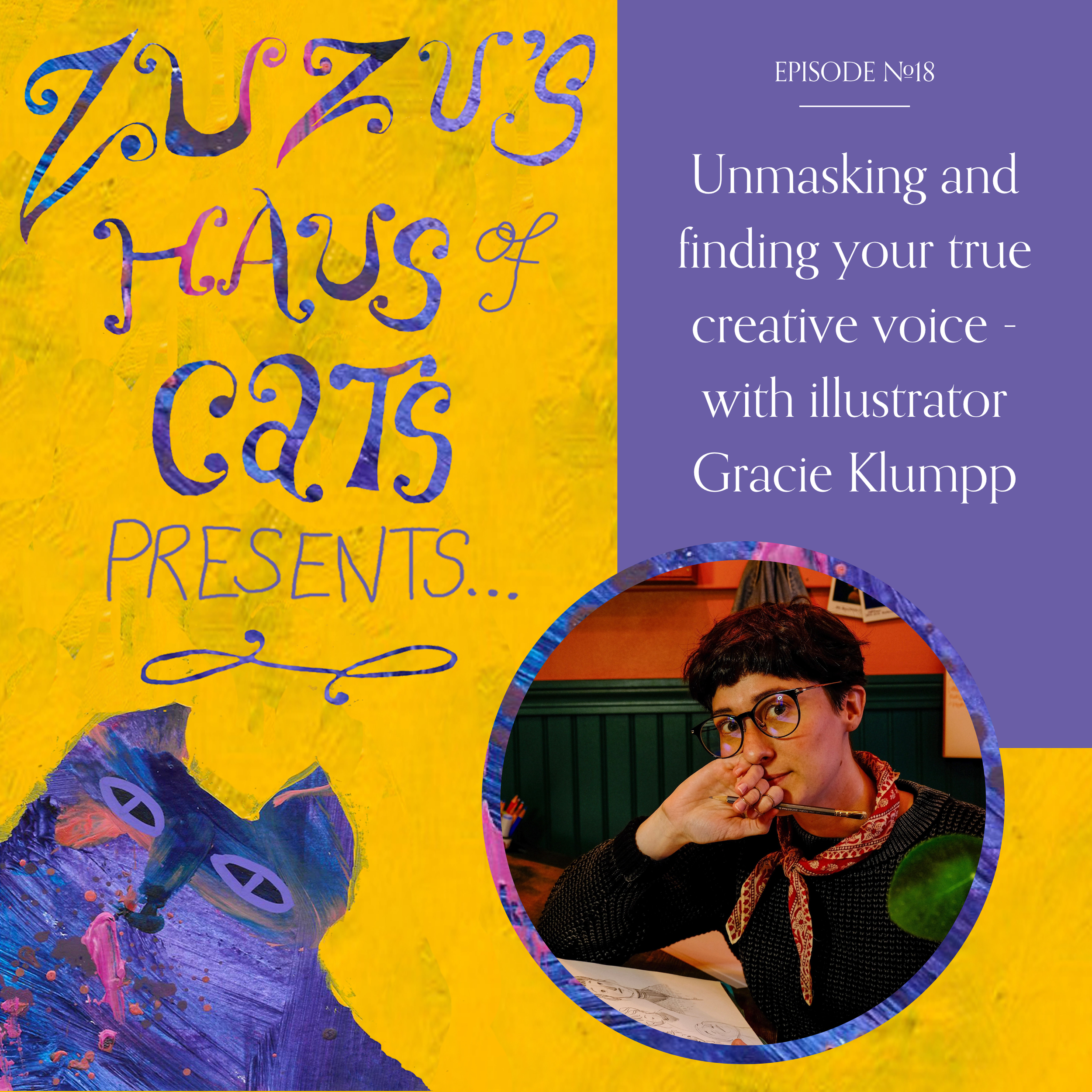
In this episode, I had the absolute pleasure of speaking with Gracie Klumpp, an autistic author and illustrator who tells stories with words and pictures. What struck me most about our conversation was how much we had in common - both being late-diagnosed AuDHD artists who've had to navigate the complex journey of unmasking whilst building creative careers. Gracie shared her fascinating path from film student to animator to illustrator, and how she's now circling back to narrative storytelling through graphic novels and comics. Her approach to letting each story dictate its own medium resonated deeply with how I work with concepts and ideas in my own practice.
The heart of our conversation centred around the unique challenges of being neurodivergent creatives in a world that wasn't designed for us. Gracie spoke beautifully about the process of archaeological self-discovery - peeling back layers of masking to find who you really are beneath all the "shoulds" and expectations. We discussed how art can be both a tool for processing our experiences and a way to help others feel less alone, particularly when we're brave enough to explore the darker, more difficult aspects of the human experience alongside hope and transformation.
I was so inspired by my conversation with Gracie and I know you will be too.
Listen to the episode here (click the arrow at the bottom right to play), or find it wherever you get your podcasts:
Find out more about Gracie:
Gracie is an Autistic Author & Illustrator, trained in animation at Huntington University.
She tells stories with words and pictures.
She's been obsessed with stories and their power to reach deep into our bones, and help us understand ourselves and each other since she was very small—and she's been telling them in one way or another ever since (professionally since 2012)! She's bounced around doing various jobs from teaching art to elementary students, to curriculum design to branding and book covers, but her heart has always been with narrative storytelling.
Whether it's illustrating for other people's written work or creating her own graphic novels, she cares about finding and telling the honest, poignant, dark yet hopeful stories that say something about what it means to be human, and make us feel less alone.
-
Introduction
Hello and welcome to Zuzu's Haus of Cats Presents. I'm your host, artist Eli Trier, although you can call me Zuzu. On this podcast, I talk to my fellow artists about the magic of the creative process. We'll talk about what they make and in particular, how they make it. Their rituals and workflows, inspirations and disenchantments, ebbs and flows. We'll even take a peek behind the scenes of their businesses to see how they're using their creativity there too, and how they balance the needs of their business with the needs of their art.
If you're interested in getting a behind the scenes look at what makes artists tick and enjoy conversations about art, creativity, neurodivergence and business, then you're in the right place.
Hi everyone, welcome back. What an incredible season this has been so far. I've had such an amazing time talking to all of these incredible artists and creative people. I just think it's absolutely fascinating—all the differences and also all the similarities. There's been so much to learn from every single guest I've had. And today's guest is no different.
I am so happy to introduce you to Gracie Klumpp. Gracie is an autistic author and illustrator trained in animation at Huntington University. She tells stories with words and pictures. She's been obsessed with stories and their power to reach deep into our bones and help us understand ourselves and each other since she was very small. And she's been telling them in one way or another ever since, professionally since 2012.
She's bounced around doing various jobs from teaching art to elementary students, to curriculum design, to branding and book covers. But her heart has always been with narrative storytelling. Whether it's illustrating for other people's written work or creating her own graphic novels, she cares about finding and telling the honest, poignant, dark yet hopeful stories that say something about what it means to be human and make us feel less alone.
Now, if you know anything about me, you know that this ticks all of my boxes. This is exactly what I try to do with my own work. And this conversation was just so incredibly life affirming and immediately made me want to go and get back into the studio and start painting. So I hope it does the same for you. Let's dive straight in and welcome Gracie to the studio.
Meet Gracie Klumpp
Eli: I am delighted to be joined today by Gracie Klumpp. She's the most incredible illustrator and I am so happy to have you here with me today, Gracie. Thank you so much for joining me.
Gracie: Oh, thank you so much for having me.
Eli: Why don't you kick us off by telling us a little bit about your background, who you are, what you do and how you got started as an artist.
Gracie: Well, it seems like such a simple question, but there's actually so much that can be said with that. So I always struggle a little bit to know where to start, but I am an author illustrator. I like to say that I tell stories with words and pictures just to simplify it and leave it open-ended because I like to work in a lot of different mediums. For me, the focus is really on telling stories and the format can change a lot, just depending on what that story is.
I've done a little bit of everything from teaching elementary art to curriculum design and freelance illustration with book covers and even branding and a little bit of graphic design kind of stuff to family portraits, things like that. I've done kind of a little bit of a lot of different things.
And at the moment, I'm really trying to focus more on narrative storytelling. I've been really getting into comic making or using panel style, illustration panel storytelling and trying to get into making graphic novels. So that's kind of what I've been more into recently.
The Origin Story
Gracie: How it all started—I've really been into stories from a very, very early age. When I was very small, I would always want to be watching movies or reading picture books. Before I could read, I basically had no interest in learning to read because I had all these picture books and I would look at all the pictures and assume what all the stories were and make up stories of my own. So it took me quite a while to even really realise that there are words that people read that go with those pictures. I always had all these worlds going on in my head all the time and coming up with stories and seeing them everywhere. And that's just always been such a big part of who I am.
My family is a pretty creative family. My grandpa is an artist. My grandma, my mum, my aunt, like pretty much everyone in my family does something creative, whether it's sewing quilts and clothes or writing. There's all sorts of different things. So when I was growing up, there would pretty much always be some kind of making of some kind going on. So that was always a pretty natural part of my life.
Around middle school time, the Lord of the Rings movies had just come out and I used to watch all of those and all of the behind the scenes. I think that was the first time that we really got to see a lot of behind the scenes of how a lot of films are made. And so that was such a big thing for me to see what that was like, the world behind the world and all the people that work together to make these things happen. And I just thought that was such a magical thing that I wanted to be a part of in some way. So that was probably one of the first things that I consciously remember knowing, oh, there's a job for this. Like people get paid to tell stories in this way.
Education and Career Evolution
Gracie: I went to college first for film. I was studying to become a filmmaker. And then the college that I went to actually had an animation program as well. It was a super tiny college and it was all pretty new, but they had an animation program as well. Part of the way the program worked was some of the classes were combined. So things like storyboarding and the earlier, you know, one-on-one type of classes were combined film and animation. And so I got a taste of that as well and really fell in love with it.
So I switched over to animation. I think it kind of fit my more introverted personality better as well, because you can work in teams, absolutely, but also you're kind of the one creating everything with the world. So you could kind of sit back and take a little bit of your time with it. It's a little bit less socially demanding, I guess.
So I got into animation and from there is really just a very short hop and a jump into illustration. I directed an animated short film in college and got really burnt out. And then for my senior year, I wanted to step back and do something a little bit quieter, a little bit calmer. So I did a big illustration project for my senior year. And that just kind of naturally led me into doing freelance illustration and that kind of thing.
And animation principles really serve illustration very well. Like I learned so much in studying animation that's incredibly helpful doing illustration—with being able to communicate emotions and pushing, really pushing poses to understand what's going on and making the action really dynamic and everything.
So since then I've been doing mostly freelance illustration of some kind or another, but now I've kind of been circling back around to really more narrative storytelling. So it's sort of, it feels like I've gone through a lot of different phases, but I still keep circling around that main thing, which is just telling stories, however they most need to be told or whatever the best format for the stories is really what I'm interested in. The story is really the core thing for me.
Eli: Oh, I love that. I find that so exciting. And I'm so envious of you being able to go and study animation. It's been like one of those things—in another life, I would be an animator. I'm obsessed with animation. I love it so much. It's so magical. And the amount of time and effort and love that has to go into building something animated is just, it blows my mind.
Gracie: Yes. It's very intense. And I think that was one of the things that really let me know it was the right thing for me to be pursuing when I didn't mind sitting for hours and hours and hours, 14 hour plus days just to animate this six second little clip. Like I was so into it, it didn't bother me. I guess that's when I probably should have understood more about hyper-focus and neurodivergence. I didn't know at the time, but yeah, it is such a labour of love, but yeah, it really is a beautiful thing to see, however people do it, whatever format that looks like, people pouring so much of themselves into this art form that then goes out to all these other people who can enjoy it and experience that and go through the emotional journey of that. It really is just such a beautiful thing that it all starts with the lines on a page. I just find that so magical.
Choosing the Right Medium for Each Story
Eli: So the storytelling thing is the core of your work across all of these different mediums. So how do you decide which medium goes with which story? What's your process for figuring that out?
Gracie: That is a fantastic question. I do feel like I kind of need to qualify this a little bit. I absolutely do love using multiple formats and I have done so many different types, especially in college and kind of dabbling with them since then. I don't get paid to do all of them or haven't broken into those industries.
I do feel like I need to qualify that, but it does absolutely start with story first for me, no matter what it is. I don't know if this is different than how other people think of it, but for me, I don't think of myself as like, I am now just an author or just a comic artist and everything I make has to go through that funnel.
I'm not sure if that's really different than other people. I haven't talked to other people about this that much, but for me, it always does start with the really the core of the thing, which is what is that story? And then this is probably not a very satisfying answer, but it really, it's sort of a gut feeling. It's almost like the story kind of presents itself and you have to be curious and ask it questions and try to understand it and what it is enough to feel out how it wants to be told. That sounds so ethereal, but I don't know how else to describe it.
Eli: I think that's a delicious answer and I totally get it.
Gracie: Yeah, you really just have to, different stories have different, I don't know, tones of voice or, I really, I'm not sure how to describe it. And there is also the question of what is accessible to you? Like what ways are accessible for you to be able to tell the story.
For example, I have a story that I'm working on now that I think would make a fantastic, like I can see it as a live action limited television series. I feel like that would work really well. So I am writing it as a screenplay, but I also know, I may not be able to make that happen. And another way that I think it could be told well is through a graphic novel. So by writing it as a screenplay, you know, in a script form, it could become one or the other. And it might become more clear to me as I keep writing it what I should really try to pursue for that.
But there is also that question of what am I able, capable, what do I have capacity for? So some things might change over time as well. So there might be a little story or even just a piece of an idea that starts really small and first I write it as a poem and put it on my substack and maybe put an illustration with it. And then it might grow into something else later. You kind of keep those options open as well and see if you create something and then later it's kind of tapping on your shoulder and it's like, I want to be something bigger. And so then you try to listen to that and see what you're able to do with that next.
Eli: Yeah. I love that. I love that so much. And it's so similar to the way that I work as well, interestingly enough.
Gracie: Oh, yes. I'd love to hear more about that.
Eli: Because I work a lot with ideas and concepts and things. And I suppose they're stories in a way. But it's very much a sort of co-creation with how does this idea most want to be expressed? And like you said, what do I have the capacity for right now? And sometimes I make something and I know I'm just kind of sticking a pin in the idea for later. And sometimes I'm telling the same story in a collection of paintings, in a piece of writing, in a zine or something like that. And it develops and it evolves kind of over time until it becomes a bigger body of work.
Gracie: I think that's really beautiful. And I think there's something to that as well. This is sort of a tangent, but I think with the way that social media works now where there's this sense of urgency to always be creating something new and like everything that you make has to be brand new and shiny and you have to do that every day or every week or whatever. And with art things and telling stories, things take so much time and that is of a lot of value. The time that it takes and the effort you put into it is very valuable. And so I think that's really beautiful to be able to revisit ideas over time and let them grow into other things instead of constantly be trying to create something new and shiny all the time.
And also letting yourself go back to the things that are important to you, like ideas that come back up as part of your life and your experiences. Because I think that's where all of it really comes from—those things that are meaningful to us, things that like experiences we've been through that we want to express something about and letting ourselves circle back to those same ideas, I think is really wonderful.
Neurodivergence in Art
Eli: Yeah, absolutely. And I wanted to ask you about that as well, because one theme that comes through in both of our work, which is one of the reasons why I was so excited to talk to you, is this idea of neurodivergence and the fact we're both autistic and we're both ADHD. Am I right? Obviously, it plays a huge part in the work that we make and it's a lot of the stories you tell, it's certainly in a lot of the stories that I tell. So I'm curious, how have you found expressing your neurodivergence through your artwork? And has that process evolved over time?
Gracie: Definitely. Well, okay, let me back up a minute here. So I've actually only been aware of my neurodivergence for the past few years. So it's a new thing for me to be learning about and understanding and looking back at the art that I've created and back at my own stories and experiences and everything and understanding that about myself. But of course, we create from our experiences and who we are, so it was always there.
I can look back at work that I've made and see that in there, even though I didn't know what it was at the time. I think early on, especially if I think about maybe like college years, like I mentioned that I did an illustration project after I had done this animated short film and I was really burnt out and I was going through a lot of mental health struggles at the time that I didn't understand. And so I did this series of illustrations and illustrated journals that were really about looking for hope in places. And the journals especially were more about asking a lot of questions to try to understand myself.
I don't think I would have put it this way at the time, but asking some of that question, like, what is wrong with me? What is, you know what I mean? Like there wasn't anything wrong with me, but that feeling of like, I really missed the boat. I'm doing everything wrong. I don't understand why this is so hard for me. Like all this stuff that I still didn't even understand it at the time, but I was, now that if I look back at it now, I was exploring a lot of those things. And so earlier on, I think there was a lot of those questions that came through in my art.
And now I'm trying to continue to explore that and doing so in some more overt ways. Like I am working on a picture book with Sarah Shotts about neurodivergence and sensory processing, which I'm really excited about. So that's obviously a very direct talking about neurodivergence and what that feels like. It's called How It Feels to Me.
Here's another example. I don't know if this is really directly answering the question, but another example of having created some work that I didn't know was rooted in my neurodivergence, but you can really tell now when you look back at it. I wrote a novel a couple years ago for NaNoWriMo. It was really kind of a throwaway project at the time. I was trying to break myself out of some perfectionism and art block by forcing myself to do this thing where you write 50,000 words in one month. And I thought, well, it'll just be a good way to kind of break some things loose and then I can move on with the other projects. And the main character, June, is very clearly neurodivergent, multiply neurodivergent. Now that I look at it, looking back at it, but again, I didn't know that at the time.
I think expressing ourselves through art can be such a helpful thing in understanding ourselves. And especially with the late diagnosed neurodivergent journey. I guess it's just been really helpful for me to look back at work that I've created and recognise myself in that. And then now I do want to create more work around that because one of the things that helped me start to go down that journey myself was seeing other people express their experiences whether it was through art or just talking about it in videos on social media that kind of thing, you know, how it actually feels to them to be neurodivergent. And that helped me understand, you know, yes, I relate to that me too I feel that as well. And so I do want to be able to pay that forward in some way by continuing to put it in my art and I mean even if I wasn't talking directly about neurodivergence, I would probably always really be talking about neurodivergence because it is a part of my experience and who I am. So I guess it has changed in that now I'm aware of it, but it was always there.
Eli: Yeah. And I think that's so beautiful. And something that you have on your website, which really spoke to me is that you want to, you say that you want to say something about what it means to be human. And I think that is such a neurodivergent urge. We use ourselves as this sort of lens through which to view humanity and then sort of report back in, you know, whatever media we're using at the time. And I've seen that so often, particularly with neurodivergent artists and writers and things. It's like, we're not just talking about neurodivergence, but we're using that as an access point to humanity as a whole. How do you feel about that? Like, what aspects are you most drawn to? About the human experience?
Finding Hope in Pain
Gracie: Yeah, that's another big question for me. So there's so much I can say about this. This has also changed over time, the things that I'm most drawn to expressing.
Like I mentioned in college, I had a lot of mental health struggles with that and undiagnosed neurodivergence and childhood trauma, which I've talked about a bit, especially on my Instagram. So for like that project I mentioned, the focus was really on hope and beauty and finding those like little moments of beauty and connection, which I do think is very powerful and very important. And I think being able to notice those and celebrate those is a very important thing.
But then about eight years ago, I went through another really difficult period. My mum passed away and it brought up all suddenly and it brought up all sorts of stuff from my growing up. And anyway, long story short, I started expressing pain through my art as well as part of me processing a lot of these feelings that I had had, whereas in college, I think I was, although the noticing all the beauty and joy and everything is so important and definitely has its place, I think for me, it was maybe another form of masking where I was not really digging very deep or I was looking in the wrong places. I think because I thought there was something inherently wrong with me, I was looking for other things to kind of fill that hole a bit.
And then I started going to therapy around eight years ago and learning a lot more about my experiences and everything. And then I started expressing more of that in ways that definitely got a lot darker and heavier. But I think that is really important as well to actually honestly look at trauma, our experiences, what we've been through. And I think all neurodivergent people experience trauma of some kind, just from existing in a world that's not made for us. And so I think at that point, I started realising, although both things are really important, I needed to be, instead of kind of holding myself and my experiences at arm's length in my art, I needed to be really expressing the things that hurt and kind of pull them out of my chest and put them on the page and poke at them and ask them questions and talk about it in that way so that it wasn't this like hidden thing that was just inside of me that I was kind of covering up.
But still doing it with hope as well. So I started telling much heavier, darker stories, but then trying to do that with hope as well. So it's not about revelling in the pain or keeping it that way. It's about being able to honestly talk about the things that are difficult and create conversation around those things with art and stories so that we can all. It certainly made me feel less alone to do that. And I hope it made other people feel less alone to see that and be able to start talking about it and acknowledging that these are all parts of our human experience as well.
So that's been a lot more of my focus. I do tend to be drawn toward the darker but still hopeful stories, the ones that are more, yeah, I guess just honest about all the mess that is also part of the human experience.
Eli: The thing I love most about talking to other autistic ADHD people is that so much of the conversation is just like, oh my God, me too. I am so excited by what you're saying here and I recognise so much of my own experience in it. Like for me, it was about feeling safe enough to actually go back in and process that pain and acknowledge that there was pain and anger and that I had maybe been mistreated along the way and all of these things. But until I felt safe in my like day to day life, it did more harm than good to really kind of explore that. So I did something very similar. I started off, you know, my first major art project was all about gratitude. And then it's not until kind of much later that I'm like, oh, actually, I want to explore like this avenue and it's a bit darker and it's a bit more like it requires more of me, but I'm better resourced these days to be able to go to that place.
Gracie: Yes, I think it is really important. I forget who said it, somebody was talking about this, that it's important to be aware of maybe not creating art and sharing it out of your wounds, but from your scars. So you've had a little bit of time to be processing it yourself and not exactly distance from it, but yeah, exactly. You have more resources to deal with it. Although for me, I think also creating art and telling stories from it is a part of the processing of it, but yeah, it's not the immediate that you, you do have to be a little further down that journey of understanding it and everything before you can really, I guess, know even what to do with it.
Eli: Yeah, yeah, absolutely. Absolutely. So I'm so excited by all of this. I keep saying I'm recording a lot of episodes recently, and I keep saying this to people like, I'm so inspired now I want to go and paint. It's a sign of a good guest.
Gracie: Yeah, that's great. Wonderful. Yeah, I think that always is such a wonderful thing to see ourselves reflected in other people and then be able to, even if we're creating individually at our own desks, you still feel connected to other people who did, where you did have that me too moment and you recognise this, you're going along some of the same journeys. That is really powerful.
The Challenge of Masking in Creative Work
Eli: Yeah, yeah, it really is. It really is. Which brings me very nicely onto my next question, which is all about masking. And I think this is a really important question for so many of us who are neurodivergent and have spent a lifetime masking in order to be safe, in order to fit in and not rock the boat and slide under the radar. But when you are an artist, when you're a writer, when you're doing something creative, it requires you to be unmasked. And that's such an interesting balance to maintain of really kind of letting it all out and being your true sort of authentic self in your work, but also understanding that being completely unmasked all the time is not necessarily the healthiest thing to do in a world that doesn't respond well to that sort of thing. So I'm curious how you have navigated that and how you feel about it.
Gracie: Yeah, this is another great question. I think it's extremely important for us to understand ourselves better through and being able to unmask. I think all of us have probably spent for in various circumstances, we've spent a lot of time squashing ourselves into various boxes to try to be what the world expects us to be. And that can look like so many different things.
But thinking about it just from a creative and creative career perspective, for me it even looked like, I can think of some really almost silly examples of when I started doing freelance illustration in college, I had this idea that all quote unquote, professional art had to be really clean and like all the line work had to meet up. It had to be like a colouring book. I just had this very specific idea of what I thought it was supposed to look like. And it wasn't what I naturally wanted to create, but I wasn't even fully aware of that. I just kept going in that for years, honestly, because I thought that's what it was supposed to be. Probably a bit of black and white or literal thinking there. I don't know exactly where I got that from, but I definitely did.
And that took years to even realise and then start to unlearn. So I'm definitely not an expert in this. And like I said, I've only actually been aware of my own neurodivergence for three years, but I have found that I've been kind of struggling with this journey for my whole life. Like, I think we all probably have.
So, again, looking back, I can see more of it, like see more of that happening times when I have made assumptions or somehow gotten a specific idea of what things were supposed to be and trying to fit myself into that and putting all of the attention on what I thought was wrong with me or that I didn't fit trying to change myself instead of trying to actually open that up more and be more of myself.
The Journey of Self-Discovery
Gracie: And I think that's a really, really important part of the neurodivergent journey and especially probably a late diagnosed neurodivergent journey of being able to really dig deep and learn who you are. I think it requires a lot of, I guess a lot of sort of inner child work of thinking back of like, from, I'm not sure if I'm answering this in a way, I'm kind of going all over the place. But for me, I've had to do a lot of really intentional like, wait, okay. I've put myself in all these boxes. I've taken on a lot of identities that weren't necessarily my own, but I have never felt comfortable with them. Something's always been wrong, but I could never really put my finger on what it was.
And so I spent a lot of time kind of trying to figure out again, how to force myself into the things I thought I should be taking business classes because I thought, well, I'm just not businessy enough. I'm not like, this isn't working because I'm not doing all of the things that these people, other people somehow naturally know how to do. And that's the problem. So I go down that road for a while and try to really make that work. And of course it never really did. Or things like, I'm supposed to be making art this way. So I tried to do that and, you know, it doesn't really work.
So I think realising I was neurodivergent and just even going through therapy was a super helpful process of being able to look back and really dig into who I am and think back, like even things like, wait, okay, what were the movies and books that I loved as a kid that I still love now? And even like colours or clothing, I used to wear overalls all the time and that made myself stop wearing overalls all the time. And I'm not wearing them now, but I almost always am like. Those kinds of things where I think it takes a lot of really intentional effort when you put on so many masks and so many layers of masks to take them off where you don't even know who you are. But you're like, wait, do I even like this? What do I like? You're drawing something and you're like, do I even like this colour? I don't know.
It's so awkward and uncomfortable to have those questions about yourself. And it takes so much effort to keep peeling those layers back. And I think for me, so much of it has been silly things like making lists, making a Pinterest board of stories that I loved as a kid or, yeah, keeping lists of things, like becoming a sort of detective and collector of your own personality, like, and not overthinking it too much. Like the tiniest little thing can be sort of a clue of who you actually are. Like this particular line, this way of making a mark, this combination of colours, these storytelling tropes, like anything can kind of be a clue.
And it can be, I think it can be really overwhelming, that feeling of not knowing who you are. I'd struggle with that for a long time, but then it can kind of help to be thinking of each little thing each, I'm going to rewatch this movie from my childhood and like, oh, but that sparks something. And then I'm going to try this little thing that I think was a part of me that I maybe abandoned along the way. Just kind of experimenting with that definitely helps. And sometimes you're wrong and that's okay.
It's a very awkward and difficult process. But I think for me, starting to also make art that was more honest and more messy and not expecting it to be kind of perfect when you first put it down on the page or look like something in particular when you're really, it really is like an excavation kind of process. It's like archaeology. You're trying to really dig down and find what's there. And you kind of have to trust that there is something there and that it's worth finding, and that can be really hard too. But it's all just a really long process.
And I think it's something that everyone, not even neurodivergent people, but everyone can and needs to go through that process of kind of returning to yourself and learning more about, exploring more and discovering more about what really makes you tick and what makes you you and then how you can create from that because it's really important. The world needs exactly what only you can make. So finding more of that is not only really, really good for us just as people, it's also good for the rest of the world when we can keep unmasking that and finding that because it is the best thing in the world for you to be exactly who you are and to create exactly how you want to create. That's an absolute magic that there's really no other way to describe it. And it's super important.
So I think that's part of, I guess our responsibility as artists also, it's to keep digging into that. And it can be really hard when it's also you know, business if we're trying to make money doing it, it can be a really difficult thing to balance those two out. But I think that we do have to keep coming back to that core of who we are and what really lights us up. And that's where we'll make our best work as well.
Eli: That is so wonderfully put. I'm so inspired by you, Gracie. I just think that's absolutely amazing. Wow. I really want to sit and absorb everything you've said. I want to go away and think about it and journal on it. It's amazing. It's really amazing. I really appreciate these insights. And I really think that my audience is going to appreciate these as well because it's really fucking hard to be a neurodivergent person in the world. It's really, really hard. And the only way that we can get through it is by sharing our experiences with other neurodivergent people because the neurotypical psychologists and psychiatrists and the people who write the DSM manuals and all of that, they don't know what it's like to live as a neurodivergent person.
And I think you mentioned earlier, like you got so much from hearing the stories of other neurodivergent people on social media or seeing art or reading books or all of this stuff. And I was the same, that's how I kind of came to the idea that like, oh shit, maybe this is the thing, this is the answer. And it's so incredibly valuable. So I just want to say like, thank you. I really appreciate you being so open and honest about your experiences because it is incredibly helpful.
The Power of Neurodivergent Art
Gracie: Yeah, and I think there's so many times, especially early on where I thought, well, maybe there is something to this. Maybe I am neurodivergent. But then I would talk to other neurotypical people and try to explain what it felt like in my head or what was going on as my thought processes and they either completely didn't understand it, or clearly thought they understood it and were like, oh, yeah, yeah, that's that's normal. But it never, it just still never clicked where I'm like, but I still don't understand, like, why is this so hard? Or why can I not fully express what I mean? Why does it feel like it's no big deal for you? And it's a really big deal for me. And yeah, we have to find some way, whatever that is, of externalising the internal experience.
And I think art is probably, art storytelling of some form, whatever form, is the best way to do it because it sort of removes us from the very like clinical, practical, logical way of trying to explain, you know, this is the step-by-step way of how my brain works that it gets really muddy. But if you can look at an image, you can read a story, you can experience a piece of art somehow. Everyone's going to experience that a little bit differently, but that feeling that you get that that really big like blossoming me too feeling I think is something that it's really hard to fully get in a different way. I think it's difficult to express ourselves fully in a different way.
So I think in some ways kind of removing more rules from how we have to express ourselves makes it actually easier to feel seen and understood by other people, which feels so counterintuitive when we are as neurodivergent people trying to mask so much and putting so many rules on things because we have to in order to move through this world. So it feels so counterintuitive to be like we have to get rid of those rules that we've put on ourselves or
that other people have put on us or that, just the way the world works has put on us and just keep removing those things. It feels incredibly vulnerable and it feels like we must be doing it wrong because the only way we've felt safe before is by, you know, obsessively ticking all those boxes. And see, it just feels really like, just not the way, not the direction you're supposed to go. But then I feel like the further you get into it, you're like, oh my gosh, this feels so freeing. This feels much more right. And then of course, being in community with other people who get that and who understand more of how your brain works, even though we all have these very unique individual experiences. Just, there's just such an incredible freedom there that feels so foreign to I think how a lot of us experienced a lot of the world, especially early on. Yeah. With all the rules.
Eli: Oh, magnificent. And it does actually bring me on to the sort of the next kind of phase of the questions that I've got for you. Because you are also like you say, you are running a business like you are doing this for money.
Balancing Art and Business
Eli: So how do you balance that out? Like how do you balance the needs of your creativity with the needs of your business? What does that look like for you?
Gracie: I think the short answer is I still don't know. I'm much less good at the business side, I think. And like I said, especially early on, particularly before I knew anything about neurodivergence, I spent such a long time chasing these, oh, I just have to learn how to do the business-y, blazory, suitcase-carrying kind of thing, you know? I wasted so much time going down that road, and I still haven't really figured out fully how to make it work to be fully transparent. I have gone full-time at some points, but most of the time I've always had another part-time job.
I've never, I've made money, like enough, but I've never really been, I've never made as much as I could make going and getting a more standard regular kind of job. So I don't know that I definitely haven't really figured it out, but, connecting back with what we were just talking about, I do think it does feel really counterintuitive, but I think I think this is the right way to go, at least for me right now. I've been leaning away from the try to fit myself into the business box, work myself like crazy, burnout, do the whole cycle over and over again. That doesn't really, I've never actually found that it actually got me any more stability or financial stability or success or really feeling like I had things under control.
And so now I'm trying to kind of lean the other way and prioritise my creative needs more. Like what do I really want and what do I really need to do? Like listening to the hyper-focus, the special interests, really, what really lights that fire, that thing that like almost hurts in your chest. Like learning to listen to that instead of all of the, you know, the 10 ways to make your creative business work things. Not that they're not valuable in any way, but learning to kind of start with that feeling, I think has at least been helpful for my mental health. And I think that's important. I think that's something that I completely ignored, especially early on when I was just thinking everything was wrong with me and trying so hard to do it in a different way and it didn't really work anyway. I completely ignored the mental toll, the mental and physical toll of doing that.
So now and for most of my career really, I've had at least a part-time job. Sometimes I've even had a full-time job, like an office job for a while. And I'm trying to let that be enough. For the financial part to kind of set that aside a little bit. I mean, it's very difficult to working a part-time job isn't a full-time income, but I'm trying to kind of separate those things a bit more in my mind because if nothing else it's really difficult to create something really emotionally truthful and what's the word I'm looking for? Something that really can kind of flow easily when you're also trying to make it work as a product. If you're thinking the whole time, I really have to sell, I have to be able to sell this or how is that going to look? What's the marketing behind that going to be? It can really stunt so much of the creative process. And that really does have, I think, a pretty big toll on mental health when we're getting in the way of that really important expression part.
It stunts the art itself too. Like it's just not, it's not as good. It doesn't feel, I feel kind of like, I shouldn't say it that way. It's not like it's not good art. It's just, it's less fulfilling for us.
Eli: I was going to say it's coloured by the idea of commerce. Like it's not completely uninhibited in the same way when you're thinking about the audience.
Gracie: Yeah, exactly. And so, it's tricky because we all have to eat. We all have to pay for the roof over our heads. But the way that I've been trying to think about that more is like, okay, I've got this other part-time job. I've got this other thing that's relatively stable that there's a certain level of financial stability in that. And now I need to take care of myself and my mental health and my creative needs by leaning into the things that really work for me that are really delicious to me for lack of another way of putting it that I think also will result in the best work that I think ultimately people there will be some way hopefully of monetising that because I think people can really tell when it's coming from this really more freed truthful place.
I don't know if I'm explaining this well.
There's sort of a, I think there's a difficult kind of gap. That's a leap of faith. And I think that's where I'm at right now, where I've kind of stepped back from trying to really force things in my creative business to fulfil all of my financial needs. And instead am trying to let the part-time job do that for now and go in a direction that I am not getting for at the moment, at least for the most part. I'm still doing some freelance, smaller freelance jobs, but in trying to go with the things that really light me up that I'm really interested in, that I think will ultimately long term be a better investment and still hopefully get some financial return from that. But either way, it's better for me in the short term and it's just better for the stories. Like even if nothing actually comes with them financially, I want to be able to tell the best stories that I can. If it helps people somehow, if they feel less alone, like yes, I have to feed myself. Yeah. But also, I don't know, I know maybe this is a neurodivergent thing too. It almost matters more to me that it helps somebody. It goes out into the world and someone feels less alone from it.
So I just want to do that. I want to make everything work to make that happen. And obviously I still need to be practical in the ways that I go about it and try to learn more about marketing and the ways that you make things happen and be able to make money from them. I'm trying to swing the pendulum in the opposite direction for now of going a different way and it really is, I don't know how, I don't really know quite how to describe it. It's been so difficult for me since I started working. I've always had a really unhealthy relationship with money and self-worth and it's taken such a long time, but something even clicked just even in the last couple of months. I don't know exactly how it happened, I guess just practice, but I've made finally realising like, yes, I am worth stepping back from some of the kind of churn of day-to-day business operations and moving in directions that are more fulfilling to me that really feel like there's something really special there. I'm worth that as well.
Finding Self-Worth Beyond Financial Success
Gracie: I think that was honestly like the biggest thing about it where I was like, oh, but it's, I think there's a certain amount of looking for permission to do the thing that I wanted to do in all of this trying to make it be financially viable like looking for a capitalistic society to give me permission to exist as a human being in the way that I wanted to by making enough money, you know and doing that thing that unless I make it whatever enough is I still I don't even know what that number would be but that unless I made enough money doing that thing that I am somehow not worthy as a human being I can't I'm not allowed to exist in that way. And I'm trying to stop looking to the world for permission to do that. And instead looking into myself for permission to make the thing even if it's not the way that I make money. So I can find other ways to put food on the table. And that is okay. Like there's no shame in that. There shouldn't be shame in that.
And there is so much benefit to leaning into doing the things that are really like that fire in your soul. And that's more important than putting a price tag on it. And I know that's so, it's hard because we all want to be full time, right? I mean, most people are like, that dream of being full time and getting paid for it not having to worry about money. And that's, you know, I would still love that too. And I'm not saying it's not possible, but I think there is a mindset shift that at least for me needed to happen around that to switch it in the opposite direction. And then hopefully, you know, they can figure out more of a balance between those things.
Eli: That makes perfect sense. And it's really timely for me with what I'm sort of doing at the moment. Because I've been in this place as well where I need to give myself when I started going being an artist sort of full time in public a couple of years ago. My one caveat was I want to do this on my own terms. I had been an illustrator in the past and just completely burned out on making art to other people's specifications and never making anything for myself. And I actually had to like come away from it for five years or so before I came back. And this time around, I was like, OK, I'm just going to make the art that I want to make. And I'm going to find the people that resonate with that rather than making work that I think an audience will like. And I have a lot of internet business knowledge in my head that I'm slowly trying to like wade through and discard and be like, no, no, no, I just want to do the thing that I want to do. And then this thing will pop up and be like, no, no, you must have, I didn't know an email sign up and no, no, you must have a need back. No, no, you must do this. You must be here. You must be doing this. And it's like playing whack-a-mole, you know, it's just like, no, I don't want to. No.
But the times when I've really lent into just doing the thing that I really want to do that lights me up, that gets me really excited, that's when I'm at my most kind of resonant and that's when the people find me and and the magic happens, you know. So I know that that's what I need to be doing. But at the same time, the conditioning, the masking, the self-censorship, it's it's strong, you know, it's really strong.
Gracie: Yeah, those roots go real deep. Yeah, you're absolutely right. I think whack-a-mole is a really great imagery for that. It absolutely does. It feels like that every day. Or one day you might think, I've got this. I've let myself release this thing. I'm good. And then the next day, or even two minutes later, you're like, ah, but I shouldn't be doing this. And it is so hard to figure out what are the things that you really do have to do that are, you know, the practice things that reasonably you have to do and what are the things that you can let go and I think honestly it's just at least I hope that it's something that you can keep figuring out through time by basically experimentation of like okay I'm just going to let this drop and I'm going to try this other thing I'm going to do this and but it is it's so hard it is so hard to fight those patterns that we have in our very well worn ruts in our brains that tell us there are certain ways we have to do it and that those ways are mostly dictated from outside of us. And so learning to listen to more of what's inside and then figure out how to balance that with good advice from the outside. It's so hard. It's really difficult and I don't have the answer. I wish I did.
Final Advice for Creative Entrepreneurs
Eli: Oh, Gracie, this has been such an incredible conversation. And I could just talk to you for hours and hours and hours. But unfortunately, we have to wrap things up because otherwise, we'd be listening for hours and hours and hours. The final question, the question that I ask everybody is, and I think we've kind of touched on this as we've gone through this whole conversation. But what advice would you give to anyone who is interested in making their art and their creativity into their sort of full time gig?
Gracie: This is such a good question and it's also, I think, a difficult one to answer.
I think it's very difficult to be full time and that does not mean that it's impossible. So do not give up hope. I think number one, keep trying. But also I think it's really important for us to keep working on those assumptions that we have about, especially our self-worth when it comes to whether or not we're full time and to continue to separate ourselves from those. It's not be ashamed if we have to have a part-time job or even a full-time job. I think there's so much about the way that the world works that we think that success has to look like being able to do it full time and fully support yourself on that.
I think it is good to keep working toward that. And I think it is fully possible, but it might take a really long time, especially when we're doing so much internal work to unmask ourselves personally. And as artists, like there is so much work in all of that and to unpack all of that. And so I think being patient and gentle with ourselves and knowing also that our journey to full-time is probably going to look really different than what it's looked like for other, especially neurotypical people. So giving ourselves permission to do it differently, to take a long time, to take the scenic route and give ourselves the space to do what we need to do along the way to take care of ourselves. So sometimes that might be getting a part-time or a full-time job in order to not be so stressed about finances or so that we can go to therapy or we can, you know, making sure you prioritise the things that you need to prioritise because you know that your self-worth does not depend on you being a full-time, very financially successful artist and your work doesn't depend, like the worth of your work does not depend on you being a full-time artist. It's very difficult to divorce those things, especially with everything that the world screams at us. It's really, really hard to do. So it's much easier said than done.
But I think that's where I'm at right now is trying to balance those things and make those mindset shifts and get excited about and really focus on and get excited about the work that I want to do, the things that really light you up, the things that you cannot help but wake up and want to do every day and recognising that there is so much value in that, whether or not you get paid for it or whether or not you get paid a full-time wage for it, while still working hard to make our dreams a reality, help the world understand the incredible value in art and stories. And the world does not value them the way that they should. And that's not on... We can try to educate the world about that, but that doesn't have to mean anything for our self-worth. We shouldn't be ashamed of that. And we should be able to... We want to always try to be still valuing our work across the board.
I feel like there's something else I'm trying to say here with it. It's so difficult because there's the kind of mental health side of things, the mindset shift of having your own self-worth without getting paid for it. And then there's also the very real practical, you need to pay your bills and also people should pay money, good money for art because it has value and we should be able to charge enough to make a full-time living on it. Like we should, there's no excuse for that. But in the meantime, we have to take care of ourselves. So kind of balancing those things, it's so difficult.
But I think giving ourselves permission to make art anyway and also not waiting until we can be full time. I think there's a certain amount of that too where we often feel like, I can't really do all these things that I want to do or I'm not really a real artist until I'm full time. You know, all of that, there's so much there and none of that is true. If you even want to be an artist, you're an artist, done. I gave you permission, you know, it's, it's all there already.
So anyway, it's very complex and there's a lot to it, but yeah, don't give up, keep working, but also know that you already have permission to be everything you want to be right now and focus on your work and the things that you really want to do as much as you can, whatever your financial circumstances are. And I know that's not always really possible. There are times where I didn't make work for extremely long periods of time because I did just have to focus on surviving financially. And that's okay too. That's life.
Eli: That's so wise.
Gracie: Oh gosh. I don't know. I have a lot to keep learning. I'm telling myself all of this, I think as much as I'm telling everyone else. Sometimes it's easier to do that, you know?
So this is for me too.
Eli: Yeah, I think that's the way it goes, isn't it? Like we just share what we know when we know it and the things that we need to remind ourselves of and I think, yeah, being able to kind of stick a pin in those things and say them out loud often is just, or hear them said out loud, even if it's by ourselves, is so valuable.
Gracie, this has been an absolute treat. And I know that people are going to want to come and find you and join up with your community and be in your world. So where can they do that? Where can they find you on the internet?
Gracie: Yes. So my website is just gracieklumpp.com. You can find links to everything on there. I do have an Instagram. I'm not on there every day for mental health reasons, but I do have a lot of work on there and I kind of try to pop in every once in a while. And I also have a Substack. So that's just, I think it's just substack.gracieklumpp.com. I think that's where you can find it. But it's, you search my name in Substack, my newsletter is called Leave the Fingerprints, which is all about leaving it messy and not being perfectionist. And I'm much more active on Substack there too.
Eli: Fantastic. And all of those links, of course, will be in the show notes as well. So if you're listening, you can come back and find them there. Gracie, this has been an absolute treat. Thank you so much for sharing your time and your insights and your wisdom with us today. I really appreciate it.
Gracie: Thank you so much for inviting me, Eli. This has been such a wonderful conversation. I've really enjoyed it.
Closing
Eli: Wow. What an absolutely incredible conversation. I am so inspired. I am so just lifted up by that. And I am immediately going to go and paint right now because wow.
If you want to find out more about Gracie and I'm sure that you will then you need to go over to the show notes which is zuzushausofcats.com—that's house spelled H-A-U-S—forward slash podcast and that's where you'll find not only the show notes from today's episode but also all of our episodes to date so you can catch up on any that you might have missed. Thank you so much for listening and I will see you in our next episode which will be our last one of the whole season so stay tuned for that see you then. Bye bye.
Where next?
Back to the podcast page
Visit the Salon
Sign up to get new episodes straight to your box